
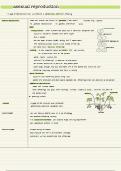
asexual reproduction
produce identical
a
type of reproduction that will a
genetically offspring
-
·
asexual reproduction
·
does not involve the fusion of gametes (sex cells) Involves / parent
only
no gamete reproduction no genetic alteration quick
·
types
chromosomes
fission
binary when a
parent cell splits into 2 identical daughter cells
D
- -
occurs in bacteria amoeba and some algae DNA
,
replication
DNA is copied
a
·
2
·
the cell begin to
grow longer ,
pulling the
copies apart chromosome
segregation
the membrane pinches inward the middle of the cell
·s
·
in
·
cell splits into 2 identical off springs cytokinesis
budding -
a new
organism grows by mitosis and cell division 3 z
on a
particular site on the parent
·
yeast ,
hydra , cac tus ,
etc .
·
the bud (or offspring) is identical to the
parent
·
cell division occurs on a part of the parent plant
when large enough the bud break off of the and live its
can
parent on own
·
,
·
offspring may stay attached and form a
colony
·
spore formation
·
occurs in non-flowering plants , fungl , etc
.
·
spores are produced and each spore develops into offsprings that are identical to the parent
·
vegetative reproduction
·
does not involve seeds
·
some offsprings can grow from cuttings , runners , tubers or bulbs , which all are part of
unizomes
an
the parent plant stolons
E H
M
Y
I
I
j
ex runners
growing
S
.
a
-
j 25
I
T
I
&
-
·
mitosis ·
a
type of cell division that produces
genetically Identical daughter cells
·
advantages do not require special cells or a lot of energy
·
can produce offspring quickly
·
in a stable environment .
Can create large ,
thriving populations
·
can reproduce without a mate
·
disadvantages ·
limited ability to adapt
face die-off If environment
massive changes
·
·
mutations will be passed onto the offsprings
produce identical
a
type of reproduction that will a
genetically offspring
-
·
asexual reproduction
·
does not involve the fusion of gametes (sex cells) Involves / parent
only
no gamete reproduction no genetic alteration quick
·
types
chromosomes
fission
binary when a
parent cell splits into 2 identical daughter cells
D
- -
occurs in bacteria amoeba and some algae DNA
,
replication
DNA is copied
a
·
2
·
the cell begin to
grow longer ,
pulling the
copies apart chromosome
segregation
the membrane pinches inward the middle of the cell
·s
·
in
·
cell splits into 2 identical off springs cytokinesis
budding -
a new
organism grows by mitosis and cell division 3 z
on a
particular site on the parent
·
yeast ,
hydra , cac tus ,
etc .
·
the bud (or offspring) is identical to the
parent
·
cell division occurs on a part of the parent plant
when large enough the bud break off of the and live its
can
parent on own
·
,
·
offspring may stay attached and form a
colony
·
spore formation
·
occurs in non-flowering plants , fungl , etc
.
·
spores are produced and each spore develops into offsprings that are identical to the parent
·
vegetative reproduction
·
does not involve seeds
·
some offsprings can grow from cuttings , runners , tubers or bulbs , which all are part of
unizomes
an
the parent plant stolons
E H
M
Y
I
I
j
ex runners
growing
S
.
a
-
j 25
I
T
I
&
-
·
mitosis ·
a
type of cell division that produces
genetically Identical daughter cells
·
advantages do not require special cells or a lot of energy
·
can produce offspring quickly
·
in a stable environment .
Can create large ,
thriving populations
·
can reproduce without a mate
·
disadvantages ·
limited ability to adapt
face die-off If environment
massive changes
·
·
mutations will be passed onto the offsprings


