Virtual SC- Government CP final exam vocab
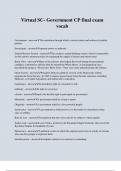
ght of a monarch to rule authority - answerthe right to use power citizens - answerPeople who had the right to participate in government Monarchy - answerA government ruled by a king or queen Oligarchy - answerA government ruled by a few powerful people Aristocracy - answerA government in which power is in the hands of a hereditary ruling class or nobility Rule by Law - answerrecognition that laws exist and all are subject to them equally Justian code - answera set of laws, written by the Byzantine Empire Justinian, that served the Byzantine Empire for hundreds of years. Democracy - answerA political system in which the supreme power lies in a body of citizens who can elect people to represent them absolute power - answercomplete control over someone or something Indirect Democracy - answera system of government that gives citizens the opportunity to vote for representatives who work on their behalf Direct Democracy - answerA form of government in which citizens rule directly and not through representatives Federalist Papers - answerA collection of 85 articles written by Alexander Hamilton, John Jay, and James Madison under the name "Publius" to defend the Constitution in detail. Natural Law - answerA doctrine that society should be governed by certain ethical principles that are part of nature and, as such, can be understood by reason. Democratic Centralism - answerThe Leninist organizational structure that concentrates power in the hands of the party elite. free enterprise - answerEconomic system in which individuals and businesses are allowed to compete for profit with a minimum of government interference Enlightenment - answerA movement in the 18th century that advocated the use of reason in the reappraisal of accepted ideas and social institutions. centralized government - answerA government in which power is concentrated in a central authority to which local governments are subject individual freedom - answerfree to do whatever you want as long as it doesnt infringe on others freedom liberty - answerFreedom from government control equality - answerthe state of being equal, especially in status, rights, and opportunities. Justice - answerRespecting the rights of others and giving them what is rightfully theirs John Locke - answer17th century English philosopher who opposed the Divine Right of Kings and who asserted that people have a natural right to life, liberty, and property. Karl Marx - answer. 19th century philosopher, political economist, sociologist, humanist, political theorist, and revolutionary. Often recognized as the father of communism. Analysis of history led to his belief that communism would replace capitalism as it replaced feudalism. Believed in a classless society. Aristotle - answerGreek philosopher. A pupil of Plato, the tutor of Alexander the Great, and the author of works on logic, metaphysics, ethics, natural sciences, politics, and poetics, he profoundly influenced Western thought. In his philosophical system, which led him to criticize what he saw as Plato's metaphysical excesses, theory follows empirical observation and logic, based on the syllogism, is the essential method of rational inquiry. Franklin Roosevelt - answerPresident of the US during Great Depression and World War II Lyndon B. Johnson - answersigned the civil rights act of 1964 into law and the voting rights act of 1965. he had a war on poverty in his agenda. in an attempt to win, he set a few goals, including the great society, the economic opportunity act, and other programs that provided food stamps and welfare to needy famillies. he also created a department of housing and urban development. his most important legislation was probably medicare and medicaid. Machiavelli - answerRenaissance writer; formerly a politician, wrote The Prince, a work on ethics and government, describing how rulers maintain power by methods that ignore right or wrong; accepted the philosophy that "the end justifies the means." Napoleon Bonaparte - answerOverthrew the French revolutionary government (The Directory) in 1799 and became emperor of France in 1804. Failed to defeat Great Britain and abdicated in 1814. Returned to power briefly in 1815 but was defeated and died in exile. James Madison - answer"Father of the Constitution," Federalist leader, and fourth President of the United States. Vladimir Lenin - answerLeader of the Bolshevik (later Communist) Party. He lived in exile in Switzerland until 1917, then returned to Russia to lead the Bolsheviks to victory during the Russian Revolution and the civil war that followed. Montesquieu - answerFrench political philosopher who advocated the separation of executive and legislative and judicial powers () Rousseau - answer() Believed that society threatened natural rights and freedoms. Wrote about society's corruption caused by the revival of sciences and art instead of it's improvement. He was sponsored by the wealthy and participated in salons but often felt uncomfortable and denounced them. Wrote "The Social Contract." Unit 2 - answer philosophies - answerA set of views and theories related to knowledge and ideas Charters - answerDocuments granting the right to organize settlements in an area colonial legislatures - answerIn every colony the lower of these two houses was elected; this lower house controlled taxes. Only in Rhode Island and Connecticut were the upper houses elected. Pilgrims - answerEnglish Puritans who founded Plymouth colony in 1620 Mercantilism - answerAn economic policy under which nations sought to increase their wealth and power by obtaining large amounts of gold and silver and by selling more goods than they bought trade - answerExchange of goods and services
Written for
- Institution
- VirtualSC
- Course
- VirtualSC
Document information
- Uploaded on
- July 3, 2024
- Number of pages
- 24
- Written in
- 2023/2024
- Type
- Exam (elaborations)
- Contains
- Questions & answers
Subjects
-
virtual sc government cp final exam vocab

Also available in package deal