INSURANCE AS PART OF RISK
MANAGEMENT
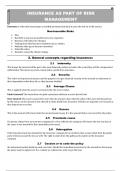
Insurance is when the insured pays a monthly premium (amount) to pass the risk on to the insurer.
Non-Insurable Risks
➢ War.
➢ Bad Debt is not non-insurable but is very expensive.
➢ Business risks like price changes.
➢ Trading stock that becomes outdated such as clothes.
➢ Machines that age or become outmoded.
➢ Unlawful action.
➢ Disasters caused by climate change.
2. General concepts regarding insurance:
2.1 Indemnity
This means the insured will be put in the same financial position as before the event (they will be compensated
sufficiently). This means a person cannot make a profit from insurance.
2.2 Security
This refers to long-term insurance and the purpose is to give financial security to the insured at retirement or
their dependants when they die, or they become disabled.
2.3 Average Clause
This is applied when the asset is not insured for the correct value.
Under-insured: The insured has not paid a premium sufficient to cover the full risk.
Over-insured: The asset is insured for more than its present value. Only the value of the asset will be paid out
by the insurer as the insured is not allowed to make profit from insurance. Vehicles are typically over-insured as
they depreciate over time.
2.4 Excess
This is the amount of the loss/claim the insured needs to pay. It is the amount that is not covered by the policy.
2.5 Proximate cause
If a person claims from an insurance company for a loss suffered, the company will ensure the loss was due to
the cause it was insured for (the immediate/real cause).
2.6 Subrogation
If the insured person has claimed for the insurance company for an accident, they cannot claim from the guilty
party who has caused the loss as well. The right to claim from the guilty party is given to the insurance
company.
2.7 Cession or to cede the policy
An endowment policy builds up cash over time. Should the immediate need arise by the insured for the money,
the policy may be signed over to a creditor as collateral in order to get the loan.
MANAGEMENT
Insurance is when the insured pays a monthly premium (amount) to pass the risk on to the insurer.
Non-Insurable Risks
➢ War.
➢ Bad Debt is not non-insurable but is very expensive.
➢ Business risks like price changes.
➢ Trading stock that becomes outdated such as clothes.
➢ Machines that age or become outmoded.
➢ Unlawful action.
➢ Disasters caused by climate change.
2. General concepts regarding insurance:
2.1 Indemnity
This means the insured will be put in the same financial position as before the event (they will be compensated
sufficiently). This means a person cannot make a profit from insurance.
2.2 Security
This refers to long-term insurance and the purpose is to give financial security to the insured at retirement or
their dependants when they die, or they become disabled.
2.3 Average Clause
This is applied when the asset is not insured for the correct value.
Under-insured: The insured has not paid a premium sufficient to cover the full risk.
Over-insured: The asset is insured for more than its present value. Only the value of the asset will be paid out
by the insurer as the insured is not allowed to make profit from insurance. Vehicles are typically over-insured as
they depreciate over time.
2.4 Excess
This is the amount of the loss/claim the insured needs to pay. It is the amount that is not covered by the policy.
2.5 Proximate cause
If a person claims from an insurance company for a loss suffered, the company will ensure the loss was due to
the cause it was insured for (the immediate/real cause).
2.6 Subrogation
If the insured person has claimed for the insurance company for an accident, they cannot claim from the guilty
party who has caused the loss as well. The right to claim from the guilty party is given to the insurance
company.
2.7 Cession or to cede the policy
An endowment policy builds up cash over time. Should the immediate need arise by the insured for the money,
the policy may be signed over to a creditor as collateral in order to get the loan.