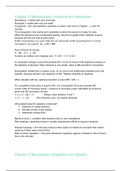
Chapter 10 Market power: monopoly and monopsony
Monopsony = market with only one buyer
Monopoly = market with only one seller
In general , the monopolist’s quantity is lower and price is higher. → cost for
society
The monopolist is the market and completely controls the amount of output for sale.
When the demand curve is downward sloping, the price is greater than marginal revenue
because all units are sold at same price.
Profit maximizing q is such that the incremental profit resulting from a small
increase in q is just 0. So → MC =MR
Rule of thumb for pricing:
P−MC ÷ P=−1 ÷ Ed
So price as markup over marginal cost : P=MC ÷(1+(1/ Ed))
A monopolist charges a price that exceeds MC, but by an amount that depends inversely on
the elasticity of demand. When demand is very elastic, there is little benefit for monopolist.
Monopolistic market has no supply curve, so no one-to-one relationship between price and
quantity, because decision only depends on MC. Relation depends on elasticity.
When situation with tax, optimal production is when MR = MC + t.
For competitive firms price is equal to MC. For monopolistic firm price exceeds MC.
Lerner index of monopoly power = measure of monopoly power calculated as excess of
price over MC as fraction of price.
→ L=(P−MC )÷ P Always value between 0 and 1
→ L=−1 ÷ Ed (firm demand curve, not market demand)
What determines firm elasticity of demand?
1. Elasticity of market demand.
2. Number of firms in the market.
3. Interaction among firms.
Barrier to entry = condition that impedes entry by new competitors.
Rent seeking = spending money in socially unproductive efforts to acquire monopoly.
Natural monopoly = firm that can produce entire output of market at cost lower than what it
would be if there were several firms.
Rate of return regulation = max price allowed by regulatory agency is based on rate of return
that a firm will earn.
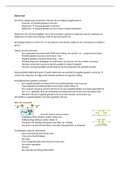
Chapter 12 Monopolistic competition and oligopoly
Monopsony = market with only one buyer
Monopoly = market with only one seller
In general , the monopolist’s quantity is lower and price is higher. → cost for
society
The monopolist is the market and completely controls the amount of output for sale.
When the demand curve is downward sloping, the price is greater than marginal revenue
because all units are sold at same price.
Profit maximizing q is such that the incremental profit resulting from a small
increase in q is just 0. So → MC =MR
Rule of thumb for pricing:
P−MC ÷ P=−1 ÷ Ed
So price as markup over marginal cost : P=MC ÷(1+(1/ Ed))
A monopolist charges a price that exceeds MC, but by an amount that depends inversely on
the elasticity of demand. When demand is very elastic, there is little benefit for monopolist.
Monopolistic market has no supply curve, so no one-to-one relationship between price and
quantity, because decision only depends on MC. Relation depends on elasticity.
When situation with tax, optimal production is when MR = MC + t.
For competitive firms price is equal to MC. For monopolistic firm price exceeds MC.
Lerner index of monopoly power = measure of monopoly power calculated as excess of
price over MC as fraction of price.
→ L=(P−MC )÷ P Always value between 0 and 1
→ L=−1 ÷ Ed (firm demand curve, not market demand)
What determines firm elasticity of demand?
1. Elasticity of market demand.
2. Number of firms in the market.
3. Interaction among firms.
Barrier to entry = condition that impedes entry by new competitors.
Rent seeking = spending money in socially unproductive efforts to acquire monopoly.
Natural monopoly = firm that can produce entire output of market at cost lower than what it
would be if there were several firms.
Rate of return regulation = max price allowed by regulatory agency is based on rate of return
that a firm will earn.
Chapter 12 Monopolistic competition and oligopoly