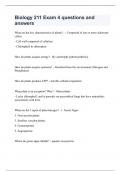
Biology 211 Exam 4 questions and answers What are the key characteristics of plants? - - Composed of one or more eukaryote cell(s) - Cell wall composed of cellulose - Chlorophyll in chloroplast How do plants acquire energy? - By autotrophy (photosynthesis) How do plants acquire nutrients? - Absorbed from the environment (Nitrogen and Phosphorus) How do plants produce ATP? - Aerobic cellular respiration What plant is an exception? Why? - Ghost plants - Lacks chlorophyll, and is parasitic on mycorrhizal fungi that have mutualistic associations with trees What are the 5 types of plant lineages? - 1. Green Algae 2. Nonvascular plants 3. Seedless vascular plants 4. Gymnosperms 5. Angiosperms Where do green algae inhabit? - aquatic ecosystems What are the characteristics of green algae? - - Unicellular or multicellular - No tissues or organs How does green algae acquire nutrients and water? - - Carbon dioxide - Nitrogen - Phosphorus - Water absorbed across cell membrane What is the ecological importance (historically and presently) of green algae? - - Photosynthesis contributes to increased biological production and biodiversity in aquatic ecosystems All plant groups contribute to increased biodiversity by providing resources: a)______, b) _______, and c) _____ - a) food to consumers b) oxygen and c) habitat Where do non -vascular plants inhabit? - aquatic and terrestrial ecosystems What are the characteristics of non -vascular plants? - - Cells organized into tissues/organs - Cuticle and stomata - No vascular tissue - Embryo released from plant in a desiccation -resistant spore What is a waxy layer that prevents water loss from stems and leaves? - Cuticle What has pores that allow gas to exchange in photosynthetic tissues and guard cells close under conditions of water stress (to reduce further water loss)? - Stomata How do the cuticle and stomata acquire nutrients and water? - - Rhizoids anchor plant to substrate (e.g., soil, wood, rock) and absorb water, nutrients (N,P) - Carbon dioxide absorbed through stomata What is the ecological importance (historically) of the cuticle and stomata? - - Resources provided by first terrestrial plants enabled evolution of terrestrial consumers - Explosion in biodiversity, organism abundance, and biological production Where do seedless vascular plants inhabit? - aquatic and wet terrestrial ecosystems What are the characteristics of seedless vascular plants? - - Cuticle and stomata - Vascular tissue conducts water, nutrients, and carbohydrates through plants - Embryo released from plant in a desiccation -resistant spore How do seedless vascular plants acquire nutrients and water? - Vascular tissue - Xylem - Phloem __________ conducts water and nutrients from roots to photosynthetic cells - Xylem __________ conducts carbohydrates from photosynthetic cells to roots - Phloem What is the ecological importance (historically and presently) of seedless vascular plants? - - Vascular tissue and lignin enable plants to grow tall and inhabit drier habitats - Increased terrestrial plant abundance and diversity (habitat and food resources) enables increased biodiversity and organism abundance Where do gymnosperms inhabit? - Terrestrial ecosystem What are the characteristics of gymnosperms? - - Cuticle and stomata* - Vascular tissue and lignin* - Embryo released from plant in a seed* ‣ *Adaptation for terrestrial life How do gymnosperms acquire nutrients and water? - Vascular system What is the ecological importance (historically and presently) of gymnosperms? - - First plants capable of reproducing in dry terrestrial habitat - Increased food and habitat resources and increased biodiversity and organism abundance Where do angiosperms inhabit? - aquatic and terrestrial ecosystem What are the characteristics of angiosperms? - - Cuticle and stomata* - Vascular tissue and lignin* - Embryo released from plant in a seed (surrounded by fruit)*
Exam (elaborations)
Biology 211 Exam 4 questions and answers
Rating
Sold
-
Pages
35
Grade
A
Uploaded on
29-06-2024
Written in
2023/2024
What are the key characteristics of plants? - - Composed of one or more eukaryote cell(s) - Cell wall composed of cellulose - Chlorophyll in chloroplast How do plants acquire energy? - By autotrophy (photosynthesis) How do plants acquire nutrients? - Absorbed from the environment (Nitrogen and Phosphorus) How do plants produce ATP? - Aerobic cellular respiration What plant is an exception? Why? - Ghost plants - Lacks chlorophyll, and is parasitic on mycorrhizal fungi that have mutualistic associations with trees What are the 5 types of plant lineages? - 1. Green Algae 2. Nonvascular plants 3. Seedless vascular plants 4. Gymnosperms 5. Angiosperms Where do green algae inhabit? - aquatic ecosystems What are the characteristics of green algae? - - Unicellular or multicellular - No tissues or organs How does green algae acquire nutrients and water? - - Carbon dioxide - Nitrogen - Phosphorus - Water absorbed across cell membrane What is the ecological importance (historically and presently) of green algae? - - Photosynthesis contributes to increased biological production and biodiversity in aquatic ecosystems All plant groups contribute to increased biodiversity by providing resources: a)______, b) _______, and c) _____ - a) food to consumers b) oxygen and c) habitat Where do non-vascular plants inhabit? - aquatic and terrestrial ecosystems What are the characteristics of non-vascular plants? - - Cells organized into tissues/organs - Cuticle and stomata - No vascular tissue - Embryo released from plant in a desiccation-resistant spore What is a waxy layer that prevents water loss from stems and leaves? - Cuticle What has pores that allow gas to exchange in photosynthetic tissues and guard cells close under conditions of water stress (to reduce further water loss)? - Stomata How do the cuticle and stomata acquire nutrients and water? - - Rhizoids anchor plant to substrate (e.g., soil, wood, rock) and absorb water, nutrients (N,P) - Carbon dioxide absorbed through stomata What is the ecological importance (historically) of the cuticle and stomata? - - Resources provided by first terrestrial plants enabled evolution of terrestrial consumers - Explosion in biodiversity, organism abundance, and biological production
Show more
Read less
Institution
Bio211
Course
Bio211
Whoops! We can’t load your doc right now. Try again or contact support.
Written for
- Institution
- Bio211
- Course
- Bio211
Document information
- Uploaded on
- June 29, 2024
- Number of pages
- 35
- Written in
- 2023/2024
- Type
- Exam (elaborations)
- Contains
- Questions & answers
Subjects
- biology 211 exam 4
-
biology 211 exam 4 questions and answers
Content preview
$16.99
Get access to the full document:
100% satisfaction guarantee
Immediately available after payment
Both online and in PDF
No strings attached

Also available in package deal
Package deal
Lowa State University BIO 211 Questions and Answers 2024 bundle
9
2024
$ 136.41
More info