

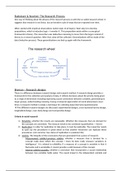
Rudestam & Newton: The Research Process
One way of thinking about the phases of the research process is with the so-called research wheel. It
suggests that research is not linear, but an iterative cycle of steps that are repeated over time.
Often started with empirical observations (select topic of all topics). Next step is to develop
propositions, which is inductive logic > I wonder if.. This proposition exists within a conceptual
framework in theory. The researcher uses deductive reasoning to move from the larger context of
theory to a research question. After that, data will be collected. Generalizations will be made of the
data (inductive process). These generalizations are tied up again with the framework.
Bryman – Research designs
There is a difference between research design and research method. A research design provides a
framework for the collection and analysis of data. It reflects decisions about the priority being given
to a range of dimensions including expressing causal connections between variables, generalizing to
larger groups, understanding meaning, having a temporal appreciation of social phenomena (over
time). A research method is simply a technique for collecting data (interview/questionnaire).
Five different research designs are discussed: experimental designs, cross-sectional/survey-design,
longitudinal design, case study design and comparative design.
Criteria in social research
1) Reliability: whether the results are repeatable. Whether the measures that are devised for
the concepts are consistent. The measure needs to be consistent (quantitative). > IQ test
2) Replication: In order for replication to take place, it must be replicable. The researcher needs
to spell out the procedures in great detail so that another researcher can replicate these
procedures. (not common: low status of replication in academic life).
3) Validity: The integrity of the conclusions that are generated from a piece of research.
- Measurement validity/construct validity : whether a measure that is devised for a
concept really does reflect the concept > Does IQ tests really measure variations in
intelligence?. It is related to reliability: If a measure of a concept is unstable in that it
fluctuates and is unreliable, it cannot provide a valid measure of the concept.
- Internal validity/causality: whether a conclusion that incorporates a causal relationship
between two variables holds water. The causal impact is the independent variable and
One way of thinking about the phases of the research process is with the so-called research wheel. It
suggests that research is not linear, but an iterative cycle of steps that are repeated over time.
Often started with empirical observations (select topic of all topics). Next step is to develop
propositions, which is inductive logic > I wonder if.. This proposition exists within a conceptual
framework in theory. The researcher uses deductive reasoning to move from the larger context of
theory to a research question. After that, data will be collected. Generalizations will be made of the
data (inductive process). These generalizations are tied up again with the framework.
Bryman – Research designs
There is a difference between research design and research method. A research design provides a
framework for the collection and analysis of data. It reflects decisions about the priority being given
to a range of dimensions including expressing causal connections between variables, generalizing to
larger groups, understanding meaning, having a temporal appreciation of social phenomena (over
time). A research method is simply a technique for collecting data (interview/questionnaire).
Five different research designs are discussed: experimental designs, cross-sectional/survey-design,
longitudinal design, case study design and comparative design.
Criteria in social research
1) Reliability: whether the results are repeatable. Whether the measures that are devised for
the concepts are consistent. The measure needs to be consistent (quantitative). > IQ test
2) Replication: In order for replication to take place, it must be replicable. The researcher needs
to spell out the procedures in great detail so that another researcher can replicate these
procedures. (not common: low status of replication in academic life).
3) Validity: The integrity of the conclusions that are generated from a piece of research.
- Measurement validity/construct validity : whether a measure that is devised for a
concept really does reflect the concept > Does IQ tests really measure variations in
intelligence?. It is related to reliability: If a measure of a concept is unstable in that it
fluctuates and is unreliable, it cannot provide a valid measure of the concept.
- Internal validity/causality: whether a conclusion that incorporates a causal relationship
between two variables holds water. The causal impact is the independent variable and


