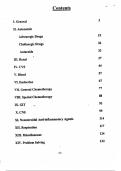
Contents
I. General 3
II. Autonomic
Adrenergic Drugs 19
Cholinergic Drugs 26
Autacoids 33
III. Renal 37
IV. CVS 44
57
V. Blood
VI. Endocrine 67
VII. General Chemotherapy 77
VIII. Special Chemotherapy 88
IX. GIT _ 93
99
X.CNS
XI. Nonsteroidal Anti-inflammatory Agents 114
117
XII. Respiration
124
XIII. Miscellaneous
XIV. Problem Solving 132
•2-
, Pharmacokinetics
1. The following areTrue concerning diffusion of drugs across cell membranes EXCEPT:
A. Most drugs cross cell membranes primarily by passive diffusion.
B. Diffusion depends on lipid-solublity.
C. Acidification of urine hastens excretion of weakly acidic drugs.
D. Aspirin is mostly non-ionized in the empty stomach.
E. Drugs can cross cell membrane mainly in non-ionized form.
2. Important factor/s which may govern diffusion of drugs across cell membranes
A. pKa value of the drug
B. pH of the medium
C. Lipid solubility of the drug
D. Molecular weight of the drug
E. All of the above
3. Which of the following statements is/are True?
A. Bioavailability after oral administration is determined by hepatic extraction ratio
B. Dialysis is usefiil in toxicity of drugs with large volume of distribution
C. Propranolol increases hepatic first pass metabolism.
D. Drugs with variable bioavailability include digoxin &phenytoin.
E. A&D
4. Which of the following is a True statement?
A. Acetylation is a phase I reaction
B. Theophylline is adrug with saturation kinetics and narrow therapeutic index
C. Aconstant amount ofadrug with 1ST -order kinetics is eliminated per unit time.
D. Steady-state plasma concentration ofdrugs with zero-order kinetics isachieved after 4
E. The first-pass effect is most likely to occur ifthe drug is given sublingually.
-3-
,5. Drug/s reducing hepatic 1st pass metabolism is/are:
A. Rifampicin C. Erythromycin
B. Propranolol D. B and C E. All ofthe above
6. Clearance is useful in calculation of
A. Maintenance dose. D. Bioavailability
B. Loading dose. E. A and C.
C. t1/2.
7. Which of the following is a True statement concerning drug clearance?
A. Clearance is useful in calculation of loading dose.
B. When extraction ratio is less than 0.2 its clearance is nearly enzyme-dependent
C. Itis inverselyjM-oportional to the blood flow to the clearing organ.
D. Lipid solubility increases renal excretion of drugs.
E. It is directly proportional to volume of distribution
8. A main determinant of bioavailability (F) following oral administration is
A. Hepatic extraction ratio (E)
B. Elimination rate constant (Ke)
C. Bioequivalence
D. Volume of distribution
E. All of the above
9. Lipophilicity reduces
A. Absorption^
B. Volume of distribution (Va)
C. Hepatic elimination
D. Renal excretion
E.BandD
-4-
, 10. Drugs with small volume ofdistribution (Vd) are characterized by
A. Limited tissue uptake
B. Dialysis is useful in toxicity
C. Their Vd cannot be less than 5 liters.
D. All of the above.
E. AandB
11. The following characteristic ofa drug tends to reduce its volume ofdistribution
A. Low ionization at physiological pH
B. High Lipid solubility
C. High tissue binding
D. High plasma proteins binding
E. A and D
12. The following drugs do not readily cross to the CNS in meningitis
A. Streptomycin C. Tetracycline
B. Rifampicin D. Penicillins E. A and C
13. The following drugs do not readily cross to the CNS
A. Dopamine C. Atropine
B. Levodopa D. Neostgmine E. A and D
14. The following is/are a phase II reaction/s
A. Reduction C. Acetylation
B. Hydrolysis D. Oxidation E. C and D
15. Microsomal enzymes include
A. Dehydrogenase
B. Esterases
C. CY P450 enzyme system (mixed-function oxidases).
D. Glucoronyl transferase
E. C and D
10. D ll.D 12. E 13. E 14.C 15. E
-5-
I. General 3
II. Autonomic
Adrenergic Drugs 19
Cholinergic Drugs 26
Autacoids 33
III. Renal 37
IV. CVS 44
57
V. Blood
VI. Endocrine 67
VII. General Chemotherapy 77
VIII. Special Chemotherapy 88
IX. GIT _ 93
99
X.CNS
XI. Nonsteroidal Anti-inflammatory Agents 114
117
XII. Respiration
124
XIII. Miscellaneous
XIV. Problem Solving 132
•2-
, Pharmacokinetics
1. The following areTrue concerning diffusion of drugs across cell membranes EXCEPT:
A. Most drugs cross cell membranes primarily by passive diffusion.
B. Diffusion depends on lipid-solublity.
C. Acidification of urine hastens excretion of weakly acidic drugs.
D. Aspirin is mostly non-ionized in the empty stomach.
E. Drugs can cross cell membrane mainly in non-ionized form.
2. Important factor/s which may govern diffusion of drugs across cell membranes
A. pKa value of the drug
B. pH of the medium
C. Lipid solubility of the drug
D. Molecular weight of the drug
E. All of the above
3. Which of the following statements is/are True?
A. Bioavailability after oral administration is determined by hepatic extraction ratio
B. Dialysis is usefiil in toxicity of drugs with large volume of distribution
C. Propranolol increases hepatic first pass metabolism.
D. Drugs with variable bioavailability include digoxin &phenytoin.
E. A&D
4. Which of the following is a True statement?
A. Acetylation is a phase I reaction
B. Theophylline is adrug with saturation kinetics and narrow therapeutic index
C. Aconstant amount ofadrug with 1ST -order kinetics is eliminated per unit time.
D. Steady-state plasma concentration ofdrugs with zero-order kinetics isachieved after 4
E. The first-pass effect is most likely to occur ifthe drug is given sublingually.
-3-
,5. Drug/s reducing hepatic 1st pass metabolism is/are:
A. Rifampicin C. Erythromycin
B. Propranolol D. B and C E. All ofthe above
6. Clearance is useful in calculation of
A. Maintenance dose. D. Bioavailability
B. Loading dose. E. A and C.
C. t1/2.
7. Which of the following is a True statement concerning drug clearance?
A. Clearance is useful in calculation of loading dose.
B. When extraction ratio is less than 0.2 its clearance is nearly enzyme-dependent
C. Itis inverselyjM-oportional to the blood flow to the clearing organ.
D. Lipid solubility increases renal excretion of drugs.
E. It is directly proportional to volume of distribution
8. A main determinant of bioavailability (F) following oral administration is
A. Hepatic extraction ratio (E)
B. Elimination rate constant (Ke)
C. Bioequivalence
D. Volume of distribution
E. All of the above
9. Lipophilicity reduces
A. Absorption^
B. Volume of distribution (Va)
C. Hepatic elimination
D. Renal excretion
E.BandD
-4-
, 10. Drugs with small volume ofdistribution (Vd) are characterized by
A. Limited tissue uptake
B. Dialysis is useful in toxicity
C. Their Vd cannot be less than 5 liters.
D. All of the above.
E. AandB
11. The following characteristic ofa drug tends to reduce its volume ofdistribution
A. Low ionization at physiological pH
B. High Lipid solubility
C. High tissue binding
D. High plasma proteins binding
E. A and D
12. The following drugs do not readily cross to the CNS in meningitis
A. Streptomycin C. Tetracycline
B. Rifampicin D. Penicillins E. A and C
13. The following drugs do not readily cross to the CNS
A. Dopamine C. Atropine
B. Levodopa D. Neostgmine E. A and D
14. The following is/are a phase II reaction/s
A. Reduction C. Acetylation
B. Hydrolysis D. Oxidation E. C and D
15. Microsomal enzymes include
A. Dehydrogenase
B. Esterases
C. CY P450 enzyme system (mixed-function oxidases).
D. Glucoronyl transferase
E. C and D
10. D ll.D 12. E 13. E 14.C 15. E
-5-