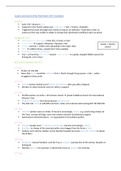
Complete Summary For Rasmussen Mental
Health Exam 1, Complete Solution.
Culture
Includes traditions of thought and behavior, such as language and history that can be
socially acquired, shared, and passed on to new generations.
The concept of culture is most often considered with racial or ethnic minority groups.
However, the concept of culture also includes sexual orientation, age groups, physical
abilities or disabilities, gender, religion, or socioeconomic status.
FREUD'S PSYCHOANALYTIC THEORY
Chapter 3
Id
The primitive, PLEASURE-seeking part (according to Freud, predominantly sexual
pleasure) of our personalities that lurks in the unconscious mind.
The IMPULSIVE part of our psyche which responds directly and immediately to the
instincts.
Engages in PRIMARY PROCESS thinking, which is primitive, illogical, irrational, and
fantasy oriented.
Ego
Our sense of self. And acts as an intermediary between the Id and the world by using
ego defense mechanisms, such as repression, denial, and rationalization.
Engages in secondary process thinking, which is rational, REALISTIC, and orientated
towards PROBLEM SOLVING.
Superego
Assigned to those processes that Freud referred to as our conscience (our sense of
what is right or wrong) and is greatly influenced by our parents' or caregivers' MORALS
and ETHICAL stances.
The superego's function is to control the id's impulses, especially those which society
forbids, such as sex and aggression. It also has the function of persuading the ego to
turn to moralistic goals rather than simply realistic ones and to strive for perfection.
Maslow's Hierarchy of Needs
1. Physiological- food, water, oxygen, elimination, rest, sex
2. Safety- protection, security, stability, order, structure, limits
3. Love and Belonging Needs- affiliation, affection, lover
4. Esteem- competency, achievement, esteem from others
5. Self Actualization- becoming everything one is capable of
, 6. Self Transcendent Needs - when an individual "seeks to further a cause beyond the
self and to experience a communion beyond the boundaries of the self through peak
experiences."
Erickson's Stages of Development - Infant: Birth - 1.5 yrs old
Trust vs. Mistrust
Task: develop a basic sense of trust and comfort and minimal fear and uncertainty.
Erickson's Stages of Development - Early childhood (toddler) - 1.5-3 yrs old
Autonomy vs. Shame/doubt
Task: gain self control and independence
Erickson's Stages of Development - Preschooler 3-6 yrs old
Initiative vs. Guilt
Task: achieve sense of purpose and task mastery
Erickson's Stages of Development - School age 6-12 yrs old
Industry vs. Inferiority
Task: self confidence thru learning and competition
Erickson's Stages of Development - Adolescent 12-20 yrs old
REMEMBER
Identity vs. Role confusion
Task: differentiation from parents leads to fidelity, integrate all the above for sense of
self
Erickson's Stages of Development - Young adult 20-30 yrs old
REMEMBER
Intimacy vs. isolation
Task: form intense long term relationships
Erickson's Stages of Development - Adult 30-65 yrs old
REMEMBER
Generativity vs. Self-absorption
Task: achieve life goals and obtain concern for future generation
Erickson's Stages of Development - Older adult 65+
Integrity vs. Despair
Task: derive meaning from life and sense of self worth
Neurotransmitters
Chapter 4
Dopamine
Functions:
COGNITION
MOTIVATION
Health Exam 1, Complete Solution.
Culture
Includes traditions of thought and behavior, such as language and history that can be
socially acquired, shared, and passed on to new generations.
The concept of culture is most often considered with racial or ethnic minority groups.
However, the concept of culture also includes sexual orientation, age groups, physical
abilities or disabilities, gender, religion, or socioeconomic status.
FREUD'S PSYCHOANALYTIC THEORY
Chapter 3
Id
The primitive, PLEASURE-seeking part (according to Freud, predominantly sexual
pleasure) of our personalities that lurks in the unconscious mind.
The IMPULSIVE part of our psyche which responds directly and immediately to the
instincts.
Engages in PRIMARY PROCESS thinking, which is primitive, illogical, irrational, and
fantasy oriented.
Ego
Our sense of self. And acts as an intermediary between the Id and the world by using
ego defense mechanisms, such as repression, denial, and rationalization.
Engages in secondary process thinking, which is rational, REALISTIC, and orientated
towards PROBLEM SOLVING.
Superego
Assigned to those processes that Freud referred to as our conscience (our sense of
what is right or wrong) and is greatly influenced by our parents' or caregivers' MORALS
and ETHICAL stances.
The superego's function is to control the id's impulses, especially those which society
forbids, such as sex and aggression. It also has the function of persuading the ego to
turn to moralistic goals rather than simply realistic ones and to strive for perfection.
Maslow's Hierarchy of Needs
1. Physiological- food, water, oxygen, elimination, rest, sex
2. Safety- protection, security, stability, order, structure, limits
3. Love and Belonging Needs- affiliation, affection, lover
4. Esteem- competency, achievement, esteem from others
5. Self Actualization- becoming everything one is capable of
, 6. Self Transcendent Needs - when an individual "seeks to further a cause beyond the
self and to experience a communion beyond the boundaries of the self through peak
experiences."
Erickson's Stages of Development - Infant: Birth - 1.5 yrs old
Trust vs. Mistrust
Task: develop a basic sense of trust and comfort and minimal fear and uncertainty.
Erickson's Stages of Development - Early childhood (toddler) - 1.5-3 yrs old
Autonomy vs. Shame/doubt
Task: gain self control and independence
Erickson's Stages of Development - Preschooler 3-6 yrs old
Initiative vs. Guilt
Task: achieve sense of purpose and task mastery
Erickson's Stages of Development - School age 6-12 yrs old
Industry vs. Inferiority
Task: self confidence thru learning and competition
Erickson's Stages of Development - Adolescent 12-20 yrs old
REMEMBER
Identity vs. Role confusion
Task: differentiation from parents leads to fidelity, integrate all the above for sense of
self
Erickson's Stages of Development - Young adult 20-30 yrs old
REMEMBER
Intimacy vs. isolation
Task: form intense long term relationships
Erickson's Stages of Development - Adult 30-65 yrs old
REMEMBER
Generativity vs. Self-absorption
Task: achieve life goals and obtain concern for future generation
Erickson's Stages of Development - Older adult 65+
Integrity vs. Despair
Task: derive meaning from life and sense of self worth
Neurotransmitters
Chapter 4
Dopamine
Functions:
COGNITION
MOTIVATION