Chamberlain BIOS251 Exam 2 Questions and Answers Graded A 2024
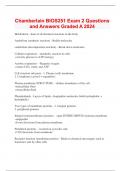
Metabolism - Sum of all chemical reactions in the body Anabolism (synthesis reaction) - Builds molecules catabolism (decomposition reaction) - Break down molecules Cellular respiration - -metabolic reaction in cells -converts glucose to ATP (energy) Aerobic respiration - -Requires oxygen -creates CO2, water, and ATP Cell structure sub parts - 1. Plasma (cell) membrane 2. Cytoplasm (cytosol + organelles) Plasma membrane STRUCTURE - -defines boundaries of the cell -intracellular fluid -extracellular fluid Phospholipids - Layers of lipids, Ampipathic molecules (both hydrophobic + hydrophilic) Two types of membrane proteins - 1. integral proteins 2. peripheral proteins Integral (transmembrane) proteins - -span ENTIRE DEPTH of plasma membrane -ampipathic -do not dissociate from plasma membrane Peripheral proteins - -located on cytosolic side -CAN dissociate from membrane Receptor function (membrane protein) - Binds to chemical messengers such as hormones sent by other cells Enzyme function (membrane protein) - Breaks down a chemical messenger and terminates it's effect Gated channel function (membrane protein) - Gate that opens and closes to allow select solutes through Channel function (membrane protein) - Constantly open and allows solutes through Cell-identity marker (membrane protein) - Glycoprotein distinguishing body's own cells from foreign cells Cell-adhesion molecule (membrane protein) - Binds one cell to another Functions of plasma membrane - 1. Define boundaries of cell 2. Provide structural support for fell 3. Provide protection for cell 4. Regulate transport of substances in + out of cell 5. Monitor and detect changes in extra cellular fluid Gradient across plasma membrane - Difference in concentration of s chemical between one side of plasma membrane to another Plasma membrane transports - 1. Passive transport (no energy required) 2. Active transport (requires energy) Active transport - -requires energy -vesticular transport Passive transport - -no energy required -simple diffusion -facilitated diffusion -osmosis Tonicity - how the solution influences the shape of body cells (Isotonic, hypertonic, hypotonic) Isotonic - -majority of IV fluids -equal # of non-penetrating molecules to reference solution
Written for
- Institution
-
Chamberlain College Of Nursing
- Course
-
BIOS.
Document information
- Uploaded on
- June 26, 2024
- Number of pages
- 8
- Written in
- 2023/2024
- Type
- Exam (elaborations)
- Contains
- Questions & answers
Subjects
- chamberlain bios251
- chamberlain
- bios251 exam 2
- bios251
-
chamberlain bios251 exam 2 questions and answers
-
chamberlain bios251 exam 2

Also available in package deal