Comp 2 Q1
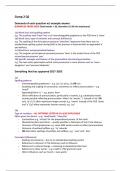
Demands of each question w/ example answer
(EXAMPLES FROM 2019) (Total marks = 20, therefore 15-20 min maximum)
1a) Word class and spelling pattern
e.g. The auxiliary verb ‘haue’ has a u/v interchangeable grapheme as the PDE form is ‘have’.
1b) Word class, type of variation and concept (influence)
e.g. The spelling of the third person pronoun ‘shee/she’ represents how there was no
standardised spelling system during EME as the pronoun is featured with an appended ‘e’
and without.
1c) Word form and grammatical feature
e.g. The singular second person personal pronoun ‘thou’ is the archaic form of the PDE
second person pronoun ‘you’.
1d) Specific example and feature of the grammatical structure/punctuation
e.g. The text omits apostrophes which mark possession in noun phrases such as ‘mens
daughters’ and ‘womans Modestie’.
Everything that has appeared 2017-2023
1a)
Spelling patterns
- Interchangeable graphemes – e.g. u/v, i/j, w/uu, i/y OR ie/y
- Doubling and singling of consonants, sometimes to reflect pronunciation – e.g.
‘wooll’
- Appended/silent ‘e’ – e.g. poore, farre
- Other reflections of pronunciation, particularly in vowels, e.g. substituted vowel
sounds possibly reflecting pronunciation ‘wikes’ for ‘weeks’, ‘i’ instead of ‘ee’. OR
ie/y, ‘ie’ (/iː/) often represents longer sounds e.g. ‘manie’ instead of the PDE ‘many’
and ‘y’ (/ɪ/) often represents shorter sounds, e.g. ‘cry’
1b)
Type of variation – ALL PATTERNS LISTED IN 1A ALSO APPLICABLE
Often gives two forms – e.g. ‘mad/made’, ‘shee/she’
- Contractions e.g. ‘o’clock’ for the prepositional phrase ‘of the clock’
- Obsolete/archaic word form – usually specifies in footnotes of text if not obvious
- Omission of final graphemes e.g. some EME writers wrote to reflect pronunciation
- Omission of prefixes/suffixes e.g. ‘-ly’ adverbs
- OR alternative spellings of prefixes and suffixes, e.g. ‘-cion’ and ‘-tion’
Concepts (influences)
- Spelling inconsistency – due to no standardised spelling system
- Reference to Johnson’s 1755 dictionary and its influence
- Reference to cultural change – reasoning to obsolete/archaic lexis
- Reference to other works – e.g. Lowth’s 1762 grammar book
- Other influences such as French – loan words
Demands of each question w/ example answer
(EXAMPLES FROM 2019) (Total marks = 20, therefore 15-20 min maximum)
1a) Word class and spelling pattern
e.g. The auxiliary verb ‘haue’ has a u/v interchangeable grapheme as the PDE form is ‘have’.
1b) Word class, type of variation and concept (influence)
e.g. The spelling of the third person pronoun ‘shee/she’ represents how there was no
standardised spelling system during EME as the pronoun is featured with an appended ‘e’
and without.
1c) Word form and grammatical feature
e.g. The singular second person personal pronoun ‘thou’ is the archaic form of the PDE
second person pronoun ‘you’.
1d) Specific example and feature of the grammatical structure/punctuation
e.g. The text omits apostrophes which mark possession in noun phrases such as ‘mens
daughters’ and ‘womans Modestie’.
Everything that has appeared 2017-2023
1a)
Spelling patterns
- Interchangeable graphemes – e.g. u/v, i/j, w/uu, i/y OR ie/y
- Doubling and singling of consonants, sometimes to reflect pronunciation – e.g.
‘wooll’
- Appended/silent ‘e’ – e.g. poore, farre
- Other reflections of pronunciation, particularly in vowels, e.g. substituted vowel
sounds possibly reflecting pronunciation ‘wikes’ for ‘weeks’, ‘i’ instead of ‘ee’. OR
ie/y, ‘ie’ (/iː/) often represents longer sounds e.g. ‘manie’ instead of the PDE ‘many’
and ‘y’ (/ɪ/) often represents shorter sounds, e.g. ‘cry’
1b)
Type of variation – ALL PATTERNS LISTED IN 1A ALSO APPLICABLE
Often gives two forms – e.g. ‘mad/made’, ‘shee/she’
- Contractions e.g. ‘o’clock’ for the prepositional phrase ‘of the clock’
- Obsolete/archaic word form – usually specifies in footnotes of text if not obvious
- Omission of final graphemes e.g. some EME writers wrote to reflect pronunciation
- Omission of prefixes/suffixes e.g. ‘-ly’ adverbs
- OR alternative spellings of prefixes and suffixes, e.g. ‘-cion’ and ‘-tion’
Concepts (influences)
- Spelling inconsistency – due to no standardised spelling system
- Reference to Johnson’s 1755 dictionary and its influence
- Reference to cultural change – reasoning to obsolete/archaic lexis
- Reference to other works – e.g. Lowth’s 1762 grammar book
- Other influences such as French – loan words