History of biology – Summary of controversies/connections
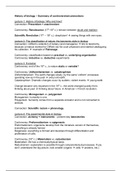
Lecture 1: History of biology: Why and how?
Connection: Presentism + anachronism
Controversy: Renaissance (17th-18th c.): tension between doubt and tradition.
Scientific Revolution (17th – 18th c.): skepticism! seeing things with own eyes.
Lecture 2: The classification of nature: the taxonomic style in biology
Connection: Clifford’s collection of botany (and menagerie) link to taxonomy,
because Linnaeus worked for Clifford (as his court physician) and started cataloguing
his collection. example of Patronage.
Controversy: classification based on practical vs. underlying organization
Controversy: Inductive vs. deductive experiments
Lecture 3: Evolution
Controversy: end of the 18th c., is nature static or variable?
Controversy: Uniformitarianism vs. catastrophism
Uniformitarianism: The earth changes slowly, by the same ‘uniform’ processes
operating now as in the past (very) old earth.
Catastrophism: Dramatic changes occur by sudden, violent events young earth.
Change became very important in the 19th c., the world changed quickly from:
thinking about past thinking about future American + French revolution.
Controversy: Monogenism vs. polygenism
Monogenism: humanity is one
Polygenism: humanity comes from a separate ancestor and is not connected to
animals.
Connection: Scientific racism + phrenology
Lecture 4: The experimental style in biology
Connection: alchemy + instruments – present day laboratories
Controversy: Preformationism vs epigenesis
Preformationism: organisms develop from the miniature version of themselves,
everything is already formed
Epigenesis: everything is formed and develops through differentiation and
proliferation of cells.
Controversy (19th c.): Materialism vs. reductionism
Materialism: life has a chemical/physical basis
Reductionism: explanation is possible through components/sub-processes; If you
don’t understand the big picture, look smaller (organs cells proteins, etc.)
Lecture 1: History of biology: Why and how?
Connection: Presentism + anachronism
Controversy: Renaissance (17th-18th c.): tension between doubt and tradition.
Scientific Revolution (17th – 18th c.): skepticism! seeing things with own eyes.
Lecture 2: The classification of nature: the taxonomic style in biology
Connection: Clifford’s collection of botany (and menagerie) link to taxonomy,
because Linnaeus worked for Clifford (as his court physician) and started cataloguing
his collection. example of Patronage.
Controversy: classification based on practical vs. underlying organization
Controversy: Inductive vs. deductive experiments
Lecture 3: Evolution
Controversy: end of the 18th c., is nature static or variable?
Controversy: Uniformitarianism vs. catastrophism
Uniformitarianism: The earth changes slowly, by the same ‘uniform’ processes
operating now as in the past (very) old earth.
Catastrophism: Dramatic changes occur by sudden, violent events young earth.
Change became very important in the 19th c., the world changed quickly from:
thinking about past thinking about future American + French revolution.
Controversy: Monogenism vs. polygenism
Monogenism: humanity is one
Polygenism: humanity comes from a separate ancestor and is not connected to
animals.
Connection: Scientific racism + phrenology
Lecture 4: The experimental style in biology
Connection: alchemy + instruments – present day laboratories
Controversy: Preformationism vs epigenesis
Preformationism: organisms develop from the miniature version of themselves,
everything is already formed
Epigenesis: everything is formed and develops through differentiation and
proliferation of cells.
Controversy (19th c.): Materialism vs. reductionism
Materialism: life has a chemical/physical basis
Reductionism: explanation is possible through components/sub-processes; If you
don’t understand the big picture, look smaller (organs cells proteins, etc.)