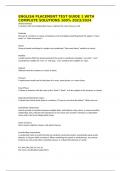
ENGLISH PLACEMENT TEST GUIDE 1 WITH
COMPLETE SOLUTIONS 100% 2023/2024
Simple Sentence
A sentence with one independent clause, making it the main clause as well.
Predicate
the part of a sentence or clause containing a verb and stating something about the subject. ("went
home" in "John went home")
Clause
Group of words consisting of a subject and a predicate ("John went home" would be a clause)
Modifier
A word used to effect the state/meaning of the word in a predicate. Examples; "very hot", "very"
would be the modifier for "hot". In "wet dog", "wet" would be the modifier for "dog".
Subjects
Indicates what the sentence or clause is about.
Pronoun
A replacement word used to take place of a noun, noun phrase, or a noun clause
Noun Phrase
A clause or sentence with the noun as the "head" ("head", as in the subject of the sentence or clause)
Dependent/Subordinate Clause
A clause that cannot stand alone in a sentence ("If you can not clean the dishes" "When you can
Subordinate Conjunction
Used to provide a transition between multiple ideas, will indicate a time, place, or cause and effect
relationship. Also, indicates the importance of one clause over another. Introduces a dependent
clause and is tied to an independent clause.
Types of clauses
Noun clauses, adjective clauses, and adverb clauses.
Coordinating Conjunctions
A conjunction (such as and) that joins two similarly constructed and/or syntactically equal words,
phrases, or clauses within a sentence. When combining two words or word phrases, no commas.
Commas are only used when connected clauses, or at least three phrases or words.
For, And, Nor, But, Or, Yet, So
The seven coordinating conjunctions.
COMPLETE SOLUTIONS 100% 2023/2024
Simple Sentence
A sentence with one independent clause, making it the main clause as well.
Predicate
the part of a sentence or clause containing a verb and stating something about the subject. ("went
home" in "John went home")
Clause
Group of words consisting of a subject and a predicate ("John went home" would be a clause)
Modifier
A word used to effect the state/meaning of the word in a predicate. Examples; "very hot", "very"
would be the modifier for "hot". In "wet dog", "wet" would be the modifier for "dog".
Subjects
Indicates what the sentence or clause is about.
Pronoun
A replacement word used to take place of a noun, noun phrase, or a noun clause
Noun Phrase
A clause or sentence with the noun as the "head" ("head", as in the subject of the sentence or clause)
Dependent/Subordinate Clause
A clause that cannot stand alone in a sentence ("If you can not clean the dishes" "When you can
Subordinate Conjunction
Used to provide a transition between multiple ideas, will indicate a time, place, or cause and effect
relationship. Also, indicates the importance of one clause over another. Introduces a dependent
clause and is tied to an independent clause.
Types of clauses
Noun clauses, adjective clauses, and adverb clauses.
Coordinating Conjunctions
A conjunction (such as and) that joins two similarly constructed and/or syntactically equal words,
phrases, or clauses within a sentence. When combining two words or word phrases, no commas.
Commas are only used when connected clauses, or at least three phrases or words.
For, And, Nor, But, Or, Yet, So
The seven coordinating conjunctions.