12. ALDEHYDES, KETONES AND CARBOXYLIC ACIDS
These are compounds containing carbon-oxygen double bond (>C=O) called carbonyl group. In aldehydes, the
carbonyl group is bonded to a carbon and hydrogen while in ketones, it is bonded to two carbon atoms. The carbonyl
compounds in which carbonyl group is bonded to oxygen are known as carboxylic acids, and their derivatives (e.g. esters,
anhydrides) while in compounds where carbon is attached to nitrogen and to halogens are called amides
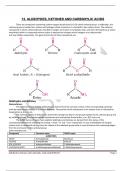
and acyl halides respectively. The general formulas of these compounds are:
Aldehydes and Ketones
Nomenclature:
The common names of most aldehydes are derived from the common names of the corresponding carboxylic
acids by replacing the ending –ic acid with aldehyde. The position of the substituent in the carbon chain is indicated by
Greek letters α, β, γ, δ, etc.
The common names of ketones are derived by naming two alkyl or aryl groups bonded to the carbonyl group and
by suffixing ketone. The positions of the substituents are indicated by Greek letters, α α′, β β′ and so on.
The IUPAC names of open chain aliphatic aldehydes and ketones are derived from the names of the
corresponding alkanes by replacing the ending –e with ‘–al’ and ‘–one’ respectively. In case of aldehydes the longest
carbon chain is numbered starting from the carbon of the aldehyde group while in case of ketones the numbering begins
from the end nearer to the carbonyl group.
Some examples are:
Compound Common name IUPAC name
ALDEHYDES
HCHO Formaldehyde Methanal
CH3CHO Acetaldehyde Ethanal
(CH3)2CHCHO Isobutyraldehyde 2-Methylpropanal
CH3CH(OCH3)CHO α-Methoxypropionaldehyde 2-Methoxypropanal
Aldehydes, Ketones and Carboxylic acids-Anil-HSSLiVE Page 1
,CH3CH2CH2CH2CHO Valeraldehyde Pentanal
CH2=CHCHO Acrolein Prop-2-enal
Phthaldehyde Benzene-1,2-dicarbaldehyde
3-Bromobenzenecarbaldehyde
m-Bromobenzaldehyde Or
3-Bromobenzaldehyde
KETONES
CH3COCH3 Acetone Propanone
CH3COCH2CH3 Ethyl methyl ketone Butanone
CH3COCH2CH2CH3 Methyl n-propyl ketone Pentan-2-one
CH3CH2COCH2CH3 Diethyl ketone Pentan-3-one
(CH3)2CHCOCH(CH3)2 Diisopropyl ketone 2,4-Dimethylpentan-3-one
(CH3)2C=CHCOCH3 Mesityl oxide 4-Methylpent-3-en-2-one
α-Methylcyclohexanone 2-Methylcyclohexanone
Preparation of Aldehydes and Ketones
1. By oxidation of alcohols: Primary alcohols on oxidation with mild oxidising agents like CrO3 to give aldehydes
while secondary alcohols give ketones.
R-CH2OH [O] R-CHO
R2CHOH [O] R2CO
2. By dehydrogenation of alcohols: Alcohols when heated with Cu or Silver catalyst at 573K, we get carbonyl
compounds. Primary alcohols give aldehydes, while secondary alcohols give ketones.
R-CH2OH Cu/573 K R-CHO
R2CHOH Cu/573 K R2CO
3. By ozonolysis of alkenes: Alkenes add ozone followed by hydrolysis with zinc dust and water, we get aldehydes
or ketones.
4. By hydration of alkynes: Alkynes add water in the presence of H2SO4 and HgSO4 to give carbonyl compounds.
Ethyne (acetylene) gives acetaldehyde and all other alkynes give ketones.
CH ≡ CH + H2O H2SO4/HgSO4 CH3-CHO
Ethyne Acetaldehyde
CH3-C ≡ CH + H2O H2SO4/HgSO4 CH3-CO-CH3
Aldehydes, Ketones and Carboxylic acids-Anil-HSSLiVE Page 2
, Propyne Acetone
Preparation of Aldehydes
1. From acyl chloride (Acid chloride) [Rosenmund’s Reduction]:
Acid chlorides react with hydrogen in presence of Pd supported on BaSO4, we get aldehydes. This reaction is
called Rosenmund’s reduction.
R-COCl + H2 Pd/BaSO4 R-CHO + HCl
Benzoyl chloride Benzaldehyde
2. From nitriles and esters:
Nitriles when reduced with stannous chloride in the presence of hydrochloric acid, we get imines, which on
hydrolysis give corresponding aldehyde. This reaction is called Stephen reaction.
RCN + SnCl2 + HCl R-CH=NH H3O+ R-CHO
Nitriles can also be selectively reduced by diisobutylaluminium hydride (DIBAL-H) to imines followed by hydrolysis to
aldehydes. DIBAL-H does not affect other reducable groups like double bonds.
R-CN 1. AlH(i-Bu)2 R-CHO
2. H2O
CH3-CH=CH-CH2-CN 1. DIBAL-H CH3-CH=CH-CH2-CHO
2 H2O
Esters are also reduced to aldehydes with DIBAL-H.
CH3-CH2-COOCH3 1. DIBAL-H CH3-CH2-CHO
2. H2O
Preparation of Aromatic aldehydes:
1. By oxidation of methylbenzene:
Methyl benzenes when oxidised by using mild oxidising agents like chromyl chloride (CrO2Cl2) or chromic oxide (CrO3)
in acetic anhydride, we get benzaldehyde.
Chromyl chloride oxidises methyl group to a chromium complex, which on hydrolysis gives corresponding
benzaldehyde. This reaction is called Etard reaction.
On treating with chromic oxide in acetic anhydride, methyl benzene is converted to benzylidene diacetate which
on acidification gives benzaldehyde.
Aldehydes, Ketones and Carboxylic acids-Anil-HSSLiVE Page 3
These are compounds containing carbon-oxygen double bond (>C=O) called carbonyl group. In aldehydes, the
carbonyl group is bonded to a carbon and hydrogen while in ketones, it is bonded to two carbon atoms. The carbonyl
compounds in which carbonyl group is bonded to oxygen are known as carboxylic acids, and their derivatives (e.g. esters,
anhydrides) while in compounds where carbon is attached to nitrogen and to halogens are called amides
and acyl halides respectively. The general formulas of these compounds are:
Aldehydes and Ketones
Nomenclature:
The common names of most aldehydes are derived from the common names of the corresponding carboxylic
acids by replacing the ending –ic acid with aldehyde. The position of the substituent in the carbon chain is indicated by
Greek letters α, β, γ, δ, etc.
The common names of ketones are derived by naming two alkyl or aryl groups bonded to the carbonyl group and
by suffixing ketone. The positions of the substituents are indicated by Greek letters, α α′, β β′ and so on.
The IUPAC names of open chain aliphatic aldehydes and ketones are derived from the names of the
corresponding alkanes by replacing the ending –e with ‘–al’ and ‘–one’ respectively. In case of aldehydes the longest
carbon chain is numbered starting from the carbon of the aldehyde group while in case of ketones the numbering begins
from the end nearer to the carbonyl group.
Some examples are:
Compound Common name IUPAC name
ALDEHYDES
HCHO Formaldehyde Methanal
CH3CHO Acetaldehyde Ethanal
(CH3)2CHCHO Isobutyraldehyde 2-Methylpropanal
CH3CH(OCH3)CHO α-Methoxypropionaldehyde 2-Methoxypropanal
Aldehydes, Ketones and Carboxylic acids-Anil-HSSLiVE Page 1
,CH3CH2CH2CH2CHO Valeraldehyde Pentanal
CH2=CHCHO Acrolein Prop-2-enal
Phthaldehyde Benzene-1,2-dicarbaldehyde
3-Bromobenzenecarbaldehyde
m-Bromobenzaldehyde Or
3-Bromobenzaldehyde
KETONES
CH3COCH3 Acetone Propanone
CH3COCH2CH3 Ethyl methyl ketone Butanone
CH3COCH2CH2CH3 Methyl n-propyl ketone Pentan-2-one
CH3CH2COCH2CH3 Diethyl ketone Pentan-3-one
(CH3)2CHCOCH(CH3)2 Diisopropyl ketone 2,4-Dimethylpentan-3-one
(CH3)2C=CHCOCH3 Mesityl oxide 4-Methylpent-3-en-2-one
α-Methylcyclohexanone 2-Methylcyclohexanone
Preparation of Aldehydes and Ketones
1. By oxidation of alcohols: Primary alcohols on oxidation with mild oxidising agents like CrO3 to give aldehydes
while secondary alcohols give ketones.
R-CH2OH [O] R-CHO
R2CHOH [O] R2CO
2. By dehydrogenation of alcohols: Alcohols when heated with Cu or Silver catalyst at 573K, we get carbonyl
compounds. Primary alcohols give aldehydes, while secondary alcohols give ketones.
R-CH2OH Cu/573 K R-CHO
R2CHOH Cu/573 K R2CO
3. By ozonolysis of alkenes: Alkenes add ozone followed by hydrolysis with zinc dust and water, we get aldehydes
or ketones.
4. By hydration of alkynes: Alkynes add water in the presence of H2SO4 and HgSO4 to give carbonyl compounds.
Ethyne (acetylene) gives acetaldehyde and all other alkynes give ketones.
CH ≡ CH + H2O H2SO4/HgSO4 CH3-CHO
Ethyne Acetaldehyde
CH3-C ≡ CH + H2O H2SO4/HgSO4 CH3-CO-CH3
Aldehydes, Ketones and Carboxylic acids-Anil-HSSLiVE Page 2
, Propyne Acetone
Preparation of Aldehydes
1. From acyl chloride (Acid chloride) [Rosenmund’s Reduction]:
Acid chlorides react with hydrogen in presence of Pd supported on BaSO4, we get aldehydes. This reaction is
called Rosenmund’s reduction.
R-COCl + H2 Pd/BaSO4 R-CHO + HCl
Benzoyl chloride Benzaldehyde
2. From nitriles and esters:
Nitriles when reduced with stannous chloride in the presence of hydrochloric acid, we get imines, which on
hydrolysis give corresponding aldehyde. This reaction is called Stephen reaction.
RCN + SnCl2 + HCl R-CH=NH H3O+ R-CHO
Nitriles can also be selectively reduced by diisobutylaluminium hydride (DIBAL-H) to imines followed by hydrolysis to
aldehydes. DIBAL-H does not affect other reducable groups like double bonds.
R-CN 1. AlH(i-Bu)2 R-CHO
2. H2O
CH3-CH=CH-CH2-CN 1. DIBAL-H CH3-CH=CH-CH2-CHO
2 H2O
Esters are also reduced to aldehydes with DIBAL-H.
CH3-CH2-COOCH3 1. DIBAL-H CH3-CH2-CHO
2. H2O
Preparation of Aromatic aldehydes:
1. By oxidation of methylbenzene:
Methyl benzenes when oxidised by using mild oxidising agents like chromyl chloride (CrO2Cl2) or chromic oxide (CrO3)
in acetic anhydride, we get benzaldehyde.
Chromyl chloride oxidises methyl group to a chromium complex, which on hydrolysis gives corresponding
benzaldehyde. This reaction is called Etard reaction.
On treating with chromic oxide in acetic anhydride, methyl benzene is converted to benzylidene diacetate which
on acidification gives benzaldehyde.
Aldehydes, Ketones and Carboxylic acids-Anil-HSSLiVE Page 3