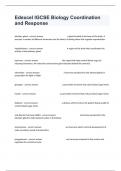
Edexcel IGCSE Biology Coordination and Response Actual Exam Questions And Detailed Correct Answers.
pituitary gland - correct answer a gland located at the base of the brain. It secretes a number of different hormones into the blood, including those that regulate reproduction. hypothalamus - correct answer A region of the brain that coordinates the activity of the pituitary gland pancreas - correct answer the organ that helps control blood sugar by releasing hormones. An endocrine and exocrine gland situated behind the stomach. adrenaline - correct answer a hormone produced by the adrenal glands in preparation for fight or flight glucagon - correct answer a pancreatic hormone that raises blood sugar levels insulin - correct answer a pancreatic hormone that reduces blood sugar levels diabetes - correct answer a disease which involves the patient being unable to control blood sugar levels anti-diuretic hormone (ADH) - correct answer a hormone produced by the pituitary gland to help reabsorb water in the kidney testosterone - correct answer sex hormone which controls development of male secondary sexual characteristics progesterone - correct answer sex hormone produced in the ovaries and regulates the menstrual cycle oestrogen - correct answer a sex hormone produced in the ovaries. It is responsible for controlling the development of female secondary sexual characteristics thyroxine - correct answer a hormone produced by the thyroid gland. It controls the body's metabolic rate nervous communication - correct answer communication in the body using nerve impulses that act on individual cells. Responses are usually short-lived. endocrine communication - correct answer communication in the body using hormones travelling slowly in the bloodstream that have widespread effects on different organs. Responses are usually longer-lasting. homeostasis - correct answer maintaining a constant internal environment. two examples of homeostasis - correct answer 1. Control of body water content 2. Control of body temperature endotherms - correct answer Animals that keep their body temperature constant, despite changes in the temperature of their surroundings i.e. 'warm blooded' negative feedback - correct answer when a change in body condition is detected, and a set of responses occurs to return the conditions to normal (to a set point). thermoregulatory centre - correct answer an area of the hypothalamus that monitors core body temperature and acts as the body's thermostat. skin epidermis - correct answer the outer layer of skin that consists of dead cells that stop water loss and protect the body against invasion by microorganisms. hair arrector muscles - correct answer small muscles attached to the base of each skin hair that can contract in cold conditions to pull the hairs upright. This traps a layer of air next to the skin insulating it. latent heat of vaporisation - correct answer the energy required to transform a liquid to a gas. vasodilation - correct answer a process where skin arterioles dilate to increase blood flow to the skin's surface. More heat is radiated from the skin helping to cool the body down in warm conditions. vasoconstriction - correct answer a process where skin arterioles constrict to reduce blood flow to the skin's surface. Less heat is radiated from the skin helping to prevent heat loss in cold conditions. sweating - correct answer a process where glands secrete liquid onto the surface of the skin. This liquid is evaporated using heat energy from the body core, cooling the body down. shivering - correct answer a process where muscles contract and relax rapidly to generate heat in cold conditions conjunctiva - correct answer mucous membrane that covers the front of the eye and lines the inside of the eyelids cornea - correct answer a transparent layer forming the front of the eye (continuous with the sclera) pupil - correct answer the hold in the iris forming an opening in the centre of the eye which lets light through iris - correct answer the coloured ring of tissue which controls the amount of light entering the eye by changing the size of the pupil lens - correct answer Biconvex transparent body situated behind the iris that focuses light on the retina choroid layer - correct answer the dark pigmented vascular layer which stops light being internally reflected inside the eye sclera - correct answer the tough white outer coat of the eye retina - correct answer the light-sensitive layer inside the eye where light energy is transduced into the electrical energy of nerve impulses by rod and cone cells rods - correct answer cells on the retina that detect light intensity and generate impulses in the optic nerve cones - correct answer cells that respond to coloured light (red, green and blue) and generate impulses in the optic nerve fovea - correct answer a small depression in the centre of the retina where a high concentration of cone cells can be found optic nerve - correct answer this neurone transmits impulses from sensory neurones in the retina to the brain ciliary muscles - correct answer circular muscles that relax or contract to enable the lens to change shape for focussing suspensory ligaments - correct answer A series of fibres that hold the lens of the eye in place blind spot - correct answer the area of the retina where an image cannot be formed because there are no rods or cones; this is where the optic nerve leaves the eye refraction - correct answer when light is bent, for example in the human eye at the air/cornea boundary and again at the lens circular muscles - correct answer muscles found in the iris that contract in bright light and relax in dim light radial muscles - correct answer muscles found in the iris that relax in bright light and contract in dim light pupil dilation - correct answer when the pupil of the eye becomes wider e.g. in response to dim light pupil constriction - correct answer when the pupil of the eye becomes smaller e.g. in response to bright light accommodation - correct answer the changes that take place in the eye which allow us to see objects at different distances stimulus - correct answer a general term for a change in the external or internal environment response - correct answer a reaction to a stimulus central nervous system (CNS) - correct answer consists of the brain and spinal cord reflex action - correct answer a rapid automatic (or involuntary) action in response to a stimulus that is not started by impulses from the brain reflex arc - correct answer the nerve pathway of a reflex e.g. stimulus > receptor > sensory neuron > CNS > relay neuron > motor neuron > effector > response sensory neurone - correct answer a neurone conducting impulses from receptors to the brain or spinal cord motor neurone - correct answer a neuron transmitting impulses from the brain or spinal cord to a muscle or gland axon - correct answer the elongated part of a nerve cell myelin sheath - correct answer fatty insulation that surrounds axons and helps
Written for
- Institution
- BIOLOGY GCSE
- Course
- BIOLOGY GCSE
Document information
- Uploaded on
- June 23, 2024
- Number of pages
- 6
- Written in
- 2023/2024
- Type
- Exam (elaborations)
- Contains
- Questions & answers
Subjects
-
edexcel igcse biology coordination and response

Also available in package deal