
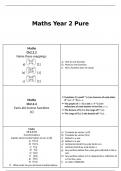
Maths Year 2 Pure
Maths
Ch2.2.2
Name these mappings:
a) One to one function
a) [1] b) Many to one function
c) Not a function (one to many)
b) [1]
c) [1]
Maths
Ch2.2.4
Facts abt inverse functions
[4]
Maths
Ch 2.2.5-6 a) Translate by vector (-a/0)
Transformations b) Translate by vector (0/a)
Explain what transformation occurs in [8] c) Reflect in y axis
a) f(x+a) d) Reflect in x axis
b) f(x)+a e) Horizontal stretch by scale factor x/a
c) f(-x) f) Vertical stretch by scale factor a
d) -f(x) g) Any sections below the x-axis gets reflected in the x-
e) f(ax) axis.
f) af(x) h) Any sections where x<0 is replaced by a reflection of
g) |f(x)| x>0 in the y axis.
h) f(|x|) i) In order of BIDMAS
i) What order do you do these transformations
, in?
Maths
Ch 2.3.6
a) n
b) the number of terms to be summed up
a) What is this equal to? [1] c) the position of the first term
b) What does n mean? [1]
c) What does r=1 mean? [1]
Pure Maths
Yr2 Ch5.2-3
Arc length & sector area a) L = θr
What is the formula for the b) A = (θr2)/2
c) A = (r2/2) x (θ-sinθ)
a) arc length [1]
b) sector area [1]
c) segment area [1]
A sequence is increasing of un+1 > un for all n ε N
Pure Maths A sequence is decreasing of un+1 < un for all n ε N
A sequence is periodic if the terms repeat in a cycle.
Yr2 Ch3.7 o For a periodic sequence there is an integer k
Recurrence relations such that un+k = un for all n ε N.
[5] o The value k is called the order/period of the
sequence.
Maths
Ch2.2.2
Name these mappings:
a) One to one function
a) [1] b) Many to one function
c) Not a function (one to many)
b) [1]
c) [1]
Maths
Ch2.2.4
Facts abt inverse functions
[4]
Maths
Ch 2.2.5-6 a) Translate by vector (-a/0)
Transformations b) Translate by vector (0/a)
Explain what transformation occurs in [8] c) Reflect in y axis
a) f(x+a) d) Reflect in x axis
b) f(x)+a e) Horizontal stretch by scale factor x/a
c) f(-x) f) Vertical stretch by scale factor a
d) -f(x) g) Any sections below the x-axis gets reflected in the x-
e) f(ax) axis.
f) af(x) h) Any sections where x<0 is replaced by a reflection of
g) |f(x)| x>0 in the y axis.
h) f(|x|) i) In order of BIDMAS
i) What order do you do these transformations
, in?
Maths
Ch 2.3.6
a) n
b) the number of terms to be summed up
a) What is this equal to? [1] c) the position of the first term
b) What does n mean? [1]
c) What does r=1 mean? [1]
Pure Maths
Yr2 Ch5.2-3
Arc length & sector area a) L = θr
What is the formula for the b) A = (θr2)/2
c) A = (r2/2) x (θ-sinθ)
a) arc length [1]
b) sector area [1]
c) segment area [1]
A sequence is increasing of un+1 > un for all n ε N
Pure Maths A sequence is decreasing of un+1 < un for all n ε N
A sequence is periodic if the terms repeat in a cycle.
Yr2 Ch3.7 o For a periodic sequence there is an integer k
Recurrence relations such that un+k = un for all n ε N.
[5] o The value k is called the order/period of the
sequence.


