
MATHS YEAR 2 STATISTICS
Stats a)
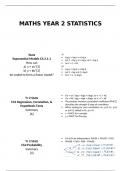
Log y = log a + n log x
Exponential Models Ch 2.1.1 Let Y = log y, X = log x, & C = log a
How can So Y = C + nX
a) y = axn [3] b)
Log y = log k + x log b
b) y = kbx [3] Let Y = log y & C= log k
be coded to form a linear model? So Y = C + x log b
If y = axn, logy = loga + nlogx, so y = C + nX
Yr 2 Stats If y = kbx, logy = logk + xlogb, so y = C + xB
Ch1 Regression, Correlation, & The product moment correlation coefficient (PMCC)
describes the strength & type of correlation.
Hypothesis Tests When testing for zero correlation, H 0: p=0, H1: p>0
Summary or p<0 (1 tailed) or H1: p=/=0
[6] r = PMCC for a sample
ρ = PMCC for the pop.
If A & B are independent, P(A/B) =. P(A/B’) = P(A)
Yr 2 Stats P(AUB) = P(A) + P(B) – P(AnB)
Ch2 Probability
Summary
[3]
Stats a)
Log y = log a + n log x
Exponential Models Ch 2.1.1 Let Y = log y, X = log x, & C = log a
How can So Y = C + nX
a) y = axn [3] b)
Log y = log k + x log b
b) y = kbx [3] Let Y = log y & C= log k
be coded to form a linear model? So Y = C + x log b
If y = axn, logy = loga + nlogx, so y = C + nX
Yr 2 Stats If y = kbx, logy = logk + xlogb, so y = C + xB
Ch1 Regression, Correlation, & The product moment correlation coefficient (PMCC)
describes the strength & type of correlation.
Hypothesis Tests When testing for zero correlation, H 0: p=0, H1: p>0
Summary or p<0 (1 tailed) or H1: p=/=0
[6] r = PMCC for a sample
ρ = PMCC for the pop.
If A & B are independent, P(A/B) =. P(A/B’) = P(A)
Yr 2 Stats P(AUB) = P(A) + P(B) – P(AnB)
Ch2 Probability
Summary
[3]


