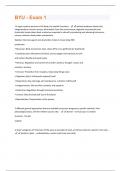
BYU - Exam 1 (Questions + Answers) Verified 100% Correct!!.
11 organ systems present in the body, the specific functions - skeletal produces blood cells; integumentary receives sensory information from the environment; digestive mechanically and chemically breaks down food; endocrine responds to stimuli by producing and releasing hormones; urinary maintains body water composition Skeletal: Internal support and protection, helps to move body, RBC production • Muscular: Body movement, heat, show off for your girlfriend (or boyfriend) • Cardiovascular: Movement of blood; carries oxygen and nutrients to cells and carbon dioxide and waste away • Nervous: Regulation and control of all other systems; thought, reason and emotion, memory • Immune: Protection from invaders, helps keep things clean • Digestive: (Roy's 2nd favorite system) Food! • Respiratory: Gas exchange, pH maintenance, nutrition, huff & puff • Integumentary: Skin and hair; protects and supports • Endocrine: Regulation through hormonal secretions • Urinary: Gets the bad stuff out of the blood • Reproductive: Perpetuation of the species 3 different general approaches that are available to prevent pregnancy, specific methods, their physcological basis, and the relative success rate. - barrier - cervical cap or condom chemical - the pill surgical 4 major categories of molecules of life, give an example of each, and know what the subunit is for each. - proteins, lipids -, carbohydrates, nucleic acids (see next card)A mad scientist has ripped apart an atom and collected all the subatomic particles located in the nucleus of the atom. Which of the following describes all the particles he has collected? - protons and neutrons A molecule of water forms when one oxygen atom binds with two hydrogen atoms, thereby completely filling the electron outer shells of the hydrogen and oxygen atoms. The type of bond linking the atoms together is - covalent atom - :the smallest unit of an element that maintains physical properties (smallest unit of matter). These take part in chemical reactions. Molecule: stable association between tow or more atoms. Ex: a molecule of water is two atoms of hydrogen plus one atom of oxygen. cancer cell formation - cancer cells form as mutations occur in DNA mutations permit the cell to escape from influence of signals that regulate and control cell division. Cell undergoes repeated uncontrolled division. - a tumor forms Additional mutations occur - cancer cell acquires ability to invade into tissue. - it may enter lymph or blood vessels and be transported to distant sites - it leaves the vessel and forms new tumor carcinogens and a list of chemical and other agents - carcinogen: any cancer producing substance or organism. Some chemicals seem be linked to specific types of cancer. -hepatitis B: a sexually transmitted carcinogen hepatitis c: a blood infection ex: drugs (shared needles) - human papillomavirus (HPV) - HIV - Estrogen-Barr virus Human T-cell leukemia/lymphoma virusCells gain specialized structure and function through what process? - Differentiation is the process by which a cell becomes different from its parents or sister cell. At various development stages of life cells differentatiate because they begin to express different genes. Cesarean - surgical delivery of a baby changes in characteristics that cells undergo as they become cancerous - G1 - growth 1 the cell starts to get bigger Synthesis - the cell replicates - during this stage, DNA can become damaged and converts into G0 G2 - grows mitosis - the cell divides. 1) genetically unstable 2) high rate of division and the rate is totally out of control 3) can become highly mobile in the body 4) usually lose specialization and require characteristics of undifferentiated cells. 5) escape apoptotic mechanisms designed to induce cell death
Written for
- Institution
- BYU
- Course
- BYU
Document information
- Uploaded on
- June 23, 2024
- Number of pages
- 19
- Written in
- 2023/2024
- Type
- Exam (elaborations)
- Contains
- Questions & answers
Subjects

Also available in package deal