BIO 100 Exam 3 Review Questions - ASU
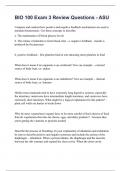
Compare and contrast how positive and negative feedback mechanisms are used to maintain homeostasis. Use these concepts to describe: a. The maintenance of blood glucose levels b. The release of platelets to form blood clots - a. negative feedback - insulin is produced by the pancreas b. positive feedback - first platelets bind to site attracting more platelets to bind What does it mean if an organism is an ectotherm? Give an example. - external source of body heat; ex: snakes What does it mean if an organism is an endotherm? Give an example. - internal source of body heat; ex: humans Herbivorous mammals tend to have extremely long digestive systems, especially the intestines; omnivores have intermediate length intestines; and carnivores have extremely short intestines. What might be a logical explanation for this pattern? - plant cell walls are harder to break down Why do strict vegetarians (vegans) have to be more careful of their choices of food than do vegetarians that also eat cheese, eggs, and dairy products? - because they aren't getting the vitamins or proteins needed Describe the process of breathing. In your explanation of inhalation and exhalation be sure to describe positive and negative pressure and include the actions of the diaphragm. - inhalation: When a person inhales, the diaphragm and the muscles between the ribs contract and expand the chest cavity. When the chest cavity expands, the pressure in the chest is lowered to a level below that of the air pressure outside. When this happens, air flows in through the airways from a high pressure to low pressure and inflates the lungs. exhalation: When a person exhales, the diaphragm and muscles between the ribs relax and make the chest cavity smaller. The decrease in the volume of the chest cavity increases the pressure to a level that is higher than the air pressure outside. The air from the lungs then flows out of the airways to the outside air. How do vaccines work? - a substance used to stimulate the production of antibodies and provide immunity against one or several diseases In Southern Copperhead snake venom, you'll find a protein called a disintegrin. Disintegrins bind to a class of membrane receptors called integrins. Platelets use integrin receptors to aggregate at a site of tissue damage. What effect do you think disintegrin has on the snake's prey? - the molecule interferes with clot formation so that the venom can travel more efficiently from the site of the bit to the rest of the body
Written for
- Institution
- BIO 100
- Course
- BIO 100
Document information
- Uploaded on
- June 22, 2024
- Number of pages
- 7
- Written in
- 2023/2024
- Type
- Exam (elaborations)
- Contains
- Questions & answers
Subjects
- bio 100 exam 3
-
bio 100 exam 3 review questions asu

Also available in package deal