1
Lectures Neuropsychological rehabilitation and treatment
Lecture 1: Introduction
Neuropsychological Rehabilitation: Interventions of neuropsychologists within the
rehabilitation of a patient. Often with neurological disorders. (Not the same as cognitive
rehabilitation patients also often have emotional, behavior and psychosocial problems)
Cognitive training
- The part of cognitive rehabilitation that focuses on reducing direct limitations due to
cognitive impairment.
- Is not so much aimed at the direct reduction of cognitive impairments, but at
reducing and learning to cope with cognitive limitations
- learning, in a structured way, to cope with cognitive limitations by applying
compensation strategies
- Not the same as function or skill training (mainly in the acute phase)
Patient groups
- Started with patients with brain injury, meanwhile:
o Patients with neurodegenerative disorders (Mild Cognitive Impairment,
Personality Disorder)
o Neuropsychological patients (schizophrenia)
o Developmental disorders (autism)
- There must be brain injury/-disease/-dysfunction causing loss of quality of
independent functioning in work, family and leisure time.
Biggest group: Acquired Brain Injury (ABI)
- Consequences of ABI:
o Sensory-motor disorders
o Neuropsychological disorders
Cognitive and executive functioning
Emotion and motivation
Behavior
Psychosocial
,2
- Combination of factors:
o direct effects of brain injury
o premorbid factors
o environment
o coping style
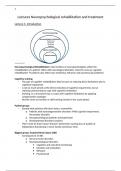
ICF model (International Classification and Functioning)
- Often patients complain about participation problems and then we disentangle all
the different aspects in limitations in activities and impairment in functions with a
neuropsychological assessment
- Level of the body
o Functions: physiological and mental characteristics of human functioning
o Disorder/impairment: absence or deviation from psychological physiological
or anatomical structure or function
- Level of the individual
o Activities: execution of a task or action by an individual
o Limitation: reduction or loss of ability to perform or activity
- Person as a member of society
o Participation: one’s involvement in societal life, roll fulfilment
o Restrictions: problems in involvement in life situations.
- Examples:
,3
Goals neuropsychological rehabilitation
- Function level: functions/abilities
- Activity level: skills
- Participation level: social roles
- Experience level: experienced well-being
- Recovery
o at a function level little evidence (repairing functions is often not a goal of
the treatment)
o also: adaptation to situation by using intact brain functions
o or: functioning at a better level with structured environment
Restorative model (recovery at neurological level)
- Goal restoration of neuropsychological function/brain structure
- Operationalization repetitive stimulation of damaged brain function through
repeated exercises, usually via computer programs
- Methods:
o Function training ultimate goal is generalization: improved performance
in different tasks and situations, not only in the trained situation or similar
tasks
Perhaps ‘too simple’
Possible support for more theory-driven elaboration (Robertson and
Murre, 1999)
Practice on de-contextualized computer-based attentional tasks in not
recommended because of lack of evidence of generalization, but
direct training on everyday tasks (including duals tasks or dealing with
background noise) may lead to gains for performance of those tasks
o Repeated practice approach
o Cognitive retraining
o Drill and practice
o Stimulation training
o Brain gymnastics
o ‘Mental muscle’ metaphor
Compensatory model (recovery at psychological level)
- Cognitive rehabilitation (Barbara Wilson, 1996) term can apply to any
interventions strategy or technique which intends to enable clients or patients, and
their family, to live with, manage, by-pass, reduce or come to terms with cognitive
deficits precipitated by injury to the brain.
- Goal compensatory/adaptation on participation and activity level
- Methods:
o Psychoeducation
o Skills training
o Strategy training
o Structure environment (physical and social)
o Use of assistive devices
o Behavior modification (learning theory, CBT)
, 4
o Neuropsychotherapy
Psychoeducation
- Education about the (neuropsychological) consequences of brain injury in general
- Education about the (neuropsychological) consequences of the patient’s brain injury
in particular
- On the basis of a neuropsychological assessment (NPA)
- In the form of a strengths/weaknesses analysis
- Translated to everyday life situations
- Reassurance about ‘normal’ consequences
Skills training
- Teaching specific skills (situation-specific behavioral routines) without aiming at
generalization to other task domains
- Learning through repeated practice, chaining
- Similarities with function training, but different aim
- Examples:
o Learning a fixed route in the rehabilitation centre
o Perform a practical task such as making coffee
o Perform ADL activities in the right order
Strategy training
- Teaching a general, abstract, top-down approach that aims at better functioning
through:
o Restructuring of tasks
o Better planning of activities
o Better control of own behavior
- Consists of a number of steps to be performed or series of questions to be asked by
the patient
- Patients need to tailor these steps/questions to specific tasks
- Generalization!
- How do you learn a strategy?
o The strategy should be tailored to the patient’s specific problems
o First implementation with guidance from the therapist (modelling)
o the patient gradually learns to apply the method to similar situations
o followed by application under supervision in other situations
o Final goal: patient internalizes method and can apply it by themselves in
other situations (generalization/transfer)
Structuring environment
- Provide external structure (cues, information, support) to the patient so they can
function at an optimal level
- Examples:
o Offering information on the right (neglect)
o Reminding the patient of appointments (memory impairment)
o Marking objects with color (object agnosia)
o Organizing the environment (dysexecutive syndrome)
Lectures Neuropsychological rehabilitation and treatment
Lecture 1: Introduction
Neuropsychological Rehabilitation: Interventions of neuropsychologists within the
rehabilitation of a patient. Often with neurological disorders. (Not the same as cognitive
rehabilitation patients also often have emotional, behavior and psychosocial problems)
Cognitive training
- The part of cognitive rehabilitation that focuses on reducing direct limitations due to
cognitive impairment.
- Is not so much aimed at the direct reduction of cognitive impairments, but at
reducing and learning to cope with cognitive limitations
- learning, in a structured way, to cope with cognitive limitations by applying
compensation strategies
- Not the same as function or skill training (mainly in the acute phase)
Patient groups
- Started with patients with brain injury, meanwhile:
o Patients with neurodegenerative disorders (Mild Cognitive Impairment,
Personality Disorder)
o Neuropsychological patients (schizophrenia)
o Developmental disorders (autism)
- There must be brain injury/-disease/-dysfunction causing loss of quality of
independent functioning in work, family and leisure time.
Biggest group: Acquired Brain Injury (ABI)
- Consequences of ABI:
o Sensory-motor disorders
o Neuropsychological disorders
Cognitive and executive functioning
Emotion and motivation
Behavior
Psychosocial
,2
- Combination of factors:
o direct effects of brain injury
o premorbid factors
o environment
o coping style
ICF model (International Classification and Functioning)
- Often patients complain about participation problems and then we disentangle all
the different aspects in limitations in activities and impairment in functions with a
neuropsychological assessment
- Level of the body
o Functions: physiological and mental characteristics of human functioning
o Disorder/impairment: absence or deviation from psychological physiological
or anatomical structure or function
- Level of the individual
o Activities: execution of a task or action by an individual
o Limitation: reduction or loss of ability to perform or activity
- Person as a member of society
o Participation: one’s involvement in societal life, roll fulfilment
o Restrictions: problems in involvement in life situations.
- Examples:
,3
Goals neuropsychological rehabilitation
- Function level: functions/abilities
- Activity level: skills
- Participation level: social roles
- Experience level: experienced well-being
- Recovery
o at a function level little evidence (repairing functions is often not a goal of
the treatment)
o also: adaptation to situation by using intact brain functions
o or: functioning at a better level with structured environment
Restorative model (recovery at neurological level)
- Goal restoration of neuropsychological function/brain structure
- Operationalization repetitive stimulation of damaged brain function through
repeated exercises, usually via computer programs
- Methods:
o Function training ultimate goal is generalization: improved performance
in different tasks and situations, not only in the trained situation or similar
tasks
Perhaps ‘too simple’
Possible support for more theory-driven elaboration (Robertson and
Murre, 1999)
Practice on de-contextualized computer-based attentional tasks in not
recommended because of lack of evidence of generalization, but
direct training on everyday tasks (including duals tasks or dealing with
background noise) may lead to gains for performance of those tasks
o Repeated practice approach
o Cognitive retraining
o Drill and practice
o Stimulation training
o Brain gymnastics
o ‘Mental muscle’ metaphor
Compensatory model (recovery at psychological level)
- Cognitive rehabilitation (Barbara Wilson, 1996) term can apply to any
interventions strategy or technique which intends to enable clients or patients, and
their family, to live with, manage, by-pass, reduce or come to terms with cognitive
deficits precipitated by injury to the brain.
- Goal compensatory/adaptation on participation and activity level
- Methods:
o Psychoeducation
o Skills training
o Strategy training
o Structure environment (physical and social)
o Use of assistive devices
o Behavior modification (learning theory, CBT)
, 4
o Neuropsychotherapy
Psychoeducation
- Education about the (neuropsychological) consequences of brain injury in general
- Education about the (neuropsychological) consequences of the patient’s brain injury
in particular
- On the basis of a neuropsychological assessment (NPA)
- In the form of a strengths/weaknesses analysis
- Translated to everyday life situations
- Reassurance about ‘normal’ consequences
Skills training
- Teaching specific skills (situation-specific behavioral routines) without aiming at
generalization to other task domains
- Learning through repeated practice, chaining
- Similarities with function training, but different aim
- Examples:
o Learning a fixed route in the rehabilitation centre
o Perform a practical task such as making coffee
o Perform ADL activities in the right order
Strategy training
- Teaching a general, abstract, top-down approach that aims at better functioning
through:
o Restructuring of tasks
o Better planning of activities
o Better control of own behavior
- Consists of a number of steps to be performed or series of questions to be asked by
the patient
- Patients need to tailor these steps/questions to specific tasks
- Generalization!
- How do you learn a strategy?
o The strategy should be tailored to the patient’s specific problems
o First implementation with guidance from the therapist (modelling)
o the patient gradually learns to apply the method to similar situations
o followed by application under supervision in other situations
o Final goal: patient internalizes method and can apply it by themselves in
other situations (generalization/transfer)
Structuring environment
- Provide external structure (cues, information, support) to the patient so they can
function at an optimal level
- Examples:
o Offering information on the right (neglect)
o Reminding the patient of appointments (memory impairment)
o Marking objects with color (object agnosia)
o Organizing the environment (dysexecutive syndrome)