OCR A Level Chemistry: Definitions and Study Guide for Exam Preparations
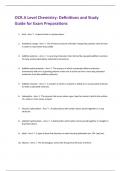
1. Acid - Ans .A species that is a proton donor. 2. Activation energy - Ans .The minimum amount of kinetic energy that particles need to have in order to react when they collide 3. Addition polymer - Ans .A very long molecular chain formed by repeated addition reactions of many unsaturated alkene molecules (monomers). 4. Addition polymerisation - Ans .The process in which unsaturated alkene molecules (monomers) add on to a growing polymer chain one at a time to form a very long saturated molecular chain (the addition polymer). 5. Addition reaction - Ans .A reaction in which a reactant is added to an unsaturated molecule to make a saturated molecule. 6. Adsorption - Ans .The process that occurs when a gas, liquid or solute is held to the surface of a solid or, more rarely, a liquid. 7. Alicyclic hydrocarbon - Ans .A hydrocarbon with carbon atoms joined together in a ring structure. 8. aliphatic hydrocarbon - Ans .A hydrocarbon with carbon atoms joined together in straight or branched chains. 9. alkali - Ans .A type of base that dissolves in water forming hydroxide ions, OH- (aq) ions. 10. alkanes - Ans .The homologous series with the general formula: CnH2n+2. 11. alkyl group - Ans .An alkane with a hydrogen atom removed, e.g. CH3, C2H5; alkyl groups are often shown as 'R'. 12. amount of substance - Ans .The quantity whose unit of the mole. Chemists use 'amount of substance' as a means of counting atoms. 13. anhydrous - Ans .A substance that contains no water molecules. 14. anion - Ans .A negatively charged ion. 15. atom economy - Ans .atom economy = molecular mass of the desired product ×100 sum of molecular masses of all products 16. atomic orbital - Ans .A region within an atom that can hold up to two electrons, with opposite spins. 17. atomic (proton) number - Ans .The number of protons in the nucleus of an atom 18. acid - Ans .A species that is a proton donor. 19. activation energy - Ans .The minimum energy required to start a reaction by the breaking of bonds. 20. addition polymer - Ans .A very long molecular chain formed by repeated addition reactions of many unsaturated alkene molecules (monomers). 21. addition polymerisation - Ans .The process in which unsaturated alkene molecules (monomers) add on to a growing polymer chain one at a time to form a very long saturated molecular chain (the addition polymer). 22. addition reaction - Ans .A reaction in which a reactant is added to an unsaturated molecule to make a saturated molecule. 23. adsorption - Ans .The process that occurs when a gas, liquid or solute is held to the surface of a solid or, more rarely, a liquid.
Written for
Document information
- Uploaded on
- June 20, 2024
- Number of pages
- 16
- Written in
- 2023/2024
- Type
- Exam (elaborations)
- Contains
- Questions & answers
Subjects
-
ocr a level chemistry definitions and study guid

Also available in package deal