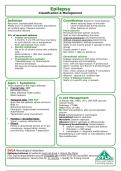
Epilepsy
Classification & Management
Definition Classification (based on 3 key features)
Recurrent, unpredictable seizures Where seizures begin in the brain
Mostly occur in isolation, but some associations Level of awareness during seizure
w/ cerebral palsy, tuberous sclerosis, Other features of seizure
mitochondrial disease Focal seizures
Previously termed ‘partial’ seizures
DDx of recurrent seizures Start on one hemisphere/ one area
Febrile convulsions Impaired awareness LOC/responsiveness
6 months- 5 yrs (3% will have one) Early Without impaired awareness experiencing
in viral infection rise in temperature strange sensations, jerking movements
Brief, generalised, tonic-clonic Starts in one muscle group spreads to other
Alcohol withdrawal groups
Pts w/ Hx of alcohol excess who suddenly Usually awake + alert
stop Non-motor = déjà vu, jamais vu
Peak incidence = 36h post cessation
Benzodiazepines Generalised seizures
Psychogenic/non-epileptic Engage networks on both sides of the brain
‘Pseudoseizures’ no characteristic Consciousness lost immediately
electrical discharges Tonic: stiff and rigid muscles pt falls back
Pts have Hx of mental health/personality Atonic: muscles turn flaccid pt falls forward
disorder Clonic: convulsions
Tonic- clonic: phases of rigidity convulsions
Myoclonic: short muscle twitches
Absence: ‘spaced out’ outward sign
Focal bilateral seizure
Starts in a specific area spreads
Signs + Symptoms
These depend on the region affected:
Frontal lobe ‘JAM’
Jacksonian march
pAlsy (Postictal Todd’s palsy)
Motor features
Ix and Management
Temporal lobe ‘ADD FAT’ Ix Bloods: FBC, U&Es, LFTs, CRP, ESR, glucose,
Aura that the epileptic attack will occur calcium levels
Déjà vu Radiology: CT/MRI
Delusional behaviour Other ECG, LP, EEG
Fear/panic: hippocampal involvement Mx Start anti-epileptics after second epileptic
Automatisms seizure:
Taste/smell: uncal involvement Focal Carbamazepine or Lamotrigine
Generalised Sodium valproate
Parietal + Occipital lobes Myoclonic Sodium valproate
Visual + sensory disturbances Absence Sodium valproate or Ethosuximide
Others Pregnancy/breastfeeding Carbamazepine
Partial or generalised seizure w/ or w/o Sodium valproate = neural tube defects
convulsions, tongue biting, urinary Phenytoin = cleft palate
incontinence, migraines + depression Lamotrigine = congenital malformations
Breastfeeding is safe whilst on anti-epileptics other
than barbiturates
DVLA Neurological disorders
Epilepsy/seizures all patients must not drive + inform the DVLA
First unprovoked/isolated seizure: 6 months off if there is no structural/EEG abnormalities
Established epilepsy: seizure-free for 12 months = qualify for driving license
Classification & Management
Definition Classification (based on 3 key features)
Recurrent, unpredictable seizures Where seizures begin in the brain
Mostly occur in isolation, but some associations Level of awareness during seizure
w/ cerebral palsy, tuberous sclerosis, Other features of seizure
mitochondrial disease Focal seizures
Previously termed ‘partial’ seizures
DDx of recurrent seizures Start on one hemisphere/ one area
Febrile convulsions Impaired awareness LOC/responsiveness
6 months- 5 yrs (3% will have one) Early Without impaired awareness experiencing
in viral infection rise in temperature strange sensations, jerking movements
Brief, generalised, tonic-clonic Starts in one muscle group spreads to other
Alcohol withdrawal groups
Pts w/ Hx of alcohol excess who suddenly Usually awake + alert
stop Non-motor = déjà vu, jamais vu
Peak incidence = 36h post cessation
Benzodiazepines Generalised seizures
Psychogenic/non-epileptic Engage networks on both sides of the brain
‘Pseudoseizures’ no characteristic Consciousness lost immediately
electrical discharges Tonic: stiff and rigid muscles pt falls back
Pts have Hx of mental health/personality Atonic: muscles turn flaccid pt falls forward
disorder Clonic: convulsions
Tonic- clonic: phases of rigidity convulsions
Myoclonic: short muscle twitches
Absence: ‘spaced out’ outward sign
Focal bilateral seizure
Starts in a specific area spreads
Signs + Symptoms
These depend on the region affected:
Frontal lobe ‘JAM’
Jacksonian march
pAlsy (Postictal Todd’s palsy)
Motor features
Ix and Management
Temporal lobe ‘ADD FAT’ Ix Bloods: FBC, U&Es, LFTs, CRP, ESR, glucose,
Aura that the epileptic attack will occur calcium levels
Déjà vu Radiology: CT/MRI
Delusional behaviour Other ECG, LP, EEG
Fear/panic: hippocampal involvement Mx Start anti-epileptics after second epileptic
Automatisms seizure:
Taste/smell: uncal involvement Focal Carbamazepine or Lamotrigine
Generalised Sodium valproate
Parietal + Occipital lobes Myoclonic Sodium valproate
Visual + sensory disturbances Absence Sodium valproate or Ethosuximide
Others Pregnancy/breastfeeding Carbamazepine
Partial or generalised seizure w/ or w/o Sodium valproate = neural tube defects
convulsions, tongue biting, urinary Phenytoin = cleft palate
incontinence, migraines + depression Lamotrigine = congenital malformations
Breastfeeding is safe whilst on anti-epileptics other
than barbiturates
DVLA Neurological disorders
Epilepsy/seizures all patients must not drive + inform the DVLA
First unprovoked/isolated seizure: 6 months off if there is no structural/EEG abnormalities
Established epilepsy: seizure-free for 12 months = qualify for driving license