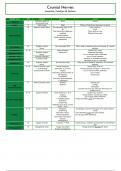
Cranial Nerves
Location, Function & Lesions
Cranial nerve S/M Location Function Lesion
S Cribriform plate of Smell Anosia
I Olfactory
the ethmoid bone
II Optic S Optic canal Sight Different field losses dependent on lesion
M Superior orbital fissue Eye movement (MR, IO, SR, Palsy results in:
IR) Ptosis
Pupil constriction (Sphincter ‘Down and out’ eye
pupillae) Dilated, fixed pupil
III Occulomotor Accommodation
Eyelid opening (Levator
palpebrae)
M Superior orbital Eye movement (SO) Palsy results in defective downward gaze → vertical
IV Trochlear
fissure diplopia
V Trigeminal S+M Facial sensation Lesions may cause:
Superior orbital Mastication Trigeminal neuralgia
Ophthalmic (V1) Loss of corneal reflex (afferent)
fissure
Maxillary (V2) Foramen rotundum Loss of facial sensation
Foramen ovale Paralysis of mastication muscles
Mandibular (V3) Deviation of jaw to weak side
M Superior orbital Eye movement (LR) Palsy results in defective abduction → horizontal
VI Abducens
fissure diplopia
S+ M Internal acoustic canal Facial movement Lesions may result in:
+ exits through Taste (Ant. 2/3 of the Flaccid paralysis of upper + lower face
stylomastoid foramen tongue) Loss of corneal reflex (efferent)
Stapedius, posterior belly of Loss of taste
VII Facial
the digastric Hyperacusis
Lacrimation
Salivation (Submandibular
+ sublingual)
S Internal acoustic canal Hearing Hearing loss
Balance Vertigo
VIII
Nystagmus
Vestibulocochlear
Acoustic neuromas are schwann cell tumours of
cochlear nerve
S+ M Jugular foramen Taste (Posterior 1/3 of Lesions may result in:
tongue) Hypersensitive carotid sinus reflex
+ parotids Loss of gag reflex (afferent)
+ stylopharyngeus Tongue deviation away from the lesion
IX Glossopharyngeal
Salivation
Swallowing
Mediates input from carotid
body + sinus
S+ M Jugular foramen Phonation Dysphagia, recurrent laryngeal nerve palsy (hoarse
Swallowing voice)
Innervates viscera Uvula deviates away from site of lesion
X Vagus (Parasympathetic Loss of gag reflex (efferent)
innervation until splenic
flexure)
Palatoglossal
M Jugular foramen Trapezius + SCM Cannot shrug/ weakness turning head to contralateral
XI Accessory
side
M Hypoglossal canal Tongue movement Tongue deviates towards the lesion
XII Hypoglossal
Except palatoglossal
Location, Function & Lesions
Cranial nerve S/M Location Function Lesion
S Cribriform plate of Smell Anosia
I Olfactory
the ethmoid bone
II Optic S Optic canal Sight Different field losses dependent on lesion
M Superior orbital fissue Eye movement (MR, IO, SR, Palsy results in:
IR) Ptosis
Pupil constriction (Sphincter ‘Down and out’ eye
pupillae) Dilated, fixed pupil
III Occulomotor Accommodation
Eyelid opening (Levator
palpebrae)
M Superior orbital Eye movement (SO) Palsy results in defective downward gaze → vertical
IV Trochlear
fissure diplopia
V Trigeminal S+M Facial sensation Lesions may cause:
Superior orbital Mastication Trigeminal neuralgia
Ophthalmic (V1) Loss of corneal reflex (afferent)
fissure
Maxillary (V2) Foramen rotundum Loss of facial sensation
Foramen ovale Paralysis of mastication muscles
Mandibular (V3) Deviation of jaw to weak side
M Superior orbital Eye movement (LR) Palsy results in defective abduction → horizontal
VI Abducens
fissure diplopia
S+ M Internal acoustic canal Facial movement Lesions may result in:
+ exits through Taste (Ant. 2/3 of the Flaccid paralysis of upper + lower face
stylomastoid foramen tongue) Loss of corneal reflex (efferent)
Stapedius, posterior belly of Loss of taste
VII Facial
the digastric Hyperacusis
Lacrimation
Salivation (Submandibular
+ sublingual)
S Internal acoustic canal Hearing Hearing loss
Balance Vertigo
VIII
Nystagmus
Vestibulocochlear
Acoustic neuromas are schwann cell tumours of
cochlear nerve
S+ M Jugular foramen Taste (Posterior 1/3 of Lesions may result in:
tongue) Hypersensitive carotid sinus reflex
+ parotids Loss of gag reflex (afferent)
+ stylopharyngeus Tongue deviation away from the lesion
IX Glossopharyngeal
Salivation
Swallowing
Mediates input from carotid
body + sinus
S+ M Jugular foramen Phonation Dysphagia, recurrent laryngeal nerve palsy (hoarse
Swallowing voice)
Innervates viscera Uvula deviates away from site of lesion
X Vagus (Parasympathetic Loss of gag reflex (efferent)
innervation until splenic
flexure)
Palatoglossal
M Jugular foramen Trapezius + SCM Cannot shrug/ weakness turning head to contralateral
XI Accessory
side
M Hypoglossal canal Tongue movement Tongue deviates towards the lesion
XII Hypoglossal
Except palatoglossal