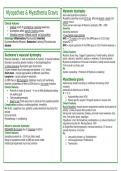
Myopathies & Myasthenia Gravis Myotonic dystrophy
Also called dystrophia myotonica
Myopathy presenting around 20-30 yrs, affecting skeletal, smooth and
cardiac muscle
Clinical features There are two main types of Myotonic dystrophy: DM1 + DM2
Gradual onset of symmetrical, proximal weakness Genetics
Dystrophies affect specific muscles groups Autosomal dominant
Sensation normal, reflexes normal, no fasciculation A trinucleotide repeat disorder
Aetiology Inflammatory Polymyositis Inherited DM1 = CTG repeat at the end of the DMPK gene on Ch19: Distal
Duchenne/Becker/Myotonic Endocrine Cushing’s/Thyrotoxicosis weakness ++
Alcohol DM2 = repeat expansion of the ZNF9 gene on Ch3: Proximal weakness +
+
Clinical features
Duchenne’s muscular dystrophy Myotonic facies (long, ‘haggard’ appearance), frontal balding, bilateral
Muscular dystrophy = ‘bad nourishment of muscles’ muscle tiredness ptosis, cataracts, dysarthria, wasting + weakness of sternomastoids
Disorders caused by genetic mutation Dystrophinopathies Myotonia is persistence of muscular contraction, lasting several seconds
X- linked recessive (Dystrophin gene found here) if the muscle is actively used
CK gets released due to damaged sarcolemma + Ca2+ enters Mx
Short-term – muscle regeneration of different sized fibres Genetic counselling + Phenytoin (If Myotonia is disabling)
Long-term – muscle atrophy weakness
In DMD there is NO Dystrophin (stabilises muscle cell membrane, Myasthenia gravis
attaches cytoskeleton of fibre to ECM) due to a non-sense mutation Autoimmune disorder resulting in insufficient functioning of ACh
Clinical features receptors
Presents in males @ around ~ 4 yrs w/ difficult/delayed walking - Antibodies to AChR found in 85-90%
toe walking gait M : F (1:2)
Calf pseudohypertrophy 1. Autoantibodies block AChR
Gower’s sign Child uses arms to stand up from squatted position 2. Muscle-specific receptor TK targets proteins in muscle cells
Clinical features:
Complications scoliosis, cardiomyopathies, immobility
Muscle fatigability muscles become progressively weaker during period of
Mx No Rx- supportive care, patients usually wheelchair bound by first
activity + slowly improve after periods of rest
decade
Extraocular muscle weakness: diplopia, proximal muscle weakness: face,
Glucocorticoids neck, limb girdle, ptosis, dysphagia
Physiotherapy + conditioning ‘Myasthenic crisis’ life threatening manifestation e.g. reduced function of
respiratory muscles (Rx: Plasmopheresis, IVIG)
Becker’s muscular dystrophy Ix Single-fibre electromyography: Increased sensitivity, CT thorax to
MISSHAPEN Dystrophin due to missense mutation exclude thymoma, CK normal
Clinical features Mx
Symptoms present @ ~ 10-20 yrs (later onset) 1. Long-acting Achase e.g. Pyridostigmine
Range of symptoms similar to DMD but much milder 2. Immunosuppression: Prednisolone
Intellectual impairment much less common 3. Thymectomy
Also called dystrophia myotonica
Myopathy presenting around 20-30 yrs, affecting skeletal, smooth and
cardiac muscle
Clinical features There are two main types of Myotonic dystrophy: DM1 + DM2
Gradual onset of symmetrical, proximal weakness Genetics
Dystrophies affect specific muscles groups Autosomal dominant
Sensation normal, reflexes normal, no fasciculation A trinucleotide repeat disorder
Aetiology Inflammatory Polymyositis Inherited DM1 = CTG repeat at the end of the DMPK gene on Ch19: Distal
Duchenne/Becker/Myotonic Endocrine Cushing’s/Thyrotoxicosis weakness ++
Alcohol DM2 = repeat expansion of the ZNF9 gene on Ch3: Proximal weakness +
+
Clinical features
Duchenne’s muscular dystrophy Myotonic facies (long, ‘haggard’ appearance), frontal balding, bilateral
Muscular dystrophy = ‘bad nourishment of muscles’ muscle tiredness ptosis, cataracts, dysarthria, wasting + weakness of sternomastoids
Disorders caused by genetic mutation Dystrophinopathies Myotonia is persistence of muscular contraction, lasting several seconds
X- linked recessive (Dystrophin gene found here) if the muscle is actively used
CK gets released due to damaged sarcolemma + Ca2+ enters Mx
Short-term – muscle regeneration of different sized fibres Genetic counselling + Phenytoin (If Myotonia is disabling)
Long-term – muscle atrophy weakness
In DMD there is NO Dystrophin (stabilises muscle cell membrane, Myasthenia gravis
attaches cytoskeleton of fibre to ECM) due to a non-sense mutation Autoimmune disorder resulting in insufficient functioning of ACh
Clinical features receptors
Presents in males @ around ~ 4 yrs w/ difficult/delayed walking - Antibodies to AChR found in 85-90%
toe walking gait M : F (1:2)
Calf pseudohypertrophy 1. Autoantibodies block AChR
Gower’s sign Child uses arms to stand up from squatted position 2. Muscle-specific receptor TK targets proteins in muscle cells
Clinical features:
Complications scoliosis, cardiomyopathies, immobility
Muscle fatigability muscles become progressively weaker during period of
Mx No Rx- supportive care, patients usually wheelchair bound by first
activity + slowly improve after periods of rest
decade
Extraocular muscle weakness: diplopia, proximal muscle weakness: face,
Glucocorticoids neck, limb girdle, ptosis, dysphagia
Physiotherapy + conditioning ‘Myasthenic crisis’ life threatening manifestation e.g. reduced function of
respiratory muscles (Rx: Plasmopheresis, IVIG)
Becker’s muscular dystrophy Ix Single-fibre electromyography: Increased sensitivity, CT thorax to
MISSHAPEN Dystrophin due to missense mutation exclude thymoma, CK normal
Clinical features Mx
Symptoms present @ ~ 10-20 yrs (later onset) 1. Long-acting Achase e.g. Pyridostigmine
Range of symptoms similar to DMD but much milder 2. Immunosuppression: Prednisolone
Intellectual impairment much less common 3. Thymectomy