1
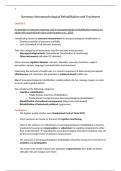
Summary Neuropsychological Rehabilitation and Treatment
Lecture 1
An overview of outcome measures used in neuropsychological rehabilitation research on
adults with acquired brain injury (Van Heugten et al., 2020)
Complicating factor for outcome measurement in neuropsychological rehabilitation is:
- Enormous number of measures available
- Lack of standard set of outcome measures
Two main categories of instruments used for outcome measurement:
- Neuropsychological tests (International Classification of Functioning)
- Other instruments (all other ICF domains)
Most common cognitive domains: memory, attention, executive functions, neglect,
perception, apraxia, language/communication and awareness
Measuring the outcome of health care is a central component of determining therapeutic
effectiveness and, therefore, the provision of evidence-based health care
Aim of neuropsychological rehabilitation: enable patients to live, manage, bypass or come
to terms with cognitive deficits
We considered the following categories:
- Cognitive rehabilitation
o Single domain (memory rehabilitation)
o Multi-domain (comprehensive neuropsychological rehabilitation)
- Rehabilitation of emotional consequences (depression and anxiety)
- Rehabilitation of behavioral problems (aggression)
Conclusions:
- The highest quality studies were Randomized Control Trials (RCT)
- Most measures are found on the level of cognitive functioning
- Most of the evidence on effectiveness of neuropsychological rehabilitation is found in
treatments focusing on compensation or adjustment to cognitive impairments rather
than restoring them repeating the neuropsychological tests after treatment may not
be the most evident form of outcome measurement
- The outcome of (neuropsychological) rehabilitation should be measures on the level of
activities and participation
- The instrument should at least have adequate responsiveness (the ability to detect
clinically relevant changes over time)
,2
Evidence-Based Cognitive Rehabilitation: Systematic Review of the Literature From 2009
Through 2014 (Cicerone et al., 2019)
Evidence supports Practice Standards for:
1. Attention deficits after TBI or stroke
2. Visual scanning for neglect after right-hemisphere stroke
3. Compensatory strategies for mild memory deficits
4. Language deficits after left-hemisphere stroke
5. Social communication deficits after TBI
6. Metacognitive strategy training for deficits in executive functioning
7. Comprehensive-holistic neuropsychological rehabilitation to reduce cognitive and
functional disability after TBI or stroke
Six possible categories that specifically address the rehabilitation of cognitive disability
- Subject characteristics (age, education, gender, severity injury, time postinjury etc)
- Treatment characteristics (setting, target behavior, nature of treatment etc)
- Methods of monitoring and analyzing change (change on dependent variable over
treatment course, rating related to target behaviors, change on functional measures)
- Maintenance of treatment effects
- Statistical analyses performed
- Evidence of treatment effectiveness (improvement on cognitive function being
assessed, evidence for generalized improvement on functional outcomes)
Conclusions:
- Trend toward increased specificity of interventions within the broad domains of
functioning efforts to specify the active ingredients of rehabilitation treatments
- Trend toward the incorporation of interventions for emotional regulation within
cognitive rehabilitation a central tenet of holistic neuropsychological rehabilitation
- Computer-based direct-attention training for modular impairments in WM can
improve specific cognitive functions and generalize to improved subjective complaints
- A combination of individual and group-based treatment may increase effectiveness
- Limited evidence regarding patient characteristics that influence treatment
effectiveness
- Various cognitive rehabilitation interventions can be effectively tailored to individuals
across levels of injury severity and of neurocognitive impairment
- Cognitive rehabilitation should always be directed toward improving everyday
functioning and should include active attempts to promote generalization or directly
apply compensatory strategies to functional contexts
- Increased emphasis on functional patient-centered outcomes (from cognitive domain
to patient functioning)
,3
INCOG 2.0 Guidelines for Cognitive Rehabilitation Following Traumatic Brain Injury, Part IV:
Cognitive-Communication and Social Cognition Disorders (Togher et al., 2023)
Moderate to severe TBI causes significant cognitive impairments, including impairments in:
- social cogntion
- the ability to recognize other’s emotions
- infer others’ thoughts
Traumatic Brain Injury (TBI) often causes cognitive impairments that effect communication
functions, resulting in Cognitive communication disorder
- Social cognition is central to cognitive-communication disorders
- Can have negative effects on psychosocial outcomes (employment, school, friends etc)
Cognitive-communication disorders should be individualized, goal- and outcome-oriented,
and appropriate to the context in which the person lives and incorporate social
communication and communication partner training
Group therapy and telerehabilitation are recommended to improve social communication
Over 70% of people experience some level of communication disability as a result of TBI
Severe communication disability Augmentative and Alternative Communication (AAC)
Signs and symptoms of communication difficulties
- Impoverished communication (flat-affect, word-finding difficulty etc)
- Excessive talkativeness
- Tangential topic production
- Domination of talking time in conversations
- Repetitiveness
Social cognition is both cognitive and affective and includes: Theory of mind (ToM),
emotion perception and emotional empathy
People with TBI have been described as egocentric in their communication, unresponsive of
social cues, missing implied meanings, being overly familiar with acquaintances, and
violating social conventions like norms for interpersonal space
Changes to communication ability become evident as soon as the person emerges from
coma, during the period of posttraumatic amnesia (PTA)
Model of cognitive-communication competence
1. Individual domain
2. Contextual domain
3. Environmental domain
4. Cognitive domain
5. Communication domain
6. Physical/sensory domain
7. Emotional/psychosocial domain
, 4
Conclusions:
- Important ingredients in social communication interventions that aim to improve skills
or establish new communication strategies:
o Behavioral shaping
o Feedback
o Modelling
o Use of multiple exemplars to promote generalization
o Opportunities for high-dose practice
- 3 considerations when designing communication interventions
1. Voluntary participation intervention should be based on client ability and need,
client awareness, motivation and engagement
2. Important to promote and measure accuracy, efficiency and stability of
performance
3. Generalization will be facilitated by using context-sensitive treatment
- A person’s cognitive communication ability should not be evaluated and treated as an
isolated skill but should be viewed within the broader context of the person’s
everyday communication needs
- Evidence for rehabilitation of cognitive-communication disorders, particularly social
interactions, communication partner training (both in person and via telehealth
delivery) and group interventions to improve cognitive communication disorders
- Evidence is emerging for rehabilitation of social cognition but impact on participation
outcomes needs further research
Summary Neuropsychological Rehabilitation and Treatment
Lecture 1
An overview of outcome measures used in neuropsychological rehabilitation research on
adults with acquired brain injury (Van Heugten et al., 2020)
Complicating factor for outcome measurement in neuropsychological rehabilitation is:
- Enormous number of measures available
- Lack of standard set of outcome measures
Two main categories of instruments used for outcome measurement:
- Neuropsychological tests (International Classification of Functioning)
- Other instruments (all other ICF domains)
Most common cognitive domains: memory, attention, executive functions, neglect,
perception, apraxia, language/communication and awareness
Measuring the outcome of health care is a central component of determining therapeutic
effectiveness and, therefore, the provision of evidence-based health care
Aim of neuropsychological rehabilitation: enable patients to live, manage, bypass or come
to terms with cognitive deficits
We considered the following categories:
- Cognitive rehabilitation
o Single domain (memory rehabilitation)
o Multi-domain (comprehensive neuropsychological rehabilitation)
- Rehabilitation of emotional consequences (depression and anxiety)
- Rehabilitation of behavioral problems (aggression)
Conclusions:
- The highest quality studies were Randomized Control Trials (RCT)
- Most measures are found on the level of cognitive functioning
- Most of the evidence on effectiveness of neuropsychological rehabilitation is found in
treatments focusing on compensation or adjustment to cognitive impairments rather
than restoring them repeating the neuropsychological tests after treatment may not
be the most evident form of outcome measurement
- The outcome of (neuropsychological) rehabilitation should be measures on the level of
activities and participation
- The instrument should at least have adequate responsiveness (the ability to detect
clinically relevant changes over time)
,2
Evidence-Based Cognitive Rehabilitation: Systematic Review of the Literature From 2009
Through 2014 (Cicerone et al., 2019)
Evidence supports Practice Standards for:
1. Attention deficits after TBI or stroke
2. Visual scanning for neglect after right-hemisphere stroke
3. Compensatory strategies for mild memory deficits
4. Language deficits after left-hemisphere stroke
5. Social communication deficits after TBI
6. Metacognitive strategy training for deficits in executive functioning
7. Comprehensive-holistic neuropsychological rehabilitation to reduce cognitive and
functional disability after TBI or stroke
Six possible categories that specifically address the rehabilitation of cognitive disability
- Subject characteristics (age, education, gender, severity injury, time postinjury etc)
- Treatment characteristics (setting, target behavior, nature of treatment etc)
- Methods of monitoring and analyzing change (change on dependent variable over
treatment course, rating related to target behaviors, change on functional measures)
- Maintenance of treatment effects
- Statistical analyses performed
- Evidence of treatment effectiveness (improvement on cognitive function being
assessed, evidence for generalized improvement on functional outcomes)
Conclusions:
- Trend toward increased specificity of interventions within the broad domains of
functioning efforts to specify the active ingredients of rehabilitation treatments
- Trend toward the incorporation of interventions for emotional regulation within
cognitive rehabilitation a central tenet of holistic neuropsychological rehabilitation
- Computer-based direct-attention training for modular impairments in WM can
improve specific cognitive functions and generalize to improved subjective complaints
- A combination of individual and group-based treatment may increase effectiveness
- Limited evidence regarding patient characteristics that influence treatment
effectiveness
- Various cognitive rehabilitation interventions can be effectively tailored to individuals
across levels of injury severity and of neurocognitive impairment
- Cognitive rehabilitation should always be directed toward improving everyday
functioning and should include active attempts to promote generalization or directly
apply compensatory strategies to functional contexts
- Increased emphasis on functional patient-centered outcomes (from cognitive domain
to patient functioning)
,3
INCOG 2.0 Guidelines for Cognitive Rehabilitation Following Traumatic Brain Injury, Part IV:
Cognitive-Communication and Social Cognition Disorders (Togher et al., 2023)
Moderate to severe TBI causes significant cognitive impairments, including impairments in:
- social cogntion
- the ability to recognize other’s emotions
- infer others’ thoughts
Traumatic Brain Injury (TBI) often causes cognitive impairments that effect communication
functions, resulting in Cognitive communication disorder
- Social cognition is central to cognitive-communication disorders
- Can have negative effects on psychosocial outcomes (employment, school, friends etc)
Cognitive-communication disorders should be individualized, goal- and outcome-oriented,
and appropriate to the context in which the person lives and incorporate social
communication and communication partner training
Group therapy and telerehabilitation are recommended to improve social communication
Over 70% of people experience some level of communication disability as a result of TBI
Severe communication disability Augmentative and Alternative Communication (AAC)
Signs and symptoms of communication difficulties
- Impoverished communication (flat-affect, word-finding difficulty etc)
- Excessive talkativeness
- Tangential topic production
- Domination of talking time in conversations
- Repetitiveness
Social cognition is both cognitive and affective and includes: Theory of mind (ToM),
emotion perception and emotional empathy
People with TBI have been described as egocentric in their communication, unresponsive of
social cues, missing implied meanings, being overly familiar with acquaintances, and
violating social conventions like norms for interpersonal space
Changes to communication ability become evident as soon as the person emerges from
coma, during the period of posttraumatic amnesia (PTA)
Model of cognitive-communication competence
1. Individual domain
2. Contextual domain
3. Environmental domain
4. Cognitive domain
5. Communication domain
6. Physical/sensory domain
7. Emotional/psychosocial domain
, 4
Conclusions:
- Important ingredients in social communication interventions that aim to improve skills
or establish new communication strategies:
o Behavioral shaping
o Feedback
o Modelling
o Use of multiple exemplars to promote generalization
o Opportunities for high-dose practice
- 3 considerations when designing communication interventions
1. Voluntary participation intervention should be based on client ability and need,
client awareness, motivation and engagement
2. Important to promote and measure accuracy, efficiency and stability of
performance
3. Generalization will be facilitated by using context-sensitive treatment
- A person’s cognitive communication ability should not be evaluated and treated as an
isolated skill but should be viewed within the broader context of the person’s
everyday communication needs
- Evidence for rehabilitation of cognitive-communication disorders, particularly social
interactions, communication partner training (both in person and via telehealth
delivery) and group interventions to improve cognitive communication disorders
- Evidence is emerging for rehabilitation of social cognition but impact on participation
outcomes needs further research