THEME 3
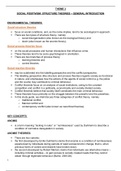
SOCIAL POSITIVISM: STRUCTURE THEORIES – GENERAL INTRODUCTION
ENVIRONMENTAL THEORIES:
Social-structure theories
focus on social conditions, and, as the name implies, tend to be sociological in approach.
There are two types of structure theory, namely
o social disorganisation (also known as the ecological theory) and
o strain (also known as the anomie theory).
Social-process theories focus
on the social processes and human interactions that influence crime.
These theories tend to be socio-psychological in orientation.
There are two branches of process theory:
o learning theories and
o control theories.
Social-reaction theories
may be subdivided into the labelling perspective and the conflict perspective.
The labelling perspective (like structure and process theories) regards society as functional
in nature, and emphasises how the actions of the agents of social control (e.g. the police
and the courts) may contribute to criminal behaviour.
Conflict theorists focus on an analysis of social institutions, owing to the constant
competition and conflict in a politically, economically and socially divided society.
Conflict theorists believe that society itself constitutes the main criminal behaviour.
These theorists focus primarily on the struggle between the powerful and the powerless.
In this study guide, we shall discuss three categories of conflict theory, namely
o traditional conflict,
o Marxist conflict and
o contemporary conflict (also known as neocritical theories).
KEY CONCEPTS
ANOMIE
is a term meaning ‘‘lacking in rules’’ or ‘‘normlessness’’ used by Durkheim to describe a
condition of normative deregulation in society.
ANOMIE THEORIES:
There are two variants:
the first (developed by Emile Durkheim) claims that anomie is a condition of normlessness
experienced by individuals during periods of rapid socioeconomic change, that is, when
previous forms of control and restraint have broken down;
the second (developed by Robert Merton) claims that individuals use alternative means –
including criminal activities – to gain access to socially created needs that they cannot
obtain through legitimate behaviour (Burke, 2005:28).
1
,CARTOGRAPHIC SCHOOL OF CRIMINOLOGY
is an approach that uses the social statistics that started becoming available in Europe in
the early ninth century: these statistics provided important demographic information on the
population, including density, gender, religious affiliations, and wealth.
Many of the relationships between crime and social phenomena identified then still serve as
a basis for criminology today (Siegel, 2004:472).
CHICAGO SCHOOL
is a group of urban sociologists who studied the relationship between environmental
conditions and crime (Siegel, 2004:472).
CULTURAL TRANSMISSION
is the concept that conduct norms are passed down from one generation to the next so that
they become stable within the boundaries of a culture.
Cultural transmission guarantees that group lifestyle and behaviour are stable and
predictable (Siegel, 2004:474).
CULTURALLY DEFINED GOALS
refer to the set of purposes and interests a culture defines as legitimate for individuals, in
Robert Merton’s version of strain theory (Bartollas, 2006:538).
INSTITUTIONALISED MEANS
refer to culturally sanctioned methods ofattaining individual goals in Robert Merton’s theory
(Bartollas, 2006:540).
MECHANICAL SOLIDARITY
is a form of social solidarity existing in small, isolated, pre-industrial societies in which individuals
sharing common experiences and circumstances share values, unquestioned beliefs and strong
emotional ties (Walsh & Hemmens, 2008:23; Siegel, 2004:478).
MODES OF ADAPTATION
is Robert Merton’s concept of how people adapt to the alleged disjunction between cultural
goals and the structural barriers that hinder the attainment of these goals.
Methods of attaining cultural goals include conformity, ritualism, innovation, retreatism and
rebellion (Walsh & Hemmens, 2008:23).
ORGANIC SOLIDARITY
is a form of social solidarity characteristic of modern societies, in which there is a high degree of
occupational specialisation and a weak normative consensus (Walsh & Hemmens, 2008:23).
SOCIAL DISORGANISATION
is the central concept of the Chicago School of Social Ecology.
The term refers to the breakdown or serious dilution of the power of informal community
rules to regulate conduct in poor neighbourhoods (Walsh & Hemmens, 2008:23). SOCIAL
DISORGANISATION THEORY is a branch of social structure theory
2
, developed by Shaw and McKay that focuses on the breakdown of institutions such as the
family and the school, coupled with high unemployment in inner-city neighbourhoods
(Siegel, 2004:482; Bartollas, 2006:543).
SOCIAL ECOLOGY
is the term used by the Chicago School to describe the interrelationships of human beings
and the communities in which they live.
Social ecology encapsulates the environmental forces that have a direct influence on
human behaviour (Walsh & Hemmens, 2008:23; Siegel, 2004:482).
SOCIAL STRUCTURE
refers to how society is organised by social institutions –the family and educational,
religious, economic, and political institutions – and stratified on the basis of various roles
and statuses (Walsh & Hemmens, 2008:23).
SOCIAL STRUCTURE THEORY
refers to the view that disadvantaged economic class position is a primary cause of crime
(Siegel, 2004:482).
STRAIN
is the emotional turmoil and conflict caused when people believe they cannot achieve their
desires and goals through legitimate means.
Members of the lower-class will feel strain because they are denied access to adequate
educational opportunities and social support (Siegel, 2004:482).
STRAIN THEORISTS
refer to criminologists who view crime as a direct result of lower-class frustration and anger
(Siegel, 2004:482).
STRAIN THEORY
is a branch of social structure theory that claims that the pressure that the social structure
exerts on people who cannot attain the cultural goal of success will encourage them to
engage in nonconforming behaviour (Bartollas, 2006:544).
3
SOCIAL POSITIVISM: STRUCTURE THEORIES – GENERAL INTRODUCTION
ENVIRONMENTAL THEORIES:
Social-structure theories
focus on social conditions, and, as the name implies, tend to be sociological in approach.
There are two types of structure theory, namely
o social disorganisation (also known as the ecological theory) and
o strain (also known as the anomie theory).
Social-process theories focus
on the social processes and human interactions that influence crime.
These theories tend to be socio-psychological in orientation.
There are two branches of process theory:
o learning theories and
o control theories.
Social-reaction theories
may be subdivided into the labelling perspective and the conflict perspective.
The labelling perspective (like structure and process theories) regards society as functional
in nature, and emphasises how the actions of the agents of social control (e.g. the police
and the courts) may contribute to criminal behaviour.
Conflict theorists focus on an analysis of social institutions, owing to the constant
competition and conflict in a politically, economically and socially divided society.
Conflict theorists believe that society itself constitutes the main criminal behaviour.
These theorists focus primarily on the struggle between the powerful and the powerless.
In this study guide, we shall discuss three categories of conflict theory, namely
o traditional conflict,
o Marxist conflict and
o contemporary conflict (also known as neocritical theories).
KEY CONCEPTS
ANOMIE
is a term meaning ‘‘lacking in rules’’ or ‘‘normlessness’’ used by Durkheim to describe a
condition of normative deregulation in society.
ANOMIE THEORIES:
There are two variants:
the first (developed by Emile Durkheim) claims that anomie is a condition of normlessness
experienced by individuals during periods of rapid socioeconomic change, that is, when
previous forms of control and restraint have broken down;
the second (developed by Robert Merton) claims that individuals use alternative means –
including criminal activities – to gain access to socially created needs that they cannot
obtain through legitimate behaviour (Burke, 2005:28).
1
,CARTOGRAPHIC SCHOOL OF CRIMINOLOGY
is an approach that uses the social statistics that started becoming available in Europe in
the early ninth century: these statistics provided important demographic information on the
population, including density, gender, religious affiliations, and wealth.
Many of the relationships between crime and social phenomena identified then still serve as
a basis for criminology today (Siegel, 2004:472).
CHICAGO SCHOOL
is a group of urban sociologists who studied the relationship between environmental
conditions and crime (Siegel, 2004:472).
CULTURAL TRANSMISSION
is the concept that conduct norms are passed down from one generation to the next so that
they become stable within the boundaries of a culture.
Cultural transmission guarantees that group lifestyle and behaviour are stable and
predictable (Siegel, 2004:474).
CULTURALLY DEFINED GOALS
refer to the set of purposes and interests a culture defines as legitimate for individuals, in
Robert Merton’s version of strain theory (Bartollas, 2006:538).
INSTITUTIONALISED MEANS
refer to culturally sanctioned methods ofattaining individual goals in Robert Merton’s theory
(Bartollas, 2006:540).
MECHANICAL SOLIDARITY
is a form of social solidarity existing in small, isolated, pre-industrial societies in which individuals
sharing common experiences and circumstances share values, unquestioned beliefs and strong
emotional ties (Walsh & Hemmens, 2008:23; Siegel, 2004:478).
MODES OF ADAPTATION
is Robert Merton’s concept of how people adapt to the alleged disjunction between cultural
goals and the structural barriers that hinder the attainment of these goals.
Methods of attaining cultural goals include conformity, ritualism, innovation, retreatism and
rebellion (Walsh & Hemmens, 2008:23).
ORGANIC SOLIDARITY
is a form of social solidarity characteristic of modern societies, in which there is a high degree of
occupational specialisation and a weak normative consensus (Walsh & Hemmens, 2008:23).
SOCIAL DISORGANISATION
is the central concept of the Chicago School of Social Ecology.
The term refers to the breakdown or serious dilution of the power of informal community
rules to regulate conduct in poor neighbourhoods (Walsh & Hemmens, 2008:23). SOCIAL
DISORGANISATION THEORY is a branch of social structure theory
2
, developed by Shaw and McKay that focuses on the breakdown of institutions such as the
family and the school, coupled with high unemployment in inner-city neighbourhoods
(Siegel, 2004:482; Bartollas, 2006:543).
SOCIAL ECOLOGY
is the term used by the Chicago School to describe the interrelationships of human beings
and the communities in which they live.
Social ecology encapsulates the environmental forces that have a direct influence on
human behaviour (Walsh & Hemmens, 2008:23; Siegel, 2004:482).
SOCIAL STRUCTURE
refers to how society is organised by social institutions –the family and educational,
religious, economic, and political institutions – and stratified on the basis of various roles
and statuses (Walsh & Hemmens, 2008:23).
SOCIAL STRUCTURE THEORY
refers to the view that disadvantaged economic class position is a primary cause of crime
(Siegel, 2004:482).
STRAIN
is the emotional turmoil and conflict caused when people believe they cannot achieve their
desires and goals through legitimate means.
Members of the lower-class will feel strain because they are denied access to adequate
educational opportunities and social support (Siegel, 2004:482).
STRAIN THEORISTS
refer to criminologists who view crime as a direct result of lower-class frustration and anger
(Siegel, 2004:482).
STRAIN THEORY
is a branch of social structure theory that claims that the pressure that the social structure
exerts on people who cannot attain the cultural goal of success will encourage them to
engage in nonconforming behaviour (Bartollas, 2006:544).
3