AC2.1 Explain the forms of social control
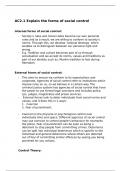
Internal forms of social control:
- Society’s rules and moral codes become our own personal
rules and as a result, we are willing to conform to society’s
norms. Through this, we develop ‘rational ideology’ which
enables us to distinguish between our personal right and
wrong.
- E.g. Tradition and culture becomes part of us through
socialisation and we accept its norms, values and traditions as
part of our identity such as, Muslim tradition to fast during
Ramadan.
External forms of social control:
- This aims to ensure we conform to its expectations and
cooperate. Agencies of social control refer to institutions which
impose rules on us, so we behave in a certain way. The
criminal justice system has agencies of social control that have
the power to use formal legal sanctions and includes police,
cps, judges, magistrates and prison services.
- External forces look to deter individuals from social norms and
values, and it does this in 2 ways:
1. Coercion
2. Fear of punishment.
- Coercion is the physical or psychological control over
individuals time and space. Different agencies of social control
may use coercion to control people’s behaviour for examples
the police. Fear of punishment can be seen as being a
deterrent to stop people from committing crimes. Deterrence
can be split into individual deterrence which is specific to the
individual and general deterrence where others are deterred
out of fear of committing similar offences by seeing you being
punished for you actions.
Control Theory:
Internal forms of social control:
- Society’s rules and moral codes become our own personal
rules and as a result, we are willing to conform to society’s
norms. Through this, we develop ‘rational ideology’ which
enables us to distinguish between our personal right and
wrong.
- E.g. Tradition and culture becomes part of us through
socialisation and we accept its norms, values and traditions as
part of our identity such as, Muslim tradition to fast during
Ramadan.
External forms of social control:
- This aims to ensure we conform to its expectations and
cooperate. Agencies of social control refer to institutions which
impose rules on us, so we behave in a certain way. The
criminal justice system has agencies of social control that have
the power to use formal legal sanctions and includes police,
cps, judges, magistrates and prison services.
- External forces look to deter individuals from social norms and
values, and it does this in 2 ways:
1. Coercion
2. Fear of punishment.
- Coercion is the physical or psychological control over
individuals time and space. Different agencies of social control
may use coercion to control people’s behaviour for examples
the police. Fear of punishment can be seen as being a
deterrent to stop people from committing crimes. Deterrence
can be split into individual deterrence which is specific to the
individual and general deterrence where others are deterred
out of fear of committing similar offences by seeing you being
punished for you actions.
Control Theory: