U of S Bio 120 Questions And Answers Rated A+
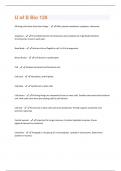
All living cells share these four things. - DNA, plasma membrane, cytoplasm, ribosomes Anaphase - Chromatids become chromosomes and complete set of gentically identical chromosomes move to each pole. Basal body - Anchors cilia or flagella to cell. In 9×3 arrangement. Binary fission - Cell division in prokaryotes Cell - Smallest structural and functional unit Cell cycle - Interphase, and M phase. Cell plate - Cytokinesis in plant cells Cell theory - All living things are composed of one or more cells. Smallest structural and functional unit. New cells come from pre-existing cells by cell division Cell wall - Found only in plant cells and some prokaryote. Provide support, protection and prevents rupturing. Central vacuole - Important for turgor pressure. Contains hydrolytic enzymes. Stores pigments/poison for protection Centrioles - Arranged in nine group of 3 microtubules. Located in Centrosome. Determines position of nucleus.Centromere - Chromatids are held together in the middle by this. Covered by kinetochore proteins Chloroplast - Green pigment called chlorophyll. Site of photosynthesis Chromatid - Chromosomes consist of two sister ________? Chromatin - Collection of eukaryotic DNA molecules with their proteins. In relaxed state
Written for
- Institution
- U of S Bio 120
- Course
- U of S Bio 120
Document information
- Uploaded on
- June 17, 2024
- Number of pages
- 7
- Written in
- 2023/2024
- Type
- Exam (elaborations)
- Contains
- Questions & answers
Subjects

Also available in package deal