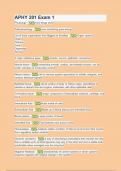
APHY 201 Exam 1
Physiology - ✅✅-how things work
Pathophysiology - ✅✅-how something goes wrong
List of body organization from Biggest to Smallest - ✅✅-Organ system
Organ
Tissues
Cells
Organelles
Atoms
4 major cell/tissue types - ✅✅-muscle, neuron, epithelial, connective
Muscle tissue - ✅✅ -comprising smooth, cardiac, and skeletal muscle; can be
under voluntary or involuntary control
Neuron tissue - ✅✅ -cell in nervous system specialized to initiate, integrate, and
conduct electrical signals
Epithelial tissue - ✅✅ -cell at surface of body or hollow organ; specialized to
secrete or absorb ions and organic molecules; with other epithelial cells
Connective tissue - ✅✅-major component of extracellular matrices, cartilage, and
bone
Intracellular fluid - ✅✅-fluids inside of cells
Extracellular fluid - ✅✅-Made up of blood plasma and interstitial fluid
Blood plasma - ✅✅-Liquid portion of blood
Interstitial fluid - ✅✅-Fluid between and around cells
Homeostasis - ✅✅-relatively stable condition of internal environment that results
from regulatory system actions
Dynamic constancy - ✅✅ -a way of describing homeostasis that includes the idea
that a variable such as blood glucose may vary in the short term but is stable and
predictable when averaged over the long term
Negative feedback - ✅✅
-characteristic of control systems in which system's
response opposes the original change in the system
, Positive feedback - ✅✅ -characteristic of control systems in which an initial
disturbance sets off train of events that increases the disturbance even further. ie
change perpetuates change
Atom - ✅✅ -mallest unit of matter that has unique chemical characteristics; has no
net charge; combines with other atoms to form chemical substances
Atomic number - ✅✅-# of protons
Atomic mass - ✅✅-# of protons + neutrons
Element - ✅✅-Atoms that are the same joined together
Proton - ✅✅-Positive charge
Neutron - ✅✅-Neutral charge
Electron - ✅✅-Negative charge
Atomic nucleus - ✅✅-Area of protons and neutrons in the center of an atom
Ion - ✅✅-atom or small molecule containing unequal number of electrons and
protons and therefore carrying a net positive or negative electrical charge
4 major elements in the human body - ✅✅-Hydrogen, Oxygen, Carbon and
Nitrogen
Molecule -✅✅-chemical substance formed by linking atoms together
Covalent bond - ✅✅-chemical bond between two atoms in which each atom
shares one of its electrons with the other
Polar covalent bond - ✅✅ -covalent bond in which two electrons are shared
unequally between two atoms of different electronegativities; atom to which the
electrons are drawn becomes slightly negative, while other atom becomes slightly
positive; also called polar bond
Polar molecule - ✅✅ -pertaining to molecule or region of molecule containing polar
covalent bonds or ionized groups; part of molecule to which electrons are drawn
becomes slightly negative, and region from which electrons are drawn becomes
slightly positive; molecule is soluble in water
Physiology - ✅✅-how things work
Pathophysiology - ✅✅-how something goes wrong
List of body organization from Biggest to Smallest - ✅✅-Organ system
Organ
Tissues
Cells
Organelles
Atoms
4 major cell/tissue types - ✅✅-muscle, neuron, epithelial, connective
Muscle tissue - ✅✅ -comprising smooth, cardiac, and skeletal muscle; can be
under voluntary or involuntary control
Neuron tissue - ✅✅ -cell in nervous system specialized to initiate, integrate, and
conduct electrical signals
Epithelial tissue - ✅✅ -cell at surface of body or hollow organ; specialized to
secrete or absorb ions and organic molecules; with other epithelial cells
Connective tissue - ✅✅-major component of extracellular matrices, cartilage, and
bone
Intracellular fluid - ✅✅-fluids inside of cells
Extracellular fluid - ✅✅-Made up of blood plasma and interstitial fluid
Blood plasma - ✅✅-Liquid portion of blood
Interstitial fluid - ✅✅-Fluid between and around cells
Homeostasis - ✅✅-relatively stable condition of internal environment that results
from regulatory system actions
Dynamic constancy - ✅✅ -a way of describing homeostasis that includes the idea
that a variable such as blood glucose may vary in the short term but is stable and
predictable when averaged over the long term
Negative feedback - ✅✅
-characteristic of control systems in which system's
response opposes the original change in the system
, Positive feedback - ✅✅ -characteristic of control systems in which an initial
disturbance sets off train of events that increases the disturbance even further. ie
change perpetuates change
Atom - ✅✅ -mallest unit of matter that has unique chemical characteristics; has no
net charge; combines with other atoms to form chemical substances
Atomic number - ✅✅-# of protons
Atomic mass - ✅✅-# of protons + neutrons
Element - ✅✅-Atoms that are the same joined together
Proton - ✅✅-Positive charge
Neutron - ✅✅-Neutral charge
Electron - ✅✅-Negative charge
Atomic nucleus - ✅✅-Area of protons and neutrons in the center of an atom
Ion - ✅✅-atom or small molecule containing unequal number of electrons and
protons and therefore carrying a net positive or negative electrical charge
4 major elements in the human body - ✅✅-Hydrogen, Oxygen, Carbon and
Nitrogen
Molecule -✅✅-chemical substance formed by linking atoms together
Covalent bond - ✅✅-chemical bond between two atoms in which each atom
shares one of its electrons with the other
Polar covalent bond - ✅✅ -covalent bond in which two electrons are shared
unequally between two atoms of different electronegativities; atom to which the
electrons are drawn becomes slightly negative, while other atom becomes slightly
positive; also called polar bond
Polar molecule - ✅✅ -pertaining to molecule or region of molecule containing polar
covalent bonds or ionized groups; part of molecule to which electrons are drawn
becomes slightly negative, and region from which electrons are drawn becomes
slightly positive; molecule is soluble in water