HHIS221: HUMAN HISTOLOGY
Lesson 2 | Epithelial Tissue
4) Epithelial cells shows polarity
● Basal pole – region of cells that faces the connective
Topic Outline:
● Four Basic Tissue Types tissue
● Epithelial Tissue ● Apical pole – faces the space or lumen
● Types of Junctional Complexes 5) All epithelial tissues lie at the basement membrane.
● Classification/Nomenclature 6) All Epithelial tissues are Avascular – lacks blood vessels
● Secretory Epithelia and Glands Functions
1) Lines the internal and covers the external surfaces of the
Four Basic Tissue Types body.
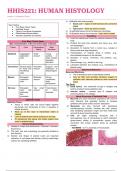
Main characteristics of the four basic types of tissues 2) Protects the body from abrasion and injury. (e.g., skin
and esophagus)
Tissue Cells Extracellular Main 3) Absorption of material from a lumen (e.g., tubules in
Matrix functions
kidney small and large intestines)
4) Transportation of material along a surface. (e.g.,
Epithelial Aggregated Small Lining of
polyhedral amount surface or cilia-mediated transport in the trachea)
cells body cavities; 5) Secretion of mucus, hormones, and proteins. (e.g.
glandular glands)
secretion 6) Gas exchange. (e.g., alveoli in the lung)
7) Lubrication between two surfaces. (e.g., mesothelium of
Connective Several types Abundant Support and pleural cavity).
of fixed and amount protection of
Basement Membrane
wandering tissue/organs
cells Basement Membrane
● Thin extracellular layer of specialized proteins
Muscle Elongated Moderate Strong ● Acts as filter and provides structural support to
contractile amount contraction; epithelial cells; attaches epithelia to other connective
cells body tissue
movements Two Parts:
1) basal lamina - thin meshwork of type IV collagen and
Nervous Elongated Very small Transmission
laminin produced by the epithelial cells.
cells with amount of nerve
extremely impulses 2) reticular lamina - contains type III collagen and
fine anchoring fibrils of VII collagen
processes Apical Structures of Epithelial Cells
1) Microvilli are small membrane projections with cores of
Epithelial Tissue
actin filaments that generally function to increase
Epithelial Tissue
epithelial cells apical surface area for absorption.
● Tissue in which cells are bound tightly together
2) Stereocilia are long microvilli with specialized
structurally and functionally to form a sheetlike or
mechanosensory function; increase the cells' surface
tubular structure
area facilitating absorption longer and less motile than
● Made up of thin layer of extracellular matrix or
microvilli & show branching distally
material
3) Cilia are larger projecting structures with a
● Lines all external and internal surfaces of our body
well-organized core of microtubules in which restricted,
● All substances that leaves and enters organs must
dynein-based sliding of microtubules causes ciliary
cross in epithelial tissue
movement that propel material along an epithelial
General Characteristics
surface.
1) Variable in shape and dimensions ( Columnar / Cuboidal /
– AXONEME - is 9+ 2 assembly of microtubules
Squamous )
2) The cells’ size and morphology are generally dictated by
their function
3) Number and Shape of stained nuclei are important
indicators of cell shape and density; primary morphologic
criterion for classifying epithelia
1
Lesson 2 | Epithelial Tissue
4) Epithelial cells shows polarity
● Basal pole – region of cells that faces the connective
Topic Outline:
● Four Basic Tissue Types tissue
● Epithelial Tissue ● Apical pole – faces the space or lumen
● Types of Junctional Complexes 5) All epithelial tissues lie at the basement membrane.
● Classification/Nomenclature 6) All Epithelial tissues are Avascular – lacks blood vessels
● Secretory Epithelia and Glands Functions
1) Lines the internal and covers the external surfaces of the
Four Basic Tissue Types body.
Main characteristics of the four basic types of tissues 2) Protects the body from abrasion and injury. (e.g., skin
and esophagus)
Tissue Cells Extracellular Main 3) Absorption of material from a lumen (e.g., tubules in
Matrix functions
kidney small and large intestines)
4) Transportation of material along a surface. (e.g.,
Epithelial Aggregated Small Lining of
polyhedral amount surface or cilia-mediated transport in the trachea)
cells body cavities; 5) Secretion of mucus, hormones, and proteins. (e.g.
glandular glands)
secretion 6) Gas exchange. (e.g., alveoli in the lung)
7) Lubrication between two surfaces. (e.g., mesothelium of
Connective Several types Abundant Support and pleural cavity).
of fixed and amount protection of
Basement Membrane
wandering tissue/organs
cells Basement Membrane
● Thin extracellular layer of specialized proteins
Muscle Elongated Moderate Strong ● Acts as filter and provides structural support to
contractile amount contraction; epithelial cells; attaches epithelia to other connective
cells body tissue
movements Two Parts:
1) basal lamina - thin meshwork of type IV collagen and
Nervous Elongated Very small Transmission
laminin produced by the epithelial cells.
cells with amount of nerve
extremely impulses 2) reticular lamina - contains type III collagen and
fine anchoring fibrils of VII collagen
processes Apical Structures of Epithelial Cells
1) Microvilli are small membrane projections with cores of
Epithelial Tissue
actin filaments that generally function to increase
Epithelial Tissue
epithelial cells apical surface area for absorption.
● Tissue in which cells are bound tightly together
2) Stereocilia are long microvilli with specialized
structurally and functionally to form a sheetlike or
mechanosensory function; increase the cells' surface
tubular structure
area facilitating absorption longer and less motile than
● Made up of thin layer of extracellular matrix or
microvilli & show branching distally
material
3) Cilia are larger projecting structures with a
● Lines all external and internal surfaces of our body
well-organized core of microtubules in which restricted,
● All substances that leaves and enters organs must
dynein-based sliding of microtubules causes ciliary
cross in epithelial tissue
movement that propel material along an epithelial
General Characteristics
surface.
1) Variable in shape and dimensions ( Columnar / Cuboidal /
– AXONEME - is 9+ 2 assembly of microtubules
Squamous )
2) The cells’ size and morphology are generally dictated by
their function
3) Number and Shape of stained nuclei are important
indicators of cell shape and density; primary morphologic
criterion for classifying epithelia
1