A Level Biology
HOMEOSTASIS OCR A Module 5
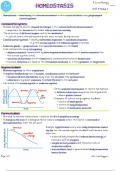
• Homeostasis → maintaining the internal environment within restricted limits using physiological
control systems
Communication systems
• Animals and plants need to respond to changes in the internal and external environment
→ important for survival and to enable cells to function normally
• The activities of different organs need to be coordinated
→ e.g. both heart rate and breathing rate must increase during exercise
• Communication systems → used by multicellular organisms to coordinate responses
→ e.g. the nervous system and endocrine system in animals
• Endocrine glands → groups of cells that secrete hormones into the blood
• Cells communicate using cell signalling
→ adjacent neurones communicate by secreting neurotransmitters which bind to receptors (see
the nervous system notes)
→ secretion of hormones into the blood allows communication between distant cells
→ hormone receptors are found on the cell-surface membrane or in the cytoplasm of target cells
Negative feedback
• Restores systems to their original level
• A negative feedback loop has a receptor, coordination centre and effector
→ receptors detect fluctuations away from the set point (the optimum level)
→ effectors bring about responses to return the level to the set point
• Can involve the nervous system or endocrine system
-min
• Often separate mechanisms to control fluctuations
Gres" ine
in different directions away from the original level
→ allows greater control
• Examples of control using negative feedback
→ control of blood glucose
→ control of body temperature
time → control of blood water potential
Positive feedback
• Not used to maintain homeostasis → positive feedback amplifies a change
• A change in the level of a biological factor causes a response where the factor is increased or
decreased further from the set point
stimulus Example: hypothermia occurs when body temperature lowers
·
Ipli
->
too far for the normal negative feedback mechanisms to be
effective
ge → a lowered body temperature reduces kinetic energy of
E molecules such as enzymes
→ enzyme activity reduces and therefore rate of
E respiration reduces
A
time → less metabolic heat is generated and body temperature
lowers further
Page 1 of 1 © Dr Zoë Huggett
, A Level Biology
THERMOREGULATION OCR A Module 5
Ectotherms Endotherms
• Regulate body temperature using behavioural • Generate heat internally through respiration
responses e.g. basking in the sun • Have a higher metabolic rate
• Have a lower metabolic rate • Mainly use physiological responses and negative
• Internal body temperature changes with the feedback to regulate body temperature within
external environmental temperature narrow limits (see below)
→ depend on the environment for their body → sometimes use behavioural responses as well
heat e.g. huddling together
• Examples: reptiles and some fish • Examples: birds and mammals
Thermoregulation in endotherms
There are also temperature
• Peripheral temperature receptors
receptors in the hypothalamus
→ found in the skin
which detect the temperature
→ detect the temperature of the skin and send impulses of the blood (core temperature).
along sensory neurones to the hypothalamus
• Hypothalamus sends impulses along motor neurones to the effectors
• Effectors → sweat glands, erector pili muscles, skeletal muscles, smooth muscle in arterioles
Response to high body temperature Response to low body temperature
• Sweat glands secrete more sweat • Sweat glands secrete less sweat
• Erector pili muscles relax → hairs on skin lie flat • Erector pili muscles contract → hairs on skin
so that no air is trapped stand up to trap an insulating layer of air
• Smooth muscle of arterioles in skin relaxes • Smooth muscle of arterioles in skin contracts
→ arterioles dilate and more blood flows close → arterioles constrict and less blood flows
to the skin surface to radiate heat close to the skin surface
• Skeletal muscles contract rapidly to generate
impulses +O
->
metabolic heat through respiration
impulses to effectors
↳
hypothalamus
~ erector pilimuscles -> relax
detected
by sweat
glands -
more sweat
temperature receptors arterioles -> vasodilation
- HIGH ↓
⑧
- 37 C
->
LOW
- X
contract
erector pilimuscles ->
detected
by
Skeletal muscles -
shivering temperature receptors
sweat
sweat
glands - less
↓
arterioles -> vasoconstriction This is an example
impulses to of homeostasis and
-Y impulses to
hypothalamus negative feedback.
,
effectors
Page 1 of 1 © Dr Zoë Huggett
, A Level Biology
THE LIVER OCR A Module 5
Excretion
• The removal of metabolic waste products from the body
• Carbon dioxide must be excreted via the lungs to keep blood pH from becoming too acidic
→ a waste product of respiration
• Nitrogenous waste must be excreted by the liver and kidneys
→ ammonia is a waste product of amino acid metabolism
→ ammonia is toxic so must be converted to urea (less toxic) for excretion
Liver structure
Af atche
• Hepatic artery hep
→ an unbranched narrow vessel that brings
oxygenated blood to the liver
r
S
• Hepatic portal vein
"OAll"hepatic
→ a branched vessel that brings blood directly
from the gut (contains substances absorbed
in the small intestine) 1 ~
• Hepatic vein
→ a wide vessel that takes deoxygenated blood - ↳
away from the liver
je I y
• Bile duct
1
→ carries bile from the liver to the gall bladder
for storage, then to the small intestine ·
adder
gall g
act
-
portal
• The liver is made up of hexagonal lobules each with a central vein
• Hepatocytes carry out the metabolic functions of the liver e.g. converting glucose to glycogen
• Kupffer cells destroy bacteria and dead red blood cells
• Sinusoids → the lumens of the blood vessels where the blood
-
from the hepatic artery and hepatic portal vein mix
-
R
central → lined with thin cells for a short diffusion distance
-
vein from blood into hepatocytes
-
·illman
Sg
Oooo
gigg.
usi
⑧
80
... ·
of
branch a
.::
so
S a --P- Make sure to look online
*
bile duct a
a
-co
↑
W
E 80 i -O
: and in past papers at
↳
↑
- ~
28
- " - ↑
-
real labelled histology
8 88
......
kupffer cells
⑧ ·::
images of the liver.
8 o .
⑧000
⑧"
....
·
⑧
808
:
: ....
⑧ 00 ⑧ See the Module 2
o·
⑧0000
.....
... notes for guidance on
⑧
... scientific drawings.
⑧
88
o
&
⑧o o
0 · .
88⑧
⑧
·
&
.
&
Pranch t
hepatic artery
branch of
hepatisportal
Page 1 of 2 © Dr Zoë Huggett
, A Level Biology
THE LIVER OCR A Module 5
Liver functions
• Stores glucose as glycogen → glycogen can be hydrolysed to glucose to raise blood glucose
• Produces bile → a substance which emulsifies lipids during lipid digestion
→ stored in the gall bladder before release into the small intestine
• Detoxification → harmful substances are removed from the blood in the sinusoids
→ some drugs are broken down by the liver into substances which can be excreted
→ ethanol (alcohol) is used as a respiratory substrate but this can cause fat
accumulation and cirrhosis (scarring) over time
→ lactate from anaerobic respiration is converted to pyruvate
• Deamination of amino acids and formation of urea
→ excess amino acids are broken down
→ the amino groups are removed to form ammonia and organic acids (this is called deamination)
→ organic acids can enter the Krebs cycle, or be converted to glucose or fat
→ ammonia is toxic so is converted to less toxic urea in the ornithine cycle
The ornithine cycle involves
reacting ammonia with carbon
dioxide to produce urea. The
cycle requires ATP.
Page 2 of 2 © Dr Zoë Huggett
HOMEOSTASIS OCR A Module 5
• Homeostasis → maintaining the internal environment within restricted limits using physiological
control systems
Communication systems
• Animals and plants need to respond to changes in the internal and external environment
→ important for survival and to enable cells to function normally
• The activities of different organs need to be coordinated
→ e.g. both heart rate and breathing rate must increase during exercise
• Communication systems → used by multicellular organisms to coordinate responses
→ e.g. the nervous system and endocrine system in animals
• Endocrine glands → groups of cells that secrete hormones into the blood
• Cells communicate using cell signalling
→ adjacent neurones communicate by secreting neurotransmitters which bind to receptors (see
the nervous system notes)
→ secretion of hormones into the blood allows communication between distant cells
→ hormone receptors are found on the cell-surface membrane or in the cytoplasm of target cells
Negative feedback
• Restores systems to their original level
• A negative feedback loop has a receptor, coordination centre and effector
→ receptors detect fluctuations away from the set point (the optimum level)
→ effectors bring about responses to return the level to the set point
• Can involve the nervous system or endocrine system
-min
• Often separate mechanisms to control fluctuations
Gres" ine
in different directions away from the original level
→ allows greater control
• Examples of control using negative feedback
→ control of blood glucose
→ control of body temperature
time → control of blood water potential
Positive feedback
• Not used to maintain homeostasis → positive feedback amplifies a change
• A change in the level of a biological factor causes a response where the factor is increased or
decreased further from the set point
stimulus Example: hypothermia occurs when body temperature lowers
·
Ipli
->
too far for the normal negative feedback mechanisms to be
effective
ge → a lowered body temperature reduces kinetic energy of
E molecules such as enzymes
→ enzyme activity reduces and therefore rate of
E respiration reduces
A
time → less metabolic heat is generated and body temperature
lowers further
Page 1 of 1 © Dr Zoë Huggett
, A Level Biology
THERMOREGULATION OCR A Module 5
Ectotherms Endotherms
• Regulate body temperature using behavioural • Generate heat internally through respiration
responses e.g. basking in the sun • Have a higher metabolic rate
• Have a lower metabolic rate • Mainly use physiological responses and negative
• Internal body temperature changes with the feedback to regulate body temperature within
external environmental temperature narrow limits (see below)
→ depend on the environment for their body → sometimes use behavioural responses as well
heat e.g. huddling together
• Examples: reptiles and some fish • Examples: birds and mammals
Thermoregulation in endotherms
There are also temperature
• Peripheral temperature receptors
receptors in the hypothalamus
→ found in the skin
which detect the temperature
→ detect the temperature of the skin and send impulses of the blood (core temperature).
along sensory neurones to the hypothalamus
• Hypothalamus sends impulses along motor neurones to the effectors
• Effectors → sweat glands, erector pili muscles, skeletal muscles, smooth muscle in arterioles
Response to high body temperature Response to low body temperature
• Sweat glands secrete more sweat • Sweat glands secrete less sweat
• Erector pili muscles relax → hairs on skin lie flat • Erector pili muscles contract → hairs on skin
so that no air is trapped stand up to trap an insulating layer of air
• Smooth muscle of arterioles in skin relaxes • Smooth muscle of arterioles in skin contracts
→ arterioles dilate and more blood flows close → arterioles constrict and less blood flows
to the skin surface to radiate heat close to the skin surface
• Skeletal muscles contract rapidly to generate
impulses +O
->
metabolic heat through respiration
impulses to effectors
↳
hypothalamus
~ erector pilimuscles -> relax
detected
by sweat
glands -
more sweat
temperature receptors arterioles -> vasodilation
- HIGH ↓
⑧
- 37 C
->
LOW
- X
contract
erector pilimuscles ->
detected
by
Skeletal muscles -
shivering temperature receptors
sweat
sweat
glands - less
↓
arterioles -> vasoconstriction This is an example
impulses to of homeostasis and
-Y impulses to
hypothalamus negative feedback.
,
effectors
Page 1 of 1 © Dr Zoë Huggett
, A Level Biology
THE LIVER OCR A Module 5
Excretion
• The removal of metabolic waste products from the body
• Carbon dioxide must be excreted via the lungs to keep blood pH from becoming too acidic
→ a waste product of respiration
• Nitrogenous waste must be excreted by the liver and kidneys
→ ammonia is a waste product of amino acid metabolism
→ ammonia is toxic so must be converted to urea (less toxic) for excretion
Liver structure
Af atche
• Hepatic artery hep
→ an unbranched narrow vessel that brings
oxygenated blood to the liver
r
S
• Hepatic portal vein
"OAll"hepatic
→ a branched vessel that brings blood directly
from the gut (contains substances absorbed
in the small intestine) 1 ~
• Hepatic vein
→ a wide vessel that takes deoxygenated blood - ↳
away from the liver
je I y
• Bile duct
1
→ carries bile from the liver to the gall bladder
for storage, then to the small intestine ·
adder
gall g
act
-
portal
• The liver is made up of hexagonal lobules each with a central vein
• Hepatocytes carry out the metabolic functions of the liver e.g. converting glucose to glycogen
• Kupffer cells destroy bacteria and dead red blood cells
• Sinusoids → the lumens of the blood vessels where the blood
-
from the hepatic artery and hepatic portal vein mix
-
R
central → lined with thin cells for a short diffusion distance
-
vein from blood into hepatocytes
-
·illman
Sg
Oooo
gigg.
usi
⑧
80
... ·
of
branch a
.::
so
S a --P- Make sure to look online
*
bile duct a
a
-co
↑
W
E 80 i -O
: and in past papers at
↳
↑
- ~
28
- " - ↑
-
real labelled histology
8 88
......
kupffer cells
⑧ ·::
images of the liver.
8 o .
⑧000
⑧"
....
·
⑧
808
:
: ....
⑧ 00 ⑧ See the Module 2
o·
⑧0000
.....
... notes for guidance on
⑧
... scientific drawings.
⑧
88
o
&
⑧o o
0 · .
88⑧
⑧
·
&
.
&
Pranch t
hepatic artery
branch of
hepatisportal
Page 1 of 2 © Dr Zoë Huggett
, A Level Biology
THE LIVER OCR A Module 5
Liver functions
• Stores glucose as glycogen → glycogen can be hydrolysed to glucose to raise blood glucose
• Produces bile → a substance which emulsifies lipids during lipid digestion
→ stored in the gall bladder before release into the small intestine
• Detoxification → harmful substances are removed from the blood in the sinusoids
→ some drugs are broken down by the liver into substances which can be excreted
→ ethanol (alcohol) is used as a respiratory substrate but this can cause fat
accumulation and cirrhosis (scarring) over time
→ lactate from anaerobic respiration is converted to pyruvate
• Deamination of amino acids and formation of urea
→ excess amino acids are broken down
→ the amino groups are removed to form ammonia and organic acids (this is called deamination)
→ organic acids can enter the Krebs cycle, or be converted to glucose or fat
→ ammonia is toxic so is converted to less toxic urea in the ornithine cycle
The ornithine cycle involves
reacting ammonia with carbon
dioxide to produce urea. The
cycle requires ATP.
Page 2 of 2 © Dr Zoë Huggett