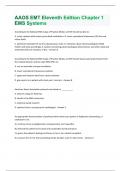
AAOS EMT Eleventh Edition Chapter 1 EMS Systems Questions and Answers Solved 100% Correct!!
According to the National EMS Scope of Practice Model, an EMT should be able to: A. assist a patient with certain prescribed medications. B. insert a peripheral intravenous (IV) line and infuse fluids. C. administer epinephrine via the subcutaneous route. D. interpret a basic electrocardiogram (ECG) rhythm and treat accordingly. 6. Cardiac monitoring, pharmacological interventions, and other advanced treatment skills are functions of the: - Answer-A According to the National EMS Scope of Practice Model, an EMT would require special permission from the medical director and the state EMS office to: A. use an automatic transport ventilator. B. insert a peripheral intravenous catheter. C. apply and interpret data from a pulse oximeter. D. give aspirin to a patient with chest pain. Incorrect - Answer-B American Heart Association protocols are based on __________. A. theories ready for field trial B. trends in the EMS community C. evidence-based research D. opinions from a core group of cardiologists - Answer-C An appropriate demonstration of professionalism when your patient is frightened, demanding, or unpleasant is to: A.) continue to be nonjudgmental, compassionate, and respectful. B.) demand the patient to be quiet and cooperative during transport. C.) ignore the patient's feelings and focus on his or her medical complaint. D.) reassure him or her that everything will be all right, even if it will not be. - Answer-AAn EMS provider who has extensive training in various aspects of advanced life support (ALS) is called a(n): A.) EMT. B.) paramedic. C.) advanced EMT (AEMT). D.) EMR. - Answer-B As an EMT, you may be authorized to administer aspirin to a patient with chest pain based on: A. medical director approval. B. the transport time to the hospital. C. the patient's condition. D. an order from a paramedic. - Answer-A Cardiac monitoring, pharmacologic interventions, and other advanced treatment skills are functions of the: A. AEMT. B. EMT. C. paramedic. D. EMR. - Answer-C Continuing education in EMS serves to: A.) prove research and statistical findings in prehospital care. B.) maintain, update, and expand your knowledge and skills. C.) enforce mandatory attendance to agency-specific training. D.) provide an ongoing review and audit of the EMS system. - Answer-B EMT training in nearly every state meets or exceeds the guidelines recommended by the: A, National Registry of EMTs. B. individual state's EMS protocols.C. National Association of EMTs. D. National Highway Traffic Safety Administration (NHTSA) - Answer-D If an EMT candidate has been convicted of a felony or misdemeanor, he or she should: A.) wait at least 24 months before taking another state-approved EMT class. B.) send an official request to the National Registry of EMT (NREMT) to seek approval to take the EMT exam. C.) recognize that any such conviction will disqualify him or her from EMT licensure. D.) contact the state EMS office and provide them with the required documentation. - Answer-D National guidelines for EMS care are intended to __________. A. provide more consistent delivery of EMS care across the United States B. reduce expenses at the local and state levels C. facilitate a national EMS labor group D. unify EMS providers under a single medical director - Answer-A
Written for
- Institution
- AAOS EMT Eleventh Edition Chapter 1 EMS Systems
- Course
- AAOS EMT Eleventh Edition Chapter 1 EMS Systems
Document information
- Uploaded on
- June 15, 2024
- Number of pages
- 9
- Written in
- 2023/2024
- Type
- Exam (elaborations)
- Contains
- Questions & answers
Subjects
-
aaos emt eleventh edition chapter 1 ems systems

Also available in package deal