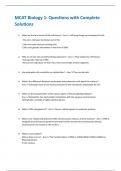
MCAT Biology 1: Questions with Complete Solutions
1. What are the four tenets of the cell theory? - Ans-All living things are composed of cells. -The cell is the basic functional unit of life. -Cells arise only from pre-existing cells -Cells carry genetic information in the form of DNA 2. Why are viruses not considered living organisms? - AnsThey violate the cell theory; -their genetic material is RNA -they cannot reproduce on their own, they must invade another organism. 3. Are eukaryotic cells unicellular or multicellular? - AnsThey can be both 4. What's the difference between aeukaryotic and prokaryotic cells about the nucleus? - AnsEukaryotes have a true nucleus enclosed in the membrane, prokaryotes do not. 5. What are the characteristics of the various layers of the phospholipid bilayer? - AnsHydrophilic: has electrostatic interactions with the aqueous environments. Hydrophobic: provides a highly selective barrier. 6. What is DNA composed of? - AnsGenes: coding regions for particular proteins. 7. What is the relationship between DNA, chromosomes, histone, and the nucleus? - AnsDNA is wrapped around histones (proteins) and then further wound into chromosomes (linear); chromosomes are located in the nucleus. 8. What is transcription? Where does it occur? - AnsThe transformation of DNA to mRNA (DNA>hnRNA>mRNA) by RNA polymerase. In the nucleus. 9. What is translation? - AnsThe formation of a peptide from mRNA 10. What is the function of the nucleolus? - AnsIt synthesizes ribosomal RNA (rRNA). 11. What is the function of the outer membrane of the mitochondria? - AnsIt separates the cytosol from inner mitochondrial environment. 12. What is the function of the inner membrane of the mitochondria which contains cristae? - AnsContains enzymes and molecules necessary for the electron transport chain. 13. What is responsible for the proton-motive force of the mitochondria? - AnsProtons pumping from the mitochondrial matrix to the intermembrane space 14. What is the significance of the proton-motive force in mitochondria? - AnsProtons flow through ATP synthase to generate ATP during oxidative phosphorylation. 15. Why is the mitochondria considered semi-autonomous? - AnsThey contain their own genes and replicate independently via binary fission. 16. How does the mitochondria cause apoptosis? - AnsBy releasing electron transport chain enzymes. 17. What do lysosomes contained? What can this result in? - AnsHydrolytic enzymes. Release of its contents is autolysis (apoptosis). 18. What is the endoplasmic reticulum continuous with? - AnsThe nuclear envelope 19. What is the function of RER? - Ansto translate proteins that will be directly secreted into the lumen. 20. What is the function of the SER? - AnsLipid synthesis Detoxification of drugs and poison Transport proteins from RER to Gogli 21. What is the function of the Golgi Apparatus? - AnsModifies cellular products by addition of carbohydrates, phosphates, and sulfates. May add signal sequences directing the delivery of the product to a specific cellular location. 22. What happens after the Golgi packages the modified cellular material into vesicles? - AnsThe vesicles are either: sent to the correct cellular location or merge with the cell membrane and release its contents via exocytosis. 23. What do peroxisomes contain? - Ans-Hydrogen peroxide -Enzymes involved in the pentose phosphate pathway 24. What is the function of peroxisomes? - Ans-Breaks down very long chain f
Written for
- Institution
- MCAT Biology 1
- Course
- MCAT Biology 1
Document information
- Uploaded on
- June 14, 2024
- Number of pages
- 11
- Written in
- 2023/2024
- Type
- Exam (elaborations)
- Contains
- Questions & answers
Subjects
-
mcat biology 1 questions with complete solutions

Also available in package deal