Energy, Enthalpy and
Thermochemistry
9.1 The nature of energy
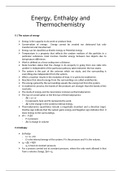
Energy is the capacity to do work or produce heat.
Conservation of energy: Energy cannot be created nor destroyed but only
transferred and transformed.
Energy can be classified as Kinetic energy or Potential energy
Temperature is a property that reflects the random motions of the particles in a
particular substance. Heat involves transfer energy between two objects due to
temperature difference.
Work is defined as a force acting over a distance.
State function states that the change in its property in going from one state into
another is independent of the particular pathway taken between the two states.
The system is the part of the universe which we study, and the surrounding is
everything else independent from the system.
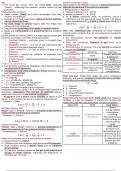
When a reaction results in the evolution of heat, it is said to be exothermic.
Reactions that absorb energy from the surroundings are called endothermic.
The energy gained by the surroundings equals the energy lost from the system.
In exothermic process, the bonds of the products are stronger than the bonds of the
reactants.
The study of energy and its conversions is known as thermodynamics
The law of conservation or the first law of thermodynamics:
- ∆E = q + w
- Q represents heat and W represents the work.
- ∆E is the change in the systems internal energy.
Thermodynamics quantitates include a magnitude (number) and a direction (sign).
Positive sign indicate that the system gains energy and Negative sign indicates that it
loses energy to the surroundings.
W = - P ∆V
- P is pressure
- ∆V is change in volume
9.2 Enthalpy
Enthalpy
- H = E + PV
- E is the internal energy of the system; P is the pressure and V is the volume.
qp = ∆E + P∆V
- qp is heat at constant pressure.
For a process carried out at constant pressure, where the only work allowed is that
from a volume change, ∆H = qp
Thermochemistry
9.1 The nature of energy
Energy is the capacity to do work or produce heat.
Conservation of energy: Energy cannot be created nor destroyed but only
transferred and transformed.
Energy can be classified as Kinetic energy or Potential energy
Temperature is a property that reflects the random motions of the particles in a
particular substance. Heat involves transfer energy between two objects due to
temperature difference.
Work is defined as a force acting over a distance.
State function states that the change in its property in going from one state into
another is independent of the particular pathway taken between the two states.
The system is the part of the universe which we study, and the surrounding is
everything else independent from the system.
When a reaction results in the evolution of heat, it is said to be exothermic.
Reactions that absorb energy from the surroundings are called endothermic.
The energy gained by the surroundings equals the energy lost from the system.
In exothermic process, the bonds of the products are stronger than the bonds of the
reactants.
The study of energy and its conversions is known as thermodynamics
The law of conservation or the first law of thermodynamics:
- ∆E = q + w
- Q represents heat and W represents the work.
- ∆E is the change in the systems internal energy.
Thermodynamics quantitates include a magnitude (number) and a direction (sign).
Positive sign indicate that the system gains energy and Negative sign indicates that it
loses energy to the surroundings.
W = - P ∆V
- P is pressure
- ∆V is change in volume
9.2 Enthalpy
Enthalpy
- H = E + PV
- E is the internal energy of the system; P is the pressure and V is the volume.
qp = ∆E + P∆V
- qp is heat at constant pressure.
For a process carried out at constant pressure, where the only work allowed is that
from a volume change, ∆H = qp