100% satisfaction guarantee Immediately available after payment Both online and in PDF No strings attached 4.6 TrustPilot
logo-home
Summary

Complete samenvatting orthopedagogiek: gezinsfactoren

Rating
4.5
(2)
Sold
30
Pages
56
Uploaded on
14-06-2024
Written in
2023/2024

Deze samenvatting (+ aantekeningen van hoorcolleges) is bedoeld voor studenten die de opleiding Pedagogische wetenschappen volgen aan Universiteit Leiden en in het 2e leerjaar zitten. Het bevat de stof dat wordt getoetst voor het vak orthopedagogiek: gezinsfactoren in blok 4. Literatuur dat hiervoor is gebruikt: 1. Humphreys et al. (2017). Signs of reactive attachment disorder and disinhibited social engagement disorder at age 12 years: Effects of institutional care history and high-quality foster care. 2. Seim et al. (2022). Reactive attachment disorder and disinhibited social engagement disorder in adolescence: Co-occurring psychopathology and psychosocial problems. 3. Buist et al. (2013). Sibling relationship quality and psychopathology of children and adolescents: A meta-analysis. 4. Van Berkel et al. (2018). The combination of sibling victimization and parental child maltreatment on mental health problems and delinquency. 5. Hayden et al. (2019). A population-based study of the behavioral and emotional adjustment of older siblings of children with and without intellectual disability. 6. Richtlijn Scheiding en problemen van jeugdigen voor jeugdhulp en jeugdbescherming: H 2, 3 en 4 7. Van Dijk et al. (2020). A meta-analysis on interparental conflict, parenting, and child adjustment in divorced families: Examining mediation using meta-analytic structural equation models. 8. Jiao et al. (2021). Dyadic relationships between a surviving parent and children in widowed families: A systematic scoping review. 9. Stikkelbroek et al. (2016). Mental health of adolescents before and after the death of a parent or sibling. 10. Van Heijningen et al. (2023). Long-term effects of experiencing childhood parental death on mental and physical health: A NESDA study. 11. Bouma et al. (2017). HESTIA Factsheet: Het Nederlandse jeugdbeschermingsstelsel onder de Jeugdwet 2015. 12. Koper et al. (2024). Effectiveness of a multidisciplinary treatment with youth-initiated mentoring for youths with mental health needs from multi-problem families: a quasi-experimental study. 13. Van Assen et al.(2020). Home-visiting interventions for families with complex and multiple problems: A systematic review and meta-analysis of out-of-home placement and child outcomes. 14. Emmelkamp et al. (2020). Risk factors for (violent) radicalization in juveniles: A multilevel meta-analysis. 15. Zych en Nasaescu (2022). s radicalization a family issue? A systematic review of family‐related risk and protective factors, consequences, and interventions against radicalization. 16. Sikkens et al. (2018). Parents’ perspectives on radicalization: A qualitative study. 17. Richtlijn Kinderen van Ouders met Psychische Problemen / Verslavingsproblemen (KOPP/KOV) voor jeugdhulp en jeugdbescherming: H 2, 3, 4 en 5 18. Leijdesdorff et al. (2017). Prevalence of psychopathology in children of parents with mental illness and/or addiction: an up to date narrative review. 19. Källquist en Salzmann-Erikson (2019). Experiences of having a parent with serious mental illness: an interpretive meta-synthesis of qualitative literature. 20. Van Santvoort et al. (2015). The impact of various parental mental disorders on children’s diagnoses: a systematic review. 21. Assink et al. (2018). The intergenerational transmission of child maltreatment: A three-level meta-analysis. 22. Lebowitz et al. (2016). Cross-generational influences on childhood anxiety disorders: pathways and mechanisms. 23. Asif et al. (2024). Influence of placement stability on developmental outcomes of children and young people in out-of-home care: Findings from the Pathways of Care Longitudinal Study. 24. Dubois-Comtois et al. (2021). Are children and adolescents in foster care at greater risk of mental health problems than their counterparts? A meta-analysis. 25. Gutterswijk et al. (2020). The outcome of non-residential youth care compared to residential youth care: A multilevel meta-analysis. De kleuren in de tekst geven belangrijke punten aan. Geel: belangrijk onderwerp/begrip Groen: subonderwerp/hoort bij belangrijk begrip Grijs: overige belangrijke woorden/woorden die bij groen horen Roze: belangrijke personen

Show more Read less
Institution
Course


Whoops! We can’t load your doc right now. Try again or contact support.

Written for

Institution
Study
Course

Document information

Uploaded on
June 14, 2024
Number of pages
56
Written in
2023/2024
Type
Summary

Subjects

Content preview

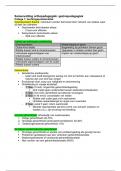
Samenvatting orthopedagogiek: gezinspedagogiek
College 1: hechtingsproblematiek
Gezinssysteem theorie: individuen worden beïnvloed door netwerk van relaties waar
zij deel van uitmaken
 Gezinsleden beïnvloeden elkaar
- Cross-over effecten
 Subsystemen beïnvloeden elkaar
- Split-over effecten

Invloed op individuele ontwikkeling
Gezinssysteem Maatschappij en gezin
Ouder-kind relatie Begeleiding bij probleem binnen gezin
Relatie tussen kind en broers/zussen Opgroeien in andere context dan gezin
Individuele eigenschappen van Impact van maatschappij op gezin
broers/zussen
Relatie tussen ouders en broers/zussen
Individuele eigenschappen van de ouder
Relatie tussen ouders

Gehechtheid
 Genetische predispositie
- Ieder kind heeft biologische aanleg om zich te hechten aan volwassene of
individu dat voor kind kan zorgen
 Evolutionair doel: zorg voor veiligheid en bescherming
 Ontwikkeling in vroege kindertijd:
- 1e fase (3 mnd): ongerichte gehechtheidsgedrag
 kind maakt geen onderscheid tussen bekenden/onbekenden
e
- 2 fase (3-6 mnd): gerichtheid op bekende verzorgers
- 3e fase (6-36 mnd): consolidatie van relatie
 Relatie met ouder gaat vorm aannemen
 Ontstaan separatieangst en angst voor vreemden
e
- 4 fase (vanaf 3 jaar): intern werkmodel
 Mentale representatie dat kind vormt van zichzelf, anderen en
relaties o.b.v. zijn ervaring met hechting

Vormen gehechtheid: afhankelijk van ouderreacties
1. Veilige gehechtheid: 60-70%
2. Onveilige gehechtheid (ambivalent/vermijdend): 30-40%
3. Gedesorganiseerde gehechtheid: 15%

Richtlijnen problematische gehechtheid
 Onveilige gehechtheid en sprake van probleemgedrag als gevolg hiervan
 Problemen gerelateerd aan een verbroken gehechtheidsrelatie
 Gedesorganiseerde of verstoorde gehechtheidsrelatie
 Niet vormen van een gehechtheidsrelatie (RHS)

Reviews from verified buyers

Showing all 2 reviews
1 year ago

1 year ago

4.5

2 reviews

5
1
4
1
3
0
2
0
1
0
Trustworthy reviews on Stuvia

All reviews are made by real Stuvia users after verified purchases.

Get to know the seller

Seller avatar
Reputation scores are based on the amount of documents a seller has sold for a fee and the reviews they have received for those documents. There are three levels: Bronze, Silver and Gold. The better the reputation, the more your can rely on the quality of the sellers work.
Denise2000 Universiteit Leiden
Follow You need to be logged in order to follow users or courses
Sold
349
Member since
3 year
Number of followers
111
Documents
65
Last sold
3 days ago
Samenvattingen van hbo tot universiteit

Ik verkoop samenvattingen voor de opleidingen: Hbo: -Pedagogiek (Haagse Hogeschool [alleen jaar 1] ) Universiteit - Pedagogische wetenschappen (Universiteit Leiden [ voor nu jaar 1 en 2] )

4.3

16 reviews

5
7
4
7
3
2
2
0
1
0

Recently viewed by you

Why students choose Stuvia

Created by fellow students, verified by reviews

Quality you can trust: written by students who passed their tests and reviewed by others who've used these notes.

Didn't get what you expected? Choose another document

No worries! You can instantly pick a different document that better fits what you're looking for.

Pay as you like, start learning right away

No subscription, no commitments. Pay the way you're used to via credit card and download your PDF document instantly.

Student with book image

“Bought, downloaded, and aced it. It really can be that simple.”

Alisha Student

Frequently asked questions