
Formations:
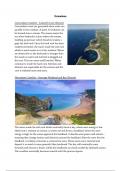
Concordant Coastline - Lulworth Cove (Dorset)
Concordant coasts are generated when rocks run
parallel to the coastline. A point of weakness can
be formed from a stream. The stream meets the
sea where hydraulic action widens the stream,
building up pressure which breaches (makes a
gap) the hard rock. Once the hard rock has been
eroded (overtime), the waves erode the soft rock
which is much easier as it is less resistant. Waves
are destructive so the backwash is stronger than
the swash so water and material is dragged out
the cove. This can cause small beaches. Waves
continue to erode the hard rock. Attrition and
abrasion are responsible for the erosion and the
cove is widened more and more.
Discordant Coastline - Swanage Headland and Bay (Dorset)
The waves erode the soft rock which eventually forms a bay, where wave energy is low.
Hard rock is resistant to erosion, so sticks out and forms a headland, where the wave
energy is high. As the waves approach the headland, it absorbs wave power and refracts -
meaning they change motion and direction around the headland. After the wave hits the
headland, it is likely to become a constructive wave. These waves carry material and
deposit it as swash is more powerful than backwash. The bay will eventually come
forwards and become a beach, whilst the headlands are slowly eroded by hydraulic action.
The coastline eventually becomes smooth until the process repeats.
, Caves, Arches, Stacks & Stumps - Old
Harry and His Wife (Dorset)
This sequence occurs on pinnacle
headlands. Marine erosion widens faults
in the base of the headland, widening
over time to create a cave. The cave will
widen due to both marine erosion and
sub-aerial processes, eroding through to
the other side of the headland, creating
an arch. The arch continues to widen
until it is unable to support itself, falling
under its own weight through mass movement, leaving a stack as one side of the arch
becomes detached from the mainland. With marine erosion attacking the base of the
stack, eventually the stack will collapse into a stump.
Blowhole - Flamborough head (Holderness)
A Blowhole is a combination of two features: a
pot hole on top of a cliff, created by chemical
weathering, and a cave, formed by marine
erosion. As the cave erodes deeper into the cliff
face and the pothole deepens, they may meet. In
this case, a channel is created for incoming waves
to travel into and up the cliff face (occasionally
water splashes out of the top of the blowhole
when energetic waves hit the cliff face).
Spits - Spurn Head (Holderness)
A spit is a long narrow strip of land which is
formed due to deposition. Longshore drift occurs
along the coast line but as the waves lose energy
(normally due to going into a sheltered area such
as behind a headland) they deposit their sediment.
Over time this creates a spit. Periodically, the
prevailing wind will change direction causing a
hook to appear. Over time, the sheltered area
behind a spit can turn into a salt marsh. The length
of a spit is influenced by surrounding currents or
rivers.
Concordant Coastline - Lulworth Cove (Dorset)
Concordant coasts are generated when rocks run
parallel to the coastline. A point of weakness can
be formed from a stream. The stream meets the
sea where hydraulic action widens the stream,
building up pressure which breaches (makes a
gap) the hard rock. Once the hard rock has been
eroded (overtime), the waves erode the soft rock
which is much easier as it is less resistant. Waves
are destructive so the backwash is stronger than
the swash so water and material is dragged out
the cove. This can cause small beaches. Waves
continue to erode the hard rock. Attrition and
abrasion are responsible for the erosion and the
cove is widened more and more.
Discordant Coastline - Swanage Headland and Bay (Dorset)
The waves erode the soft rock which eventually forms a bay, where wave energy is low.
Hard rock is resistant to erosion, so sticks out and forms a headland, where the wave
energy is high. As the waves approach the headland, it absorbs wave power and refracts -
meaning they change motion and direction around the headland. After the wave hits the
headland, it is likely to become a constructive wave. These waves carry material and
deposit it as swash is more powerful than backwash. The bay will eventually come
forwards and become a beach, whilst the headlands are slowly eroded by hydraulic action.
The coastline eventually becomes smooth until the process repeats.
, Caves, Arches, Stacks & Stumps - Old
Harry and His Wife (Dorset)
This sequence occurs on pinnacle
headlands. Marine erosion widens faults
in the base of the headland, widening
over time to create a cave. The cave will
widen due to both marine erosion and
sub-aerial processes, eroding through to
the other side of the headland, creating
an arch. The arch continues to widen
until it is unable to support itself, falling
under its own weight through mass movement, leaving a stack as one side of the arch
becomes detached from the mainland. With marine erosion attacking the base of the
stack, eventually the stack will collapse into a stump.
Blowhole - Flamborough head (Holderness)
A Blowhole is a combination of two features: a
pot hole on top of a cliff, created by chemical
weathering, and a cave, formed by marine
erosion. As the cave erodes deeper into the cliff
face and the pothole deepens, they may meet. In
this case, a channel is created for incoming waves
to travel into and up the cliff face (occasionally
water splashes out of the top of the blowhole
when energetic waves hit the cliff face).
Spits - Spurn Head (Holderness)
A spit is a long narrow strip of land which is
formed due to deposition. Longshore drift occurs
along the coast line but as the waves lose energy
(normally due to going into a sheltered area such
as behind a headland) they deposit their sediment.
Over time this creates a spit. Periodically, the
prevailing wind will change direction causing a
hook to appear. Over time, the sheltered area
behind a spit can turn into a salt marsh. The length
of a spit is influenced by surrounding currents or
rivers.


