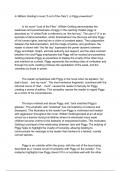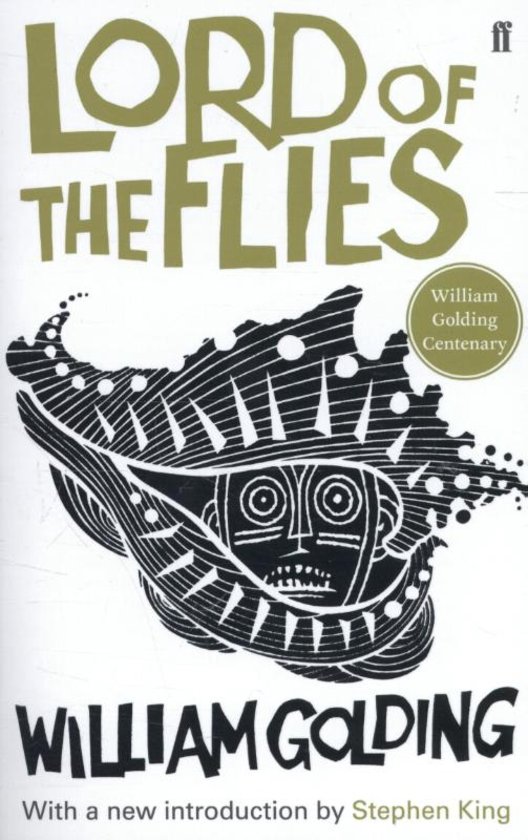
In William Golding’s novel (“Lord of the Flies”), is Piggy powerless?
In his novel “Lord of the Flies”, William Golding demonstrates the
weakness and powerlessness of piggy in the opening chapter piggy is
described as “it“ whilst Ruth is referred to as “the fair boy”. The use of “it” is an
example of dehumanisation, which foreshadows how the boys will strip Piggy
of his human rights, leaving him a victim of constant attack. The juxtaposition
between the dehumanisation, and the image of justice, and goodness, the
reader is shown with “the fair boy“ expresses the power dynamic between
Piggy and Ralph. Ralph, will hold authority and respect, and the stark contrast
between him and Piggy emphasises that Piggy will be mocked and powerless.
Golding presents Piggy as powerless to display the cruelty of the other boys
and mankind as a whole. Piggy represents the working class of civilisation and
through his work, Golding criticises the exploitation of the weak, and the
voiceless by those in power.
The reader sympathises with Piggy in the novel when he explains “my
dad’s dead… and my mum”. The short sentence fragments, combined with the
informal nouns of “dad… mum”, causes the reader to feel pity for Piggy,
creating a sense of pathos. This sympathy causes the reader to regard Piggy
as a victim of his circumstances.
The boys mistreat and abuse Piggy, and “Jack snatched Piggy’s
glasses”. The emphatic verb “snatched” has connotations of violence and
disrespect. This illustrates to the reader how Piggy is victimised and treated
with aggression throughout the novel. William Goldingworked at an all-boys’
school as a teacher during his lifetime where he witnessed many weak
children become victims to the barbarity of empowered bullies. This motivated
Golding’s portrayal of the relationship between Jack and Piggy. The bullying of
Piggy helps to highlight the cruelty of humanity, allowing Golding to
communicate his message to the reader that mankind is a twisted, morally
corrupt species.
Piggy is an outsider within the group, with the rest of the boys being
described as a “closed circuit of sympathy with Piggy on the outside”. The
metaphor highlights how Piggy doesn’t fit in or socialise well with the other
In his novel “Lord of the Flies”, William Golding demonstrates the
weakness and powerlessness of piggy in the opening chapter piggy is
described as “it“ whilst Ruth is referred to as “the fair boy”. The use of “it” is an
example of dehumanisation, which foreshadows how the boys will strip Piggy
of his human rights, leaving him a victim of constant attack. The juxtaposition
between the dehumanisation, and the image of justice, and goodness, the
reader is shown with “the fair boy“ expresses the power dynamic between
Piggy and Ralph. Ralph, will hold authority and respect, and the stark contrast
between him and Piggy emphasises that Piggy will be mocked and powerless.
Golding presents Piggy as powerless to display the cruelty of the other boys
and mankind as a whole. Piggy represents the working class of civilisation and
through his work, Golding criticises the exploitation of the weak, and the
voiceless by those in power.
The reader sympathises with Piggy in the novel when he explains “my
dad’s dead… and my mum”. The short sentence fragments, combined with the
informal nouns of “dad… mum”, causes the reader to feel pity for Piggy,
creating a sense of pathos. This sympathy causes the reader to regard Piggy
as a victim of his circumstances.
The boys mistreat and abuse Piggy, and “Jack snatched Piggy’s
glasses”. The emphatic verb “snatched” has connotations of violence and
disrespect. This illustrates to the reader how Piggy is victimised and treated
with aggression throughout the novel. William Goldingworked at an all-boys’
school as a teacher during his lifetime where he witnessed many weak
children become victims to the barbarity of empowered bullies. This motivated
Golding’s portrayal of the relationship between Jack and Piggy. The bullying of
Piggy helps to highlight the cruelty of humanity, allowing Golding to
communicate his message to the reader that mankind is a twisted, morally
corrupt species.
Piggy is an outsider within the group, with the rest of the boys being
described as a “closed circuit of sympathy with Piggy on the outside”. The
metaphor highlights how Piggy doesn’t fit in or socialise well with the other