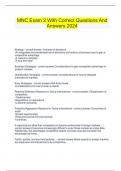
HNF 150 Exam 1 Questions And Answers Complete Study Solutions
Double) blind experiment - Answer-Neither the subjects nor the researchers know to which group the members belong until the end of the experiment. Reduces chance for biased interpretations of results 3 disaccharides - Answer-sucrose, lactose, maltose 3 simple sugars (monosaccharides) - Answer-glucose, fructose, galactose 4 Overarching Guidelines in the Dietary Guidelines - Answer-1. Follow a healthy dietary pattern at every life stage. 2. Customize and enjoy nutrient-dense food and beverage choices to reflect personal preferences, cultural traditions, and budgetary considerations. 3. Focus on meeting food group needs with nutrient-dense foods and beverages, and stay within calorie limits. 4. Limit foods and beverages higher in added sugars, saturated fat, and sodium, and limit alcoholic beverages. 5 characteristics of a nutritious diet - Answer-1. Adequacy 2. Balance 3. Calorie Control 4. Moderation 5. Variety 5 characteristics scientists evaluate when weighing the totality of evidence about a specific nutrition question - Answer--Consistent -Strong correlations -Specific -Dose-dependent -Biologically plausible6 classes of nutrients - Answer--carbohydrates, fats, proteins, vitamins, minerals, water -Only the macronutrients (fat, protein, carbohydrate) provide energy Acceptable Macronutrient Distribution Ranges (AMDR) - Answer--Provide adequate total energy and nutrients while preventing chronic diseases. -Carbs: 45-65% of cal -Fat: 20-35% -Protein: 10-35% Adecuacy - Answer-the foods provide enough of each essential nutrient, fiber, and energy. Adequate Intakes (AI) - Answer--Nutrient intake goals for individuals. -Set when scientific data are insufficient to establish RDA. adipose - Answer-Adipose is animal fat. Often referenced in regards to tissue. Stores nutrients and energy (in the form of fat), acting as a caloric reserve for our body. Anatomically, adipose tissue cushions internal organs as well as insulates our bodies AI - Answer--adequate intake -nutrient intake goals for individuals set when scientific data are insufficient to allow the establishment of an RDA value and are assumed to be adequate for healthy people Set by: the DRI committee Why: to set nutrient intake goals for nutrients that are components of a daily diet, but do not have enough scientific evidence yet amylopectin - Answer-a soluble polysaccharide and highly-branched polymer of glucose found in plants as one of the two components of starch (the other being amylose).Amylose - Answer-a polysaccharide found in plants as one of the two components of starch (making up approximately 20-30% of the structure)
Written for
- Institution
- HNF 150
- Course
- HNF 150
Document information
- Uploaded on
- June 13, 2024
- Number of pages
- 34
- Written in
- 2023/2024
- Type
- Exam (elaborations)
- Contains
- Questions & answers
Subjects

Also available in package deal