Rossetti – A Birthday
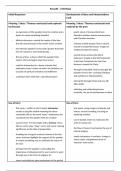
Initial Responses Development of ideas and interpretations
(red)
Meaning / Ideas / Themes constructed and explored Meaning / Ideas / Themes constructed and
by the poet explored by the poet
- an expression of the speakers love for creation and a - poetic vision of transcendent love-
desire to create something beautiful Rossetti combines intense sensuousness
with Christian devotion
- biblical references- remind the reader of the idea
that all natural beauty in the world= God’s creation - richness in both stanzas- first is natural,
second is temple-like luxury- images of
- love that the speaker has for God= greater than their royalty pervade this stanza
love for natural or man-made beauty
- second stanza evolves the literal
- the joy of love- a day in which the speaker feels Solomon's Temple in the Old Testament-
reborn- life truly begins when love arrives in the New Testament her heart has
- could be interpreted as a hymn of praise that become a temple for Christ
anticipates Jesus’s return to earth- the birthday= an - through having faith, God has brought the
occasion of spiritual revelation and fulfilment speakers love to her- converge Christian
- a spiritual union with God- a devotional poem and earthly love interpretations
- eternal life through Christ and new life
after death
- reflecting and celebrating human
creativity- the joy of spontaneous creation
Use of form Use of form
- first verse = written in strict iambic tetrameter- - lyric poem- using imagery of beauty and
creates a song like rhythm meaning the stress nature, musical sounding, focusing on
constantly falls on the word ‘heart’- emphasises the exploring emotion
consistent love the speaker feels for creation
- use of dactylic metre to emphasise the
- second verse- 4/7 lines begin with a trochee- stress verbs in stanza two
falls on verbs ‘raise’ ‘hang’ ‘carve’ and ‘work’- placing
- the flow of rhyme= harmonises the use of
significance on the idea of preparation
natural imagery
- breaking out of regular metrical scheme in the first
- iambic tetrameter→ trochees- change in
verse- trochees highlight the urgency of the speaker
to create something new to celebrate the return of metre marks a heightened sense of
intensity- more active
her love
- perhaps here the speaker is advocating the
importance of allowing love for your creator to work
through you in the form of religious art
- seems contradictory given protestants of the period
Initial Responses Development of ideas and interpretations
(red)
Meaning / Ideas / Themes constructed and explored Meaning / Ideas / Themes constructed and
by the poet explored by the poet
- an expression of the speakers love for creation and a - poetic vision of transcendent love-
desire to create something beautiful Rossetti combines intense sensuousness
with Christian devotion
- biblical references- remind the reader of the idea
that all natural beauty in the world= God’s creation - richness in both stanzas- first is natural,
second is temple-like luxury- images of
- love that the speaker has for God= greater than their royalty pervade this stanza
love for natural or man-made beauty
- second stanza evolves the literal
- the joy of love- a day in which the speaker feels Solomon's Temple in the Old Testament-
reborn- life truly begins when love arrives in the New Testament her heart has
- could be interpreted as a hymn of praise that become a temple for Christ
anticipates Jesus’s return to earth- the birthday= an - through having faith, God has brought the
occasion of spiritual revelation and fulfilment speakers love to her- converge Christian
- a spiritual union with God- a devotional poem and earthly love interpretations
- eternal life through Christ and new life
after death
- reflecting and celebrating human
creativity- the joy of spontaneous creation
Use of form Use of form
- first verse = written in strict iambic tetrameter- - lyric poem- using imagery of beauty and
creates a song like rhythm meaning the stress nature, musical sounding, focusing on
constantly falls on the word ‘heart’- emphasises the exploring emotion
consistent love the speaker feels for creation
- use of dactylic metre to emphasise the
- second verse- 4/7 lines begin with a trochee- stress verbs in stanza two
falls on verbs ‘raise’ ‘hang’ ‘carve’ and ‘work’- placing
- the flow of rhyme= harmonises the use of
significance on the idea of preparation
natural imagery
- breaking out of regular metrical scheme in the first
- iambic tetrameter→ trochees- change in
verse- trochees highlight the urgency of the speaker
to create something new to celebrate the return of metre marks a heightened sense of
intensity- more active
her love
- perhaps here the speaker is advocating the
importance of allowing love for your creator to work
through you in the form of religious art
- seems contradictory given protestants of the period