Summary #2 Freud’s psychodynamic theory
Freud’s 2 key assumptions
- People have an unconscious psyche/mind
- Motivational determinism everything/behavior has a cause (conscious or
unconscious)
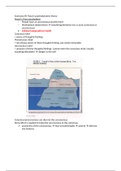
Iceberg/topographical model
Conscious mind
= aware of thoughts/feelings
Preconscious mind
= not always aware of these thoughts/feeling, but easily retrievable
Unconscious mind
= unaware of these thoughts/feelings. Cannot enter the conscious mind. Usually
troubling/distasteful danger to the self
Conscious/preconscious can slip into the unconscious.
More effort is needed to bring the unconscious to the conscious.
awareness of the unconscious fear/uncomfortable anxiety defense
mechanisms
, How to access/get insight into the unconscious?
Freudian slip
= Mistakes/error in speech, are unconscious desires breaking through your conscious. This
provides some insight in the unconscious.
Freud rendered this his case study/ proof of the existence of the unconscious.
Criticism:
Later it was proven that Freudian slips occur because:
- 2 words with the vowels in the same place vowels can easily be interchanged
- Salient cues in the environment bring certain thoughts/feelings to the attention
error of speech
Dreams
= Reflection of one’s unconscious desires.
Not portrayed literally but through symbols (otherwise it would be to upsetting)
2 contents:
Manifest: storyline/visual images
Latent: meaning of storyline/symbols
3 sources for dreams to occur
- Sensory stimulation (thunderstorm)
- Current concerns (experiences/thoughts/feelings in wake life)
- Unconscious impulse (reveal deepest layers of personality; the unconscious)
Free association
Usually done in therapy sessions:
Patient is encouraged to speak without limitations/censoring. The first thing that comes to
mind is meant to be spoken.
reveal unconscious desires/feelings/thoughts
Defense mechanisms
Perceptual defense
= The process by which an individual defends (unconsciously) against awareness of a
threatening stimulus.
Types of anxiety
Objective/realistic anxiety
= fear of a real/external factor
Moral anxiety
= conflict between EGO and SUPEREGO
too many morals fear of not respecting all the moral rules set by the SUPEREGO
Neurotic anxiety
= conflict between ID and EGO
fear that the ID’s primal/unacceptable urges come to the surface
Freud’s 2 key assumptions
- People have an unconscious psyche/mind
- Motivational determinism everything/behavior has a cause (conscious or
unconscious)
Iceberg/topographical model
Conscious mind
= aware of thoughts/feelings
Preconscious mind
= not always aware of these thoughts/feeling, but easily retrievable
Unconscious mind
= unaware of these thoughts/feelings. Cannot enter the conscious mind. Usually
troubling/distasteful danger to the self
Conscious/preconscious can slip into the unconscious.
More effort is needed to bring the unconscious to the conscious.
awareness of the unconscious fear/uncomfortable anxiety defense
mechanisms
, How to access/get insight into the unconscious?
Freudian slip
= Mistakes/error in speech, are unconscious desires breaking through your conscious. This
provides some insight in the unconscious.
Freud rendered this his case study/ proof of the existence of the unconscious.
Criticism:
Later it was proven that Freudian slips occur because:
- 2 words with the vowels in the same place vowels can easily be interchanged
- Salient cues in the environment bring certain thoughts/feelings to the attention
error of speech
Dreams
= Reflection of one’s unconscious desires.
Not portrayed literally but through symbols (otherwise it would be to upsetting)
2 contents:
Manifest: storyline/visual images
Latent: meaning of storyline/symbols
3 sources for dreams to occur
- Sensory stimulation (thunderstorm)
- Current concerns (experiences/thoughts/feelings in wake life)
- Unconscious impulse (reveal deepest layers of personality; the unconscious)
Free association
Usually done in therapy sessions:
Patient is encouraged to speak without limitations/censoring. The first thing that comes to
mind is meant to be spoken.
reveal unconscious desires/feelings/thoughts
Defense mechanisms
Perceptual defense
= The process by which an individual defends (unconsciously) against awareness of a
threatening stimulus.
Types of anxiety
Objective/realistic anxiety
= fear of a real/external factor
Moral anxiety
= conflict between EGO and SUPEREGO
too many morals fear of not respecting all the moral rules set by the SUPEREGO
Neurotic anxiety
= conflict between ID and EGO
fear that the ID’s primal/unacceptable urges come to the surface