Procedural Coding - CPT Questions & Answers Already Passed!!
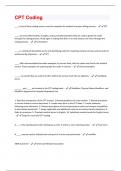
Add-on Codes (+) - Procedure performed and reported in addition to a primary procedure. A plus sign (+) next to a code in the main text indicates an add-on code. Add-on codes describe "secondary procedures" that are commonly carried out in addition to a primary procedure. Add-on codes usually use phrases such as "each additional" or "list separately in addition to the primary procedure" to show that they are NEVER used as stand-alone codes. Anesthesia Section of CPT - These codes are for anesthesia services by or supervised by a physician; and include general, regional, and local anesthesia. This section is organized by body site. Guidelines include time-based, services covered (bundled) in codes, unlisted services/special reports, and qualifying circumstances codes. Bullet Inside a Circle (Moderate Sedation) - Moderate sedation is moderate, drug-induced depression of consciousness during which patients can respond to verbal commands. The bullet inside a circle, in CPT, next to a code means that moderate sedation is part of the procedure that the surgeon performs. This means that for compliant coding, moderate sedation is not billed in addition to the code. Bullet Symbol - A bullet (a solid circle) indicates a new procedure code. The bullet symbol appears next to the code only the year that it is added. Bundled Codes - Procedure code for a surgical package that covers a group of services that should not be listed individually. Insurance payers assign a fee that reimburses all the services provided under a bundled code. When such services are billed, physicians MUST report the bundled code and not each of the other codes separately. Category I Codes - Procedure codes found in the main body of the CPT. Category I codes -- which are most of the codes in the CPT -- are five-digit numbers with no decimals. They are organized into six sections: (1) Evaluation and Management (E/M); (2) Anesthesia; (3) Surgery; (4) Radiology; (5) Pathology and Laboratory; and (6) Medicine. Category II Codes - Optional CPT codes that track performance measures. The Category II codes are listed at the end of the regular Category I CPT codes section, and are used to track performance measures for a medical goal, such as reducing tobacco use. Reporting these codes on health claims is OPTIONAL, and they are NOT paid. They do help in the development of best practices and improvedocumentation. These codes have an alphabetic character for the fifth digit such as 4000F for tobacco use cessation counseling. Category III Codes and Vaccine Codes - Temporary codes for emerging technology, services, and procedures. If a Category III code exists for a service, it rather than an unlisted code, MUST be used. these codes also have an alphabetic fifth digit such as 0184T. A temporary code may become permanent and part of the regular codes if the service it identifies proves effective and is widely performed. Both vaccine product codes and Category III codes are released twice a year and have a six-month period for implementation. Offices billing these services should check for updates at the CPT website. Code Linkage - Connection between a service and a patient's condition or illness. On correct insurance claims, each reported service is connected to a diagnosis that supports the procedure as necessary to investigate or treat the patient's condition in that health care setting. Health plans analyze this connection between the diagnostic and procedural information, called code linkage, to evaluate the medical necessity of the reported charges. Procedure codes must be verified and then used to report physician's services. Physician, a medical coder, clearinghouse coder, or a medical administrative assistant may be responsible for the selection of procedure codes. Note that it is the physician's responsibility to report the correct CPT code. To be sure that the procedure codes, and the diagnosis codes, are correctly linked and valid, a medical administrative assistant, coder, or clearinghouse would review the documentation in the patient's medical record to be sure it supports the codes. A query may be communicated to the physician to resolve outstanding questions. By verifying all information and following the rules of correct coding, medical administrative assistants ensure that the provider receives the maximum appropriate reimbursement for procedures and services. Coding Immunization - Injections and infusions of immune globulins, vaccines, toxoids, and other substances require TWO codes: (1) one code for giving the injection and (2) one code for the particular vaccine or toxoid that is given. These codes are selected from the Medicine section of CPT. Note: An E/M code is NOT used along with the codes for immunizations unless a significant separate evaluation and management service is also done.Coding Surgical Procedures - Codes in the Surgery section represent groups of procedures that include all routine elements. The combination of services is called a surgical package. According to the Surgery section guidelines in the CPT, the procedure codes for surgical procedures include the following: (1) after the decision for surgery, one related E/M encounter on the date immediately before or on the date of the procedure; (2) the operation: preparing the patient for surgery, including injection of anesthesia by the surgeon (local infiltration, metacarpal/metatarsal/digital block or topical anesthesia), and performing the operation, including normal additional procedures, such as debridement; (3) immediate postoperative care, including dictating operative notes, talking with the family and other physicians; (4) writing orders; (5) evaluating the patient in the postanesthesia recovery area; and (6) typical postoperative follow-up care. A complete procedures includes the operation, the use of a local anesthetic, and post-operative care, all covered under a single code.
Written for
- Institution
- Procedural Coding - CPT
- Course
- Procedural Coding - CPT
Document information
- Uploaded on
- June 11, 2024
- Number of pages
- 16
- Written in
- 2023/2024
- Type
- Exam (elaborations)
- Contains
- Questions & answers
Subjects

Also available in package deal