Chapter 1
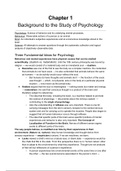
Background to the Study of Psychology
Psychology: Science of behavior and its underlying mental processes.
Behaviour: Observable actions of a person or an animal.
Mind: An individual’s subjective experiences and al unconscious knowledge stored in the
brain.
Science: All attempts to answer questions through the systematic collection and logical
analysis of objectively observable data.
Three Fundamental Ideas for Psychology
Behaviour and mental experiences have physical causes that can be studied
scientifically. (dualism vs. materialism): Until the 18th century philosophy was bound by
religion → we would consist of a material body and an immaterial soul → dualism.
● Descartes was one of the first to see the body as a complex machine. He contended
that animals do not have souls → he also contended that animals behave the same
as humans → so de activity would occur without the soul.
○ But humans do have thoughts and animals don’t → the function of the souls
was thought → which, not physical, acts on the body at a particular physical
location → now known as the pineal body.
● Hobbes argued that the soul is meaningless → nothing exists but matter and energy
→ materialism. He said that conscious thought is a product of the brain and
therefore subject to natural law.
○ The idea that the body, including the brain, is a machine helped to promote
the science of physiology → discoveries about the nervous system →
contributing to the origin of psychology.
○ Also the understanding of reflexes was very important. There is one for
carrying messages from the skin’s sensory receptor to the central nervous
system and one for carrying out to operate the muscles. People also began to
suggest that all human behaviour occurs through reflexes.
○ The idea that specific parts of the brain serve specific functions of mental
experiences and behavior is also very important: The Concept of
Localization of Function in the Brain. Nerves of different sense organs
excite to different parts of the brain.
The way people behave, is modified over time by their experiences in their
environment. (Nature vs. nurture): Idea human knowledge and thought derive from
sensory experience → empiricism (nurture). If we are machines, we learn.
● Locke viewed a child’s mind as a tabula rasa, or blank slate → experience would be
the chalk that fills in the slate. From this perspective there is no ‘human nature’ other
than to adapt to the environment by what they experience. Thought are not products
of free will but reflections of a person’s experience.
○ A person experiences two environmental events at the same time or one after
the other → the two events become associated in the person’s mind →
, association by contiguity. Thoughts are formed from combinations of
simple ideas → like chemical compounds are formed from combinations of
chemical elements → John Stuart Mill.
○ Priori knowledge is built into the human brain → posteriori knowledge is
gained from experience → nativism (nature). Without priori knowledge a
person could not acquire posteriori knowledge.
The body’s machinery, which produces behavior and mental experiences, is a product
of evolution by natural selection, (Evolution vs. creationism):
● Darwin’s fundamental idea was that living things evolve gradually, over generations,
by a process of natural selection → species change gradually in ways that allow them
to meet the demands of their environment. He studied the functions of behavior,the
ways in which an organism’s behaviour helps it to survive and reproduce.
○ Darwin illustrated how evolutionary thinking contributes to a scientific
understanding of human behaviour. The inherited mechanisms underlying
human emotions came out gradually because they promoted the survival and
reproduction of our ancestors. Kant would have said that the inherent
furnishings of the mind came about through the process of natural selection,
which gradually build all these capacities into the human brain.
The scope of psychology
Psychologists strive to explain mental experiences and behaviour → to identify causes. This
can be done on different levels → Levels of analysis.
Explanations that focus on biological processes:
● Neural explanations: All behaviours and mental experiences are products of the
nervous system. Behavioural neuroscience → exploring how the nervous system
produces a particular behaviour or experience. Some study individual neurons or
small groups, some study larger brain regions of neurons.
● Physiological explanations: This is closely related to behavioural neuroscience.
Physiologists study the way hormones and drugs act on the brain to alter behaviour
and experience.
● Genetic explanations: Genes are units of heredity that provide codes for building
your entire body, including the brain. Difference in genes → differences in the in the
brain → differences in mental experiences and behaviour → behavioral genetics.
● Evolutionary explanations: This is a way to explain how and why universal human
characteristics came about in the course of evolution → evolutionary psychology
→ scientists are interested in how behaviour evolved and identifying evolutionary
functions.
Explanations that focus on environmental experiences, knowledge, and development:
● Learning explanations: All forms of human behavior and mental experience are
modifiable by learning. Psychologist are interested in the ways that learning can
influence the types of behavior they study → learning psychology.
● Cognitive explanations: Cognition refers to information in the mind that is somehow
stored and activated by the workings of the brain. Conscious information → when a
person is aware of it and can describe it. Unconscious information → it can influence
, one’s conscious experiences and behaviour. Cognitive psychology → specifying
the types of mental information that underlie and make behaviour possible. They are
also interested in how learned info is stored and organized in the mind.
● Social explanations: Humans are by nature social animals → we need to get along
with others to survive and reproduce. By identifying how people are influenced by
other people or other people’s believes we can explain mental experiences and
behaviour → social psychology.
● Cultural explanations: Striving to characterize entire cultures in terms of the typical
ways people within them feel, think, act → cultural psychology. Psychologists often
refer to the unique history, economy and religious or philosophical traditions of a
culture to explain the values, norms and habits of people.
● Developmental explanations: The specialty that documents and describes the
typical age differences → developmental psychology. Psychologists are interested
in the processes that produce the age-related changes. Developmental psychology
brings all the other explanations in psychology together in order to explain
developmental psychology together..
Psychological specialties: Different psychological research specialties correspond to
different levels of analysis → other specialties are defined in terms of topics studied.
● Sensory psychology: Study of basic abilities to see, hear, touch, taste and smell the
environment.
● Perceptual psychology: Study of how people and animals interpret the input they
receive through their senses.
Also many psychologists combine specialties → cognitive cultural psychologists. Research
specialties in psychology are not rigidly defined.
Psychology as a profession: The main settings in which psychologists work are:
● Academic departments in universities and colleges: they are employed to conduct
basic research.
● Clinical settings: they work with clients who have psychological problems or
disorders.
● Elementary and secondary schools: they administer psychological tests, supervise
programs for children who have special needs.
● Business and government: they are hired for conducting research, screening job
candidates, helping to design more pleasant and efficient work environments and
counseling employees with work-related problems.
Background to the Study of Psychology
Psychology: Science of behavior and its underlying mental processes.
Behaviour: Observable actions of a person or an animal.
Mind: An individual’s subjective experiences and al unconscious knowledge stored in the
brain.
Science: All attempts to answer questions through the systematic collection and logical
analysis of objectively observable data.
Three Fundamental Ideas for Psychology
Behaviour and mental experiences have physical causes that can be studied
scientifically. (dualism vs. materialism): Until the 18th century philosophy was bound by
religion → we would consist of a material body and an immaterial soul → dualism.
● Descartes was one of the first to see the body as a complex machine. He contended
that animals do not have souls → he also contended that animals behave the same
as humans → so de activity would occur without the soul.
○ But humans do have thoughts and animals don’t → the function of the souls
was thought → which, not physical, acts on the body at a particular physical
location → now known as the pineal body.
● Hobbes argued that the soul is meaningless → nothing exists but matter and energy
→ materialism. He said that conscious thought is a product of the brain and
therefore subject to natural law.
○ The idea that the body, including the brain, is a machine helped to promote
the science of physiology → discoveries about the nervous system →
contributing to the origin of psychology.
○ Also the understanding of reflexes was very important. There is one for
carrying messages from the skin’s sensory receptor to the central nervous
system and one for carrying out to operate the muscles. People also began to
suggest that all human behaviour occurs through reflexes.
○ The idea that specific parts of the brain serve specific functions of mental
experiences and behavior is also very important: The Concept of
Localization of Function in the Brain. Nerves of different sense organs
excite to different parts of the brain.
The way people behave, is modified over time by their experiences in their
environment. (Nature vs. nurture): Idea human knowledge and thought derive from
sensory experience → empiricism (nurture). If we are machines, we learn.
● Locke viewed a child’s mind as a tabula rasa, or blank slate → experience would be
the chalk that fills in the slate. From this perspective there is no ‘human nature’ other
than to adapt to the environment by what they experience. Thought are not products
of free will but reflections of a person’s experience.
○ A person experiences two environmental events at the same time or one after
the other → the two events become associated in the person’s mind →
, association by contiguity. Thoughts are formed from combinations of
simple ideas → like chemical compounds are formed from combinations of
chemical elements → John Stuart Mill.
○ Priori knowledge is built into the human brain → posteriori knowledge is
gained from experience → nativism (nature). Without priori knowledge a
person could not acquire posteriori knowledge.
The body’s machinery, which produces behavior and mental experiences, is a product
of evolution by natural selection, (Evolution vs. creationism):
● Darwin’s fundamental idea was that living things evolve gradually, over generations,
by a process of natural selection → species change gradually in ways that allow them
to meet the demands of their environment. He studied the functions of behavior,the
ways in which an organism’s behaviour helps it to survive and reproduce.
○ Darwin illustrated how evolutionary thinking contributes to a scientific
understanding of human behaviour. The inherited mechanisms underlying
human emotions came out gradually because they promoted the survival and
reproduction of our ancestors. Kant would have said that the inherent
furnishings of the mind came about through the process of natural selection,
which gradually build all these capacities into the human brain.
The scope of psychology
Psychologists strive to explain mental experiences and behaviour → to identify causes. This
can be done on different levels → Levels of analysis.
Explanations that focus on biological processes:
● Neural explanations: All behaviours and mental experiences are products of the
nervous system. Behavioural neuroscience → exploring how the nervous system
produces a particular behaviour or experience. Some study individual neurons or
small groups, some study larger brain regions of neurons.
● Physiological explanations: This is closely related to behavioural neuroscience.
Physiologists study the way hormones and drugs act on the brain to alter behaviour
and experience.
● Genetic explanations: Genes are units of heredity that provide codes for building
your entire body, including the brain. Difference in genes → differences in the in the
brain → differences in mental experiences and behaviour → behavioral genetics.
● Evolutionary explanations: This is a way to explain how and why universal human
characteristics came about in the course of evolution → evolutionary psychology
→ scientists are interested in how behaviour evolved and identifying evolutionary
functions.
Explanations that focus on environmental experiences, knowledge, and development:
● Learning explanations: All forms of human behavior and mental experience are
modifiable by learning. Psychologist are interested in the ways that learning can
influence the types of behavior they study → learning psychology.
● Cognitive explanations: Cognition refers to information in the mind that is somehow
stored and activated by the workings of the brain. Conscious information → when a
person is aware of it and can describe it. Unconscious information → it can influence
, one’s conscious experiences and behaviour. Cognitive psychology → specifying
the types of mental information that underlie and make behaviour possible. They are
also interested in how learned info is stored and organized in the mind.
● Social explanations: Humans are by nature social animals → we need to get along
with others to survive and reproduce. By identifying how people are influenced by
other people or other people’s believes we can explain mental experiences and
behaviour → social psychology.
● Cultural explanations: Striving to characterize entire cultures in terms of the typical
ways people within them feel, think, act → cultural psychology. Psychologists often
refer to the unique history, economy and religious or philosophical traditions of a
culture to explain the values, norms and habits of people.
● Developmental explanations: The specialty that documents and describes the
typical age differences → developmental psychology. Psychologists are interested
in the processes that produce the age-related changes. Developmental psychology
brings all the other explanations in psychology together in order to explain
developmental psychology together..
Psychological specialties: Different psychological research specialties correspond to
different levels of analysis → other specialties are defined in terms of topics studied.
● Sensory psychology: Study of basic abilities to see, hear, touch, taste and smell the
environment.
● Perceptual psychology: Study of how people and animals interpret the input they
receive through their senses.
Also many psychologists combine specialties → cognitive cultural psychologists. Research
specialties in psychology are not rigidly defined.
Psychology as a profession: The main settings in which psychologists work are:
● Academic departments in universities and colleges: they are employed to conduct
basic research.
● Clinical settings: they work with clients who have psychological problems or
disorders.
● Elementary and secondary schools: they administer psychological tests, supervise
programs for children who have special needs.
● Business and government: they are hired for conducting research, screening job
candidates, helping to design more pleasant and efficient work environments and
counseling employees with work-related problems.