100% satisfaction guarantee Immediately available after payment Both online and in PDF No strings attached 4.2 TrustPilot
logo-home
Exam (elaborations)

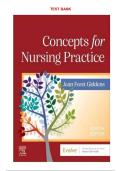
Test Bank for Concepts for Nursing Practice, 4th Edition, by Giddens

Rating
5.0
(1)
Sold
5
Pages
499
Grade
A+
Uploaded on
10-06-2024
Written in
2023/2024

Test Bank for Concepts for Nursing Practice, 4th Edition, by Giddens Concept 01: Development Giddens: Concepts for Nursing Practice, 4th Edition MULTIPLE CHOICE 1. The nurse manager of a pediatric clinic could confirm that the new nurse recognized the purpose of the HEADSS Adolescent Risk Profile when the new nurse responds that it is used to assess for needs related to a. anticipatory guidance. b. low-risk adolescents. c. physical development. d. sexual development. ANS: A The HEADSS Adolescent Risk Profile is a psychosocial assessment screening tool which assesses home, education, activities, drugs, sex, and suicide for the purpose of identifying high-risk adolescents and the need for anticipatory guidance. It is used to identify high-risk, not low-risk, adolescents. Physical development is assessed with anthropometric data. Sexual development is assessed using physical examination. OBJ: NCLEX Client Needs Category: Health Promotion and Maintenance 2. The nurse preparing a teaching plan for a preschooler knows that, according to Piaget, the expected stage of development for a preschooler is a. concrete operational. b. formal operational. N c. preoperational. d. sensorimotor. ANS: C The expected stage of development for a preschooler (3–4 years old) is pre-operational. Concrete operational describes the thinking of a school-age child (7–11 years old). Formal operational describes the thinking of an individual after about 11 years of age. Sensorimotor describes the earliest pattern of thinking from birth to 2 years old. OBJ: NCLEX Client Needs Category: Health Promotion and Maintenance 3. The school nurse talking with a high school class about the difference between growth and development would best describe growth as a. processes by which early cells specialize. b. psychosocial and cognitive changes. c. qualitative changes associated with aging. d. quantitative changes in size or weight. ANS: D Growth is a quantitative change in which an increase in cell number and size results in an increase in overall size or weight of the body or any of its parts. The processes by which early cells specialize are referred to as differentiation. Psychosocial and cognitive changes are referred to as development. Qualitative changes associated with aging are referred to as maturation. OBJ: NCLEX Client Needs Category: Health Promotion and Maintenance 4. The most appropriate response of the nurse when a mother asks what the Denver II does is that it a. can diagnose developmental disabilities. b. identifies a need for physical therapy. c. is a developmental screening tool. d. provides a framework for health teaching. ANS: C The Denver II is the most commonly used measure of developmental status used by healthcare professionals; it is a screening tool. Screening tools do not provide a diagnosis. Diagnosis requires a thorough neurodevelopment history and physical examination. Developmental delay, which is suggested by screening, is a symptom, not a diagnosis. The need for any therapy would be identified with a comprehensive evaluation, not a screening tool. Some providers use the Denver II as a framework for teaching about expected development, but this is not the primary purpose of the tool. OBJ: NCLEX Client Needs Category: Health Promotion and Maintenance 5. To plan early intervention anN d care for an infant with Down syndrome, the nurse considers knowledge of other physical development exemplars such as a. cerebral palsy. b. autism. c. attention-deficit/hyperactivity disorder (ADHD). d. failure to thrive. ANS: D Failure to thrive is also a physical development exemplar. Cerebral palsy is an exemplar of motor/developmental delay. Autism is an exemplar of social/emotional developmental delay. ADHD is an exemplar of a cognitive disorder. OBJ: NCLEX Client Needs Category: Health Promotion and Maintenance 6. To plan early intervention and care for a child with a developmental delay, the nurse would consider knowledge of the concepts most significantly impacted by development, including a. culture. b. environment. c. functional status. d. nutrition. ANS: C Function is one of the concepts most significantly impacted by development. Others include sensory-perceptual, cognition, mobility, reproduction, and sexuality. Knowledge of these concepts can help the nurse anticipate areas that need to be addressed. Culture is a concept that is considered to significantly affect development; the difference is the concepts that affect development are those that represent major influencing factors (causes); hence determination of development would be the focus of preventive interventions. Environment is considered to significantly affect development. Nutrition is considered to significantly affect development. OBJ: NCLEX Client Needs Category: Health Promotion and Maintenance 7. A mother complains to the nurse at the pediatric clinic that her 4-year-old child always talks to her toys and makes up stories. The mother wants her child to have a psychological evaluation. The nurse’s best initial response is to a. refer the child to a psychologist immediately. b. explain that playing make believe is normal at this age. c. complete a developmental screening using a validated tool. d. separate the child from the mother to get more information. ANS: B By the end of the fourth year, it is expected that a child will engage in fantasy, so this is normal at this age. A referral to a psychologist would be premature based only on the complaint of the mother. Completing a developmental screening would be very appropriate but not the initial response. The nurse would certainly want to get more information, but separating the child from the mother is not necessary at this time. OBJ: NCLEX Client NeedsNCategory: Health Promotion and Maintenance 8. A 17-year-old girl is hospitalized for appendicitis, and her mother asks the nurse why she is so needy and acting like a child. The best response of the nurse is that in the hospital, adolescents a. have separation anxiety. b. rebel against rules. c. regress because of stress. d. want to know everything. ANS: C Regression to an earlier stage of development is a common response to stress. Separation anxiety is most common in infants and toddlers. Rebellion against hospital rules is usually not an issue if the adolescent understands the rules and would not create childlike behaviors. An adolescent may want to “know everything” with their logical thinking and deductive reasoning, but that would not explain why they would act like a child. OBJ: NCLEX Client Needs Category: Health Promotion and Maintenance Concept 02: Functional Ability Giddens: Concepts for Nursing Practice, 4th Edition MULTIPLE CHOICE 1. The nurse is assessing a patient’s functional ability. Which patient best demonstrates the definition of functional ability? a. Considers self as a healthy individual; uses cane for stability b. College educated; travels frequently; can balance a checkbook c. Works out daily, reads well, cooks, and cleans house on the weekends d. Healthy individual, volunteers at church, works part time, takes care of family and house ANS: D Functional ability refers to the individual’s ability to perform the normal daily activities required to meet basic needs; fulfill usual roles in the family, workplace, and community; and maintain health and well-being. The other options are good; however, healthy individual, church volunteer, part time worker, and the patient who takes care of the family and house fully meets the criteria for functional ability. OBJ: NCLEX Client Needs Category: Physiological Integrity: Basic Care and Comfort 2. The nurse is assessing a patient’s functional performance. What assessment parameters will be most important in this assessment? a. Continence assessment, gait assessment, feeding assessment, dressing assessment, transfer assessment N b. Height, weight, body mass index (BMI), vital signs assessment c. Sleep assessment, energy assessment, memory assessment, concentration assessment d. Health and well-being, amount of community volunteer time, working outside the home, and ability to care for family and house ANS: A Functional impairment, disability, or handicap refers to varying degrees of an individual’s inability to perform the tasks required to complete normal life activities without assistance. Height, weight, BMI, and vital signs are part of a physical assessment. Sleep, energy, memory, and concentration are part of a depression screening. Healthy, volunteering, working, and caring for family and house are functional abilities, not performance. OBJ: NCLEX Client Needs Category: Physiological Integrity: Reduction of Risk Potential 3. The nurse is assessing a patient with a mobility dysfunction and wants to gain insight into the patient’s functional ability. What question would be the most appropriate? a. “Are you able to shop for yourself?” b. “Do you use a cane, walker, or wheelchair to ambulate?” c. “Do you know what today’s date is?” d. “Were you sad or depressed more than once in the last 3 days?” ANS: B “Do you use a cane, walker, or wheelchair to ambulate?” will assist the nurse in determining the patient’s ability to perform self-care activities. A nutritional health risk assessment is not the functional assessment. Knowing the date is part of a mental status exam. Assessing sadness is a question to ask in the depression screening. OBJ: NCLEX Client Needs Category: Physiological Integrity: Physiological Adaptation 4. The nurse is developing an interdisciplinary plan of care using the Roper-Logan-Tierney Model of Nursing for a patient who is currently unconscious. Which interventions would be most critical to developing a plan of care for this patient? a. Eating and drinking, personal cleansing and dressing, working and playing b. Toileting, transferring, dressing, and bathing activities c. Sleeping, expressing sexuality, socializing with peers d. Maintaining a safe environment, breathing, maintaining temperature ANS: D The most critical aspects of care for an unconscious patient are safe environment, breathing, and temperature. Eating and drinking are contraindicated in unconscious patients. Toileting, transferring, dressing, and bathing activities are BADLs. Sleeping, expressing sexuality, and socializing with peers are a part of the Roper-Logan-Tierney Model of Nursing; however, these are not the most critical for developing the plan of care in an unconscious patient. OBJ: NCLEX Client Needs Category: Physiological Integrity: Physiological Adaptation 5. The home care nurse is trying to determine the necessary services for a 65-year-old patient who was admitted to the home care service after left knee replacement. Which tool is the best for the nurse to utilize? N a. Minimum Data Set (MDS) b. Functional Status Scale (FSS) c. 24-Hour Functional Ability Questionnaire (24hFAQ) d. The Edmonton Functional Assessment Tool ANS: C The 24hFAQ assesses the postoperative patient in the home setting. The MDS is for nursing home patients. The FSS is for children. The Edmonton is for cancer patients. OBJ: NCLEX Client Needs Category: Health Promotion and Maintenance 6. The nurse is assessing a patient’s functional abilities and asks the patient, “How would you rate your ability to prepare a balanced meal?” “How would you rate your ability to balance a checkbook?” “How would you rate your ability to keep track of your appointments?” Which tool would be indicated for the best results of this patient’s perception of their abilities? a. Functional Activities Questionnaire (FAQ) b. Mini Mental Status Exam (MMSE) c. 24hFAQ d. Performance-based functional measurement ANS: A The FAQ is an example of a self-report tool which provides information about the patient’s perception of functional ability. The MMSE assesses cognitive impairment. The 24hFAQ is used to assess functional ability in postoperative patients. Performance-based tools involve actual observation of a standardized task, completion of which is judged by objective criteria. OBJ: NCLEX Client Needs Category: Health Promotion and Maintenance MULTIPLE RESPONSE 1. A 65-year-old female patient has been admitted to the medical/surgical unit. The nurse is assessing the patient’s risk for falls so that falls prevention can be implemented if necessary. Select all the risk factors that apply from this patient's history and physical. (Select all that apply.) a. Being a woman b. Taking more than six medications c. Having hypertension d. Having cataracts e. Muscle strength 3/5 bilaterally f. Incontinence ANS: B, D, E, F Adverse effects of medications can contribute to falls. Cataracts impair vision, which is a risk factor for falls. Poor muscle strength is a risk factor for falls. Incontinence of urine or stool increases risk for falls. Men have a higher risk for falls. Hypertension itself does not contribute to falls. Taking meNdications to treat hypertension that may lead to hypotension and dizziness is a fall risk. Dizziness does contribute to falls. OBJ: NCLEX Client Needs Category: Physiological Integrity: Reduction of Risk Potential Concept 03: Family Dynamics Giddens: Concepts for Nursing Practice, 4th Edition MULTIPLE CHOICE 1. The most appropriate initial nursing intervention when the nurse notes dysfunctional interactions and lack of family support for a patient would be to a. enforce hospital visiting policies. b. monitor the dysfunctional interactions. c. notify the primary care provider. d. role model appropriate support. ANS: D Nurses can, at times, role model more appropriate interactions or provide suggestions for improving communication and interactions among family members. If the nurse determines that the number of visitors has a negative impact on the patient, hospital policy may be to limit visitors, but that would not be the initial action. Monitoring the dysfunctional interactions would not be an adequate response. The primary care provider should certainly be notified, but that would not be the initial response. OBJ: NCLEX Client Needs Category: Psychosocial Integrity 2. The nurse caring for a patient would identify a need for additional interventions related to family dynamics when a. extended family offers to help. b. family members express c Noncern. c. the ill member demands attention. d. memories are shared. ANS: C It is not uncommon for the ill family member to become demanding and indicate that they deserve special treatment and care, and the supportive family may need assistance in understanding the dynamics of the illness in order to continue to be supportive. Offers from extended family to help can be indicative of positive dynamics. Concern expressed by family members can be indicative of positive dynamics. Sharing of family memories can be indicative of positive dynamics. OBJ: NCLEX Client Needs Category: Psychosocial Integrity 3. Two women have an established long-term relationship and are attending parenting classes in anticipation of finalizing adoption of a baby. The nurse identifies them as which type of family? a. Cohabiting b. Nuclear c. Same-sex d. Single parent ANS: C This family would be considered a same-sex family. Cohabiting refers to a couple who live together with no legal bond. Nuclear refers to the traditional male and female core family with one or more children. Single parent refers to a family with one adult and one or more children. OBJ: NCLEX Client Needs Category: Psychosocial Integrity 4. The nurse identifies the family with a child graduating from college as having which effect on the family life cycle? a. Minimal impact b. Considered to be a negative impact on the family unit c. Leads to role confusion d. Expectation of role change ANS: D The family life cycle developmental theory focuses on the growth and development of changes in role relationships during transitional periods. A child graduating from college is an example of a transition which requires a role change. As this is a transition, one would expect to see a change so minimal impact would not be expected. Graduation does not imply that it will be a negative change on the family life cycle or lead to role confusion. OBJ: NCLEX Client Needs Category: Psychosocial Integrity 5. When reviewing the purposes of a family assessment, the nurse educator would identify a need for further teaching if the student responded that family assessment is used to gain an understanding of which aspect of the family? a. Development N b. Function c. Political views d. Structure ANS: C An understanding of the political views of family members is not a primary purpose of a family assessment. A family assessment provides the nurse with information and an understanding of family dynamics. This is important to nurses for the provision of quality health care. A family assessment provides an understanding of family development, function, and structure. OBJ: NCLEX Client Needs Category: Health Promotion and Maintenance 6. A nurse is planning to assess the structure of a family. Which question should the nurse ask? a. “Who lives with you in this home?” b. “Who does the grocery shopping?” c. “Who provides support in your family?” d. “How old are the members of your family?” ANS: A The structure of the family includes who is in the family and what their relationship is. “Who does the shopping?” would provide information about family functioning. “Who provides support?” would provide information about family functioning. “How old are the members?” would provide information about family development. OBJ: NCLEX Client Needs Category: Psychosocial Integrity 7. Which factors which would alert the nurse to negative/dysfunctional family dynamics? a. Aging of family members b. Chronic illness of a family member c. Disability of a family member d. Intimate partner violence ANS: D Intimate partner violence is an exemplar of negative/dysfunctional family dynamics. Aging of family members is an exemplar of changes to family dynamics. Chronic illness of a family member is an exemplar of changes to family dynamics. Disability of a family member is an exemplar of changes to family dynamics. OBJ: NCLEX Client Needs Category: Psychosocial Integrity N Concept 04: Culture Giddens: Concepts for Nursing Practice, 4th Edition MULTIPLE CHOICE 1. The nurse is caring for an older Chinese adult male who is grimacing and appears restless after abdominal surgery. What is the nurse’s best action? a. Ask the patient if he is anxious about his hospital stay. b. Ask a translator to conduct a FACES pain scale assessment. c. Ask the patient about pain and assess vital signs. d. Ask the patient about any history of depression or anxiety. ANS: C In the Chinese culture, elderly Chinese people believe that they must be stoic about pain and there is a stigma about talking about any mental health problems. The nurse should ask the patient about pain and also assess vital signs for physiological signs of pain, since the patient may not admit to any pain. Assuming the patient is depressed or anxious is not the best action when considering individual cultural differences and the risk of pain after major surgery. The registered nurse should never delegate assessment to any unlicensed member of the healthcare team such as a translator. The translator may assist with communication, but the nurse is responsible for the pain assessment. OBJ: NCLEX Client Needs Category: Psychosocial Integrity | NCLEX Client Needs Category: Physiological Integrity: Basic Care and Comfort 2. Understanding cultural differN ences in health care is important because it will help the nurse to understand the manner in which people decide on obtaining treatments and medical care. In independent cultures an individual will a. put himself first. b. consult family members for advice. c. ask for a second opinion. d. travel great distances to receive the best care. ANS: A In independent cultures, an individual will put himself first in the case of a life-threatening illness, whereas even in dire circumstances, members of collectivist cultures may still consult other family members for the best course of action. In independent cultures, an individual will not consult with other family members, ask for a second opinion, or travel great distances to receive the best care. OBJ: NCLEX Client Needs Category: Psychosocial Integrity 3. When teaching an Asian patient with newly diagnosed diabetes, the nurse notes the patient nodding yes to everything that is being said. With a better understanding of cultural interdependence in self-concept, a nurse should immediately a. write everything down for the patient to refer to later. b. prompt further to elicit additional questions or concerns. c. call the recognized elder for this patient. d. call the oldest male relative for help with decision making. ANS: B When a nurse provides nutritional education to a patient who is from a culture that values greater power distance, it might appear that the patient is willing to accept all that the nurse suggests, when further prompting would elicit additional questions or concerns. The patient from a collectivist culture will usually consult family members for a best course of action. It is not acceptable for nurses to take it upon themselves to call the recognized elder or oldest male relative for help with decision making. While writing everything down may be OK for some cultures, with Asian patients it may be best to prompt further to elicit additional questions or concerns. OBJ: NCLEX Client Needs Category: Psychosocial Integrity 4. Women who are given the job of caretaker for aging relatives are subject to caregiver strain due to a. feminine attributes. b. unequal gender. c. fixed gender roles. d. female inequality. ANS: C In cultures with more fixed gender roles, women are usually given the role of caretaker for aging relatives and may suffer the stresses of caregiver strain. Feminine attributes refers to harmonious relationships, modesty, and taking care of others. Unequal gender refers to roles of males and females being unevenly distributed. Female inequality refers to female gender and roles being less than or unequal to male roles. N OBJ: NCLEX Client Needs Category: Psychosocial Integrity 5. A 60-year-old Italian immigrant presents for an annual physical. He is counseled about diagnostic testing including laboratory testing, colonoscopy, influenza vaccination, and pneumococcal vaccination. His reply is “If it ain’t broke, don’t try to fix it.” When developing a plan of care, the nurse should consider which cultural orientation for this patient? a. Short term b. Long term c. Leisurely term d. Noncommittal ANS: A Short-term cultural orientation focuses on the present or past and emphasizes quick results. Long-term cultural orientation focuses the future and long-term rewards. Long-term-oriented cultures favor thrift, perseverance, and adopting to changing circumstances. Leisurely term and noncommittal are undefined in cultural orientation. OBJ: NCLEX Client Needs Category: Psychosocial Integrity 6. The emphasis on understanding cultural influence on health care is important because of a. disability entitlements. b. HIPAA requirements. c. increasing global diversity. d. litigious society. ANS: C Culture is an essential aspect of health care because of increasing diversity. Disability entitlements refer to defined benefits for eligible mental or physically disabled beneficiaries in relation to housing, employment, and health care. HIPAA requirements refers to the HIPAA Privacy Rule, which protects the privacy of individually identifiable health information; the HIPAA Security Rule, which sets national standards for the security of electronic protected health information; and the confidentiality provisions of the Patient Safety Rule, which protect identifiable information being used to analyze patient safety events and improve patient safety. Litigious society refers to excessively ready to go to law or initiate a lawsuit. OBJ: NCLEX Client Needs Category: Health Promotion and Maintenance 7. What interrelated constructs facilitate a nurse to become culturally competent? a. Cultural diversity, self-awareness, cultural skill, and cultural knowledge b. Cultural desire, self-awareness, cultural knowledge, and cultural identity c. Cultural desire, self-awareness, cultural knowledge, and cultural diversity d. Cultural desire, self-awareness, cultural knowledge, and cultural skill ANS: D The process of cultural competence consists of four interrelated constructs: cultural desire, self-awareness, cultural knowledge, and cultural skill. Cultural diversity in the context of health care refers to achieving the highest level of health care for all people by addressing societal inequalities and histoN rical and contemporary injustices. Cultural identity is the norms, values, beliefs, and behaviors of a culture learned through families and group members. OBJ: NCLEX Client Needs Category: Psychosocial Integrity Concept 05: Spirituality Giddens: Concepts for Nursing Practice, 4th Edition MULTIPLE CHOICE 1. The nurse is assessing a patient's spirituality and observes the patient meditating before any treatments. What is the nurse’s best action? a. Document that the patient is not religious. b. Offer the patient a copy of the Bible to read. c. Arrange for quiet time for the patient as needed. d. Limit the time patient can meditate before procedures. ANS: C The nurse can best promote the patient’s spirituality practices by arranging for the patient to be left alone when possible to meditate. Meditation is an exemplar of spirituality, not necessarily of the Christian faith. The Bible is most often read by believers in the Christian faith. Meditation does not imply that the patient is not religious. Time for meditation should not be limited, whenever possible. OBJ: NCLEX Client Needs Category: Safe and Effective Care Environment: Health Promotion and Maintenance 2. When conducting a spiritual assessment of a hospitalized patient, the nurse should remain aware of which potential barrier to effective communication? a. Clarifying the meaning of a patient’s statement. b. Multi-tasking while talkin Ng to the patient. c. Listening to patients’ complete statements. d. Discussing patient’s feelings while hospitalized. ANS: B Several barriers may result in the nurse’s inability to be totally present and communicate effectively with the patient. First, the nurse may be distracted by other things and may not pay attention to the patient. Multi-tasking while trying to listen to a patient may be a barrier to effective communication. Second, the nurse may miss the meaning of the patient’s message because of failure to clarify the meaning of a word, a phrase, or a facial expression. Third, the nurse may interject personal feelings and reactions into the patient’s situation rather than allow the patient to explore and discuss his own feelings and reactions. The last barrier occurs when the nurse is busy formulating a response while the patient is still talking. In this instance, the nurse never hears the patient’s message. OBJ: NCLEX Client Needs Category: Safe and Effective Care Environment: Psychosocial Integrity 3. A patient uses rosary beads and attends mass once a week. This expression of spirituality is best described with which term? a. Religiosity b. Faith c. Belief d. Authenticity ANS: A There are a few similar and related terms to spirituality worth mentioning to provide distinction and clarification. Faith, as defined by Dyess, refers to an “evolving pattern of believing, that grounds and guides authentic living and gives meaning in the present moment of inter-relating.” Religiosity, another similar term, is an external expression (public or private), in the form of practicing a belief or faith, whereas spirituality is an internalized spiritual identity (or experiential). Specifically, religiosity is defined as “the adherence to religious dogma or creed, the expression of moral beliefs, and/or the participation in organized or individual worship, or sacred practices.” OBJ: NCLEX Client Needs Category: Safe and Effective Care Environment: Psychosocial Integrity 4. When developing a plan of care, the nurse should consider which attribute of the concept of spirituality? a. Spirituality is not a well-known universal concept. b. Chronic versus acute illnesses affect spirituality. c. Convincing patients to pray is a priority intervention. d. Referrals may be needed to spiritual counselors. ANS: D The attributes of the concept of spirituality in the context of nursing care are described below.  Spirituality is universal. All individuals, even those who profess no religious belief, are driven to derive meaning and purpose from life.  Illness impacts spirituN ality in a variety of ways. Some patients and families will draw closer to God or however they conceive that higher Power to be in an effort to seek support, healing, and comfort. Others may blame and feel anger toward that Higher Power for any illness and misfortune that may have befallen a loved one or their entire family. Still others will be neutral in their spiritual reactions.  There has to be willingness on the part of patient and/or family to share and/or act on spiritual beliefs and practices.  The nurse needs to be aware that specific spiritual beliefs and practices are impacted by family and culture.  The nurse needs to be willing to assess the concept of spirituality in patients and families and based on this ongoing assessment to integrate the spiritual beliefs of patients and families into care.  The nurse needs to be willing to refer the patient or family to a Spiritual Expert i.e., a Minister, Priest, Rabbi, an Imam.  Community-based religious organizations can provide supportive care to families and patients and nurses need to be aware of these resources. OBJ: NCLEX Client Needs Category: Safe and Effective Care Environment: Psychosocial Integrity MULTIPLE RESPONSE 1. When completing the FICA tool for spiritual assessment, which questions should the nurse ask the patient? (Select all that apply.) a. What things do you believe in that give meaning to life? b. Are you connected with a faith center in your community? c. How has your illness affected your personal beliefs? d. When was the last time you have been to church? e. What can I do for you? ANS: A, B, C, E The FICA tool for spiritual assessment stands for Faith or beliefs, Importance and influence, Community, and Address. “When was the last time you have been to church?” is not a question included in the FICA assessment. The patient may attend community activities, besides church, that foster his/her spiritual well-being. OBJ: NCLEX Client Needs Category: Health Promotion and Maintenance 2. Which are true statements about the definition of spirituality in nursing? (Select all that apply.) a. Patient’s quality of life, health, and sense of wholeness are affected by spirituality. b. An exact definition was developed and adopted in the late 1980s. c. Encompasses principle, an experience, attitudes, and belief regarding God d. Head knowledge affects spirituality more than heart knowledge. e. Mind, body, spirit, love, and caring are interconnected. ANS: A, C, E The concept of Spirituality is an elusive concept to define. Authors who write about spirituality in nursing advocaNte the position that a patient’s quality of life, health, and sense of wholeness are affected by spirituality, yet still the profession of nursing struggles to define it. Why? There are a number of explanations for this. One explanation is that spirituality represents “heart” not “head” knowledge and “heart” knowledge is difficult to encapsulate into words. A second explanation is that spirituality is unique to each person so a precise definition is somewhat elusive. The definitions of spirituality encompass the following: a principle, an experience, attitudes and belief regarding God, a sense of God, the inner person. Most descriptions of spirituality include not only transcendence but also the connection of mind, body, and spirit, plus love, caring, and compassion and a relationship with the Divine. OBJ: NCLEX Client Needs Category: Safe and Effective Care Environment: Health Promotion and Maintenance 3. Which life events should the nurse recognize as being spiritually life changing? (Select all that apply.) a. Births b. Weddings c. Medical diagnoses d. Career day to day job duties e. Loss of independence ANS: A, B, C, E The meaning and significance of the event might only be experienced by one individual; others who might be participants in the event might be left virtually untouched and unchanged. These life changing spiritual events include just about any occurrence that has intense and personal relevance to those involved in the event. Examples of spiritually life changing events include births, deaths, weddings, divorces, illnesses, diagnoses, and loss of abilities, loss of independence, death and so many more. These events, having the power to change individuals and families, also have the power to draw people toward the transcendent—for many people that transcendent is known as God but this is not universal. Day-to-day activities are not the best examples of spiritually life changing events. OBJ: NCLEX Client Needs Category: Safe and Effective Care En

Show more Read less
Institution
Concepts For Nursing Practice
Course
Concepts for Nursing Practice


Whoops! We can’t load your doc right now. Try again or contact support.

Written for

Institution
Concepts for Nursing Practice
Course
Concepts for Nursing Practice

Document information

Uploaded on
June 10, 2024
File latest updated on
November 27, 2025
Number of pages
499
Written in
2023/2024
Type
Exam (elaborations)
Contains
Questions & answers

Subjects

Content preview

TEST BANK

, Concept 01: Development

Giddens: Concepts for Nursing Practice, 4th Edition


MULTIPLE CHOICE

1. A pediatric clinic nurse manager asks a new nurse about the purpose of the HEADSS Adolescent Risk Profile.
Which reply would confirm the nurse understands its use?
a. “It helps guide anticipatory teaching.”
b. “It identifies adolescents at low risk.”
c. “It evaluates physical growth patterns.”
d. “It measures progress in sexual maturity.”


Correct Answer: A
The HEADSS tool assesses areas like home life, education, peer activities, substance use, sexuality, and mental health to
identify adolescents at risk and offer anticipatory guidance. It targets high-risk—not low-risk—youth. Physical and sexual
development are assessed through other clinical tools and exams.


2. While preparing a teaching session for parents of preschoolers, the nurse explains that, according to Piaget,
preschool-age children are in which cognitive phase?
a. Concrete operational
b. Formal operational
c. Preoperational
d. Sensorimotor


Correct Answer: C
Children between 3 and 4 years old are in the preoperational stage. The concrete operational stage applies to children aged
7–11, formal operational starts around age 11, and sensorimotor occurs from birth to 2 years.


3. A school nurse is teaching high school students the difference between growth and development. How should the
nurse define growth?
a. The process of cell differentiation
b. Mental and emotional advancement
c. Qualitative aging changes
d. Measurable increase in height or weight


Correct Answer: D

,Growth refers to measurable changes like weight and height due to increased cell number and size. Differentiation is
when cells become specialized. Development refers to psychosocial or mental changes, while qualitative aging changes
relate to maturation.


4. A mother asks the nurse what the Denver II test is used for. What is the best reply by the nurse?
a. “It gives a specific diagnosis of delays.”
b. “It helps decide if physical therapy is needed.”
c. “It’s a tool for developmental screening.”
d. “It outlines teaching points for caregivers.”

Correct Answer: C
The Denver II is widely used to screen young children for developmental concerns. It’s not diagnostic—it points out
possible delays that require further evaluation. While it can guide discussions on development, that’s not its main role.


5. While planning care for an infant with Down syndrome, the nurse reviews other physical development concerns.
Which example should the nurse consider?
a. Cerebral palsy
b. Autism spectrum disorder
c. ADHD
d. Failure to thrive


Correct Answer: D
Failure to thrive is categorized under physical development concerns. Cerebral palsy relates to motor delay, autism to
social-emotional development, and ADHD to cognitive function.


6. In preparing early care for a child with developmental delay, which factor most influenced by development
should the nurse focus on?
a. Cultural background
b. Surrounding environment
c. Functional ability
d. Nutritional status


Correct Answer: C
Function is one of the core concepts affected by development, alongside cognition, mobility, reproduction, and sensory-
perception. While factors like culture, nutrition, and environment impact development, functional status reflects how
delays manifest in daily living.

, 7. A mom tells the nurse her 4-year-old constantly talks to toys and invents stories. She’s worried something is
wrong. What is the nurse’s best first response?
a. “Let’s get a referral to a psychologist right away.”
b. “That’s a normal part of development at this age.”
c. “We’ll do a screening assessment right now.”
d. “Let’s talk to your child separately for more details.”


Correct Answer: B
Pretend play and storytelling are typical for 4-year-olds. A referral would be too early without further evidence. A
screening could be helpful, but reassurance is the appropriate initial action. Interviewing the child alone isn’t necessary at
this point.


8. A 17-year-old is hospitalized for appendicitis, and her mother tells the nurse she’s acting younger than usual.
What explanation should the nurse give?
a. “She’s feeling anxious about being apart from family.”
b. “Teens often break rules in unfamiliar settings.”
c. “She may be regressing in response to stress.”
d. “She’s just curious and wants detailed information.”


Correct Answer: C
Stress during hospitalization can cause adolescents to revert to earlier behaviors. Separation anxiety is more typical of
younger children. While teens may ask questions or challenge rules, this doesn’t explain regressive behavior like acting
childlike.

Reviews from verified buyers

Showing all reviews
4 months ago

5.0

1 reviews

5
1
4
0
3
0
2
0
1
0
Trustworthy reviews on Stuvia

All reviews are made by real Stuvia users after verified purchases.

Get to know the seller

Seller avatar
Reputation scores are based on the amount of documents a seller has sold for a fee and the reviews they have received for those documents. There are three levels: Bronze, Silver and Gold. The better the reputation, the more your can rely on the quality of the sellers work.
TopNursingTestBanks Johns Hopkins University School Of Nursing
View profile
Follow You need to be logged in order to follow users or courses
Sold
525
Member since
2 year
Number of followers
116
Documents
1012
Last sold
3 days ago
TopNursingTestBanks- Best Nursing Test Banks and Study Guides

Welcome to Top Nursing Test Banks, your trusted source for high-quality nursing test banks and exam study guides. We understand that nursing school can be overwhelming and demanding, but you don't have to navigate it alone. Our expertly curated resources are designed to make studying more efficient, boost your confidence, and help you succeed in exams. Whether you're preparing for NCLEX, ATI, or classroom tests, Top Nursing Test Banks is here to support your journey every step of the way.

Read more Read less
4.8

261 reviews

5
236
4
12
3
6
2
1
1
6

Recently viewed by you

Why students choose Stuvia

Created by fellow students, verified by reviews

Quality you can trust: written by students who passed their tests and reviewed by others who've used these notes.

Didn't get what you expected? Choose another document

No worries! You can instantly pick a different document that better fits what you're looking for.

Pay as you like, start learning right away

No subscription, no commitments. Pay the way you're used to via credit card and download your PDF document instantly.

Student with book image

“Bought, downloaded, and aced it. It really can be that simple.”

Alisha Student

Frequently asked questions