Exam Chemical Analysis – January 02, 2013
Opening remarks
1. Put your name and student number on each separate paper that you hand in.
2. This exam consists of 9 questions, for which you can earn 30 points in total. For each question, the
total number of points is given between square brackets. The exam consists of 5 A4 in total.
3. Answer the questions in a correct and concise way. Unreadable answers will not be awarded any
points! Irrelevant information containing errors will lead to a decrease in points.
4. For the open questions, an answer without explanation is not correct.
5. You may provide your answers in either Dutch or English.
6. All calculators are taboo.
Good luck!
--- PART 1: STATISTICS ---
Question 1 [4]
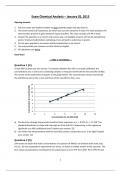
A new AES has been put into service. To evaluate whether this AES is correctly calibrated, the
concentration zinc in a few zinc-containing samples is measured with both the new and the old AES.
The results of this experiment are given in the graph below. The concentration values returned by
the old AES are put on the 𝑥 axis and those of the new AES on the 𝑦 axis.
14
Concentration Zn new AES (mM)
12
10
8
6
4
2
0
0 2 4 6 8 10 12
Concentration Zn old AES (mM)
a) The best line through these points found by linear regression is 𝑦 = 0.9913𝑥 + 2.1398. The
standard deviations on slope and intercept are 0.06 and 0.41 respectively. Is the regression
significant at a 99% confidence level? Explain your answer. [2]
b) Jan thinks that measurements with the new AES contain a systematic error. Is he right? Explain
your answer. [2]
Question 2 [5]
John wants to obtain the molar concentration of a solution of KMnO4 via titration with oxalic acid,
H2C2O4. Jan has repeated his experiment four times, to obtain a reliable answer to the question. The
four molar concentrations resulting from his experiments are 0.1979 𝑀, 0.2007 𝑀, 0.1993 𝑀 and
1
, 0.1989 𝑀. The mean value of these four concentrations is 0.1992 𝑀 and the standard deviation is
0,0012 𝑀.
a) Does the standard deviation increase or decrease when the precision of this experiment
decreases? No explanation is required. [1]
b) In which interval do you expect to find the real molar concentration of the KMnO4 solution? Use
a 95% confidence interval and explain your answer. [3]
c) What is the chance that the real molar concentration of the KMnO4 solution is lower than the
lowest value of the interval calculated in question b)? Explain shortly. [1]
--- PART 2: CHEMICAL ANALYSIS ---
Question 1 [2]
a) Select the letter where the different types of electromagnetic radiation are sorted from low to
high wavenumber. [1]
A. X-ray, infrared, microwave
B. X-ray, microwave, infrared
C. Infrared, X-ray, microwave
D. Infrared, microwave, X-ray
E. Microwave, infrared, X-ray
F. Microwave, X-ray, infrared
b) What is the main energy transition when a molecule absorbs infrared radiation? [1]
A. The molecule goes to a higher rotational energy level.
B. The molecule goes to a higher vibrational energy level.
C. The molecule goes to a higher electronic energy level.
D. The molecule is ionized.
Question 2 [3]
On the left, the UV absorption spectrum of 1,3-butadiene
is given.
a) The horizontal axis contains the wavelengths (in nm).
In which interval do you expect to find the values on
the 𝑥 axis? [1]
A. About [200; 300]
B. About [10; 1500]
C. About [216.95; 217.20]
D. You need more data to answer this question
b) We examine a molecule that fluoresces when it absorbs light with wavelength 𝜆1 . What do you
know about the wavelength of the fluorescent radiation 𝜆𝑓 ? [2]
A. 𝜆1 is always larger than or equal to 𝜆𝑓
B. 𝜆1 is always smaller than or equal to 𝜆𝑓
C. It depends on the atom or molecule which of the two wavelengths is largest
D. A,B and C are all incorrect.
2
Opening remarks
1. Put your name and student number on each separate paper that you hand in.
2. This exam consists of 9 questions, for which you can earn 30 points in total. For each question, the
total number of points is given between square brackets. The exam consists of 5 A4 in total.
3. Answer the questions in a correct and concise way. Unreadable answers will not be awarded any
points! Irrelevant information containing errors will lead to a decrease in points.
4. For the open questions, an answer without explanation is not correct.
5. You may provide your answers in either Dutch or English.
6. All calculators are taboo.
Good luck!
--- PART 1: STATISTICS ---
Question 1 [4]
A new AES has been put into service. To evaluate whether this AES is correctly calibrated, the
concentration zinc in a few zinc-containing samples is measured with both the new and the old AES.
The results of this experiment are given in the graph below. The concentration values returned by
the old AES are put on the 𝑥 axis and those of the new AES on the 𝑦 axis.
14
Concentration Zn new AES (mM)
12
10
8
6
4
2
0
0 2 4 6 8 10 12
Concentration Zn old AES (mM)
a) The best line through these points found by linear regression is 𝑦 = 0.9913𝑥 + 2.1398. The
standard deviations on slope and intercept are 0.06 and 0.41 respectively. Is the regression
significant at a 99% confidence level? Explain your answer. [2]
b) Jan thinks that measurements with the new AES contain a systematic error. Is he right? Explain
your answer. [2]
Question 2 [5]
John wants to obtain the molar concentration of a solution of KMnO4 via titration with oxalic acid,
H2C2O4. Jan has repeated his experiment four times, to obtain a reliable answer to the question. The
four molar concentrations resulting from his experiments are 0.1979 𝑀, 0.2007 𝑀, 0.1993 𝑀 and
1
, 0.1989 𝑀. The mean value of these four concentrations is 0.1992 𝑀 and the standard deviation is
0,0012 𝑀.
a) Does the standard deviation increase or decrease when the precision of this experiment
decreases? No explanation is required. [1]
b) In which interval do you expect to find the real molar concentration of the KMnO4 solution? Use
a 95% confidence interval and explain your answer. [3]
c) What is the chance that the real molar concentration of the KMnO4 solution is lower than the
lowest value of the interval calculated in question b)? Explain shortly. [1]
--- PART 2: CHEMICAL ANALYSIS ---
Question 1 [2]
a) Select the letter where the different types of electromagnetic radiation are sorted from low to
high wavenumber. [1]
A. X-ray, infrared, microwave
B. X-ray, microwave, infrared
C. Infrared, X-ray, microwave
D. Infrared, microwave, X-ray
E. Microwave, infrared, X-ray
F. Microwave, X-ray, infrared
b) What is the main energy transition when a molecule absorbs infrared radiation? [1]
A. The molecule goes to a higher rotational energy level.
B. The molecule goes to a higher vibrational energy level.
C. The molecule goes to a higher electronic energy level.
D. The molecule is ionized.
Question 2 [3]
On the left, the UV absorption spectrum of 1,3-butadiene
is given.
a) The horizontal axis contains the wavelengths (in nm).
In which interval do you expect to find the values on
the 𝑥 axis? [1]
A. About [200; 300]
B. About [10; 1500]
C. About [216.95; 217.20]
D. You need more data to answer this question
b) We examine a molecule that fluoresces when it absorbs light with wavelength 𝜆1 . What do you
know about the wavelength of the fluorescent radiation 𝜆𝑓 ? [2]
A. 𝜆1 is always larger than or equal to 𝜆𝑓
B. 𝜆1 is always smaller than or equal to 𝜆𝑓
C. It depends on the atom or molecule which of the two wavelengths is largest
D. A,B and C are all incorrect.
2