Cognitive Neuroscience (Chapter 2) Questions Perfectly Answered
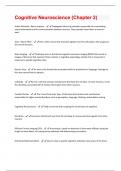
Action Potential / Nerve Impulse - Propagated electrical potential responsible for transmitting neural information and for communication between neurons. They typically travel down a neuron's axon. Axon / Nerve Fiber - Part of the neuron that transmits signals from the cell body to the synapse at the end of the axon. Brain Imaging - Technique such as functional magnetic resonance imaging (fMRI) that results in images of the brain that represent brain activity. In cognitive psychology, activity that is measured in response to specific cognitive tasks. Broca's Area - An area in the frontal lobe associated with the production of language. Damage to this area causes Broca's aphasia. Cell Body - Part of a cell that contains mechanisms that keep the cell alive. In some neurons, it and the dendrites associated with it receive information from other neurons. Cerebral Cortex - The 3-mm-thick outer layer of the brain that contains the mechanisms responsible for higher mental functions such as perception, language, thinking, and problem solving. Cognitive Neuroscience - Field concerned with studying the neural basis of cognition. Dendrites - Structures that branch out from the cell body to receive electrical signals from other neurons. Diffusion Tensor Imaging (DTI) - A technique, based on detection of how water diffuses along the length of nerve fibers, for tracing nerve pathways and determining connections. Distributed Representation - Occurs when a specific cognition activates many areas of the brain.Double Dissociation - A situation in which a single dissociation can be demonstrated in one person and the opposite type of single dissociation can be demonstrated in another person (i.e., person 1: function A is present, function B is damaged; person 2: function A is damaged, function B is present). Extrastriate Body Area (EBA) - An area in the temporal cortex that is activated by pictures of bodies and parts of bodies, but not by faces or other objects. Feature Detectors - Neurons that respond to specific visual features, such as orientation, size, or the more complex features that make up environmental stimuli.
Written for
- Institution
- Cognitive Neuroscience
- Course
- Cognitive Neuroscience
Document information
- Uploaded on
- June 9, 2024
- Number of pages
- 5
- Written in
- 2023/2024
- Type
- Exam (elaborations)
- Contains
- Questions & answers
Subjects
-
cognitive neuroscience chapter 2

Also available in package deal