Chapter One
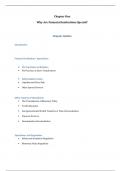
Why Are Financial Institutions Special?
Chapter Outline
Introduction
Financial Institutions’ Specialness
• FIs Function as Brokers
• FIs Function as Asset Transformers
• Information Costs
• Liquidity and Price Risk
• Other Special Services
Other Aspects of Specialness
• The Transmission of Monetary Policy
• Credit Allocation
• Intergenerational Wealth Transfers or Time Intermediation
• Payment Services
• Denomination Intermediation
Specialness and Regulation
• Safety and Soundness Regulation
, • Monetary Policy Regulation
• Credit Allocation Regulation
• Consumer Protection Regulation
• Investor Protection Regulation
• Entry Regulation
The Changing Dynamics of Specialness
• Trends in the United States
• Global Issues
Summary
Appendix 1A: The Financial Crisis: The Failure of Financial Institution Specialness
Appendix 1B: Monetary Policy Tools (www.mhhe.com/saunders7e)
, Solutions for End-of-Chapter Questions and Problems
1. What are five risks common to financial institutions?
Default or credit risk of assets, interest rate risk caused by maturity mismatches between assets
and liabilities, liability withdrawal or liquidity risk, underwriting risk, and operating cost risks.
2. Explain how economic transactions between household savers of funds and corporate
users of funds would occur in a world without financial institutions.
In a world without FIs the users of corporate funds in the economy would have to directly approach
the household savers of funds in order to satisfy their borrowing needs. This process would be
extremely costly because of the up-front information costs faced by potential lenders. Cost
inefficiencies would arise with the identification of potential borrowers, the pooling of small
savings into loans of sufficient size to finance corporate activities, and the assessment of risk and
investment opportunities. Moreover, lenders would have to monitor the activities of borrowers
over each loan's life span. The net result would be an imperfect allocation of resources in an
economy.
3. Identify and explain three economic disincentives that probably dampen the flow of funds
between household savers of funds and corporate users of funds in an economic world
without financial institutions.
Investors generally are averse to directly purchasing securities because of (a) monitoring costs, (b)
liquidity costs, and (c) price risk. Monitoring the activities of borrowers requires extensive time,
expense, and expertise. As a result, households would prefer to leave this activity to others, and by
definition, the resulting lack of monitoring would increase the riskiness of investing in corporate
debt and equity markets. The long-term nature of corporate equity and debt securities would likely
eliminate at least a portion of those households willing to lend money, as the preference of many for
near-cash liquidity would dominate the extra returns which may be available. Third, the price risk
of transactions on the secondary markets would increase without the information flows and
services generated by high volume.
, 4. Identify and explain the two functions FIs perform that would enable the smooth flow of
funds from household savers to corporate users.
FIs serve as conduits between users and savers of funds by providing a brokerage function and by
engaging in an asset transformation function. The brokerage function can benefit both savers and
users of funds and can vary according to the firm. FIs may provide only transaction services, such as
discount brokerages, or they also may offer advisory services which help reduce information costs,
such as full-line firms like Merrill Lynch. The asset transformation function is accomplished by
issuing their own securities, such as deposits and insurance policies that are more attractive to
household savers, and using the proceeds to purchase the primary securities of corporations. Thus,
FIs take on the costs associated with the purchase of securities.
Why Are Financial Institutions Special?
Chapter Outline
Introduction
Financial Institutions’ Specialness
• FIs Function as Brokers
• FIs Function as Asset Transformers
• Information Costs
• Liquidity and Price Risk
• Other Special Services
Other Aspects of Specialness
• The Transmission of Monetary Policy
• Credit Allocation
• Intergenerational Wealth Transfers or Time Intermediation
• Payment Services
• Denomination Intermediation
Specialness and Regulation
• Safety and Soundness Regulation
, • Monetary Policy Regulation
• Credit Allocation Regulation
• Consumer Protection Regulation
• Investor Protection Regulation
• Entry Regulation
The Changing Dynamics of Specialness
• Trends in the United States
• Global Issues
Summary
Appendix 1A: The Financial Crisis: The Failure of Financial Institution Specialness
Appendix 1B: Monetary Policy Tools (www.mhhe.com/saunders7e)
, Solutions for End-of-Chapter Questions and Problems
1. What are five risks common to financial institutions?
Default or credit risk of assets, interest rate risk caused by maturity mismatches between assets
and liabilities, liability withdrawal or liquidity risk, underwriting risk, and operating cost risks.
2. Explain how economic transactions between household savers of funds and corporate
users of funds would occur in a world without financial institutions.
In a world without FIs the users of corporate funds in the economy would have to directly approach
the household savers of funds in order to satisfy their borrowing needs. This process would be
extremely costly because of the up-front information costs faced by potential lenders. Cost
inefficiencies would arise with the identification of potential borrowers, the pooling of small
savings into loans of sufficient size to finance corporate activities, and the assessment of risk and
investment opportunities. Moreover, lenders would have to monitor the activities of borrowers
over each loan's life span. The net result would be an imperfect allocation of resources in an
economy.
3. Identify and explain three economic disincentives that probably dampen the flow of funds
between household savers of funds and corporate users of funds in an economic world
without financial institutions.
Investors generally are averse to directly purchasing securities because of (a) monitoring costs, (b)
liquidity costs, and (c) price risk. Monitoring the activities of borrowers requires extensive time,
expense, and expertise. As a result, households would prefer to leave this activity to others, and by
definition, the resulting lack of monitoring would increase the riskiness of investing in corporate
debt and equity markets. The long-term nature of corporate equity and debt securities would likely
eliminate at least a portion of those households willing to lend money, as the preference of many for
near-cash liquidity would dominate the extra returns which may be available. Third, the price risk
of transactions on the secondary markets would increase without the information flows and
services generated by high volume.
, 4. Identify and explain the two functions FIs perform that would enable the smooth flow of
funds from household savers to corporate users.
FIs serve as conduits between users and savers of funds by providing a brokerage function and by
engaging in an asset transformation function. The brokerage function can benefit both savers and
users of funds and can vary according to the firm. FIs may provide only transaction services, such as
discount brokerages, or they also may offer advisory services which help reduce information costs,
such as full-line firms like Merrill Lynch. The asset transformation function is accomplished by
issuing their own securities, such as deposits and insurance policies that are more attractive to
household savers, and using the proceeds to purchase the primary securities of corporations. Thus,
FIs take on the costs associated with the purchase of securities.