
5.1: Introduction to Soil Systems
What is soil?
o Dynamic ecosystem made up of: minerals, organic material, gases and
liquids
o Has inputs, outputs, storages and flows
o Quality of soil influences primary productivity
o Forms earth’s atmosphere: Lithosphere (rocks), biosphere (living
matters), hydrosphere (water)
Soil Importance
o Soils important to humans because:
- Medium for plant growth (human’s food)
- Stores 0,005% of earth’s freshwater
- Habitat for billions of microorganisms, animals, insects
- Provides raw materials: clay, sand, gravel, minerals
Soil Structure
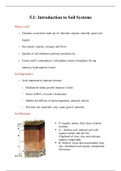
O: organic matter, litter layer of plant
residues
A: - Surface soil: mineral soil with
organic matter and soil life.
-Depleted of: iron, clay and calcium,
organic compounds
B: Subsoil: Layer that accumulates iron,
clay, aluminum and organic compounds-
illuviation
, C: Parent rock: layer of large, unbroken rocks. May accumulate more
soluble compounds
R: Bedrocks: continuous masses of hard rock, cannot be excavated by
hand
Transfers of material within soil
Biological mixing
Leaching
Inputs and outputs
Inputs:
Fertilizer
Biological Nitrogen Fixation: biochemical process where nitrogen
gas from atmosphere is chemically combined into more solid forms.
Ability to fix nitrogen restricted to symbiotic associations with
legumes and microorganisms
Plant and animal residues
Precipitation
Weathering: process that adds nutrients to ecosystem over long
periods of time- calcium, magnesium, phosphorus, potassium
Atmospheric Input: large quantities of nutrients added to ecosystem,
through precipitation or biological processes:
- Carbon: photosynthesis
- Nitrogen: lightning and precipitation
- Sulfur, calcium, sodium: precipitation
What is soil?
o Dynamic ecosystem made up of: minerals, organic material, gases and
liquids
o Has inputs, outputs, storages and flows
o Quality of soil influences primary productivity
o Forms earth’s atmosphere: Lithosphere (rocks), biosphere (living
matters), hydrosphere (water)
Soil Importance
o Soils important to humans because:
- Medium for plant growth (human’s food)
- Stores 0,005% of earth’s freshwater
- Habitat for billions of microorganisms, animals, insects
- Provides raw materials: clay, sand, gravel, minerals
Soil Structure
O: organic matter, litter layer of plant
residues
A: - Surface soil: mineral soil with
organic matter and soil life.
-Depleted of: iron, clay and calcium,
organic compounds
B: Subsoil: Layer that accumulates iron,
clay, aluminum and organic compounds-
illuviation
, C: Parent rock: layer of large, unbroken rocks. May accumulate more
soluble compounds
R: Bedrocks: continuous masses of hard rock, cannot be excavated by
hand
Transfers of material within soil
Biological mixing
Leaching
Inputs and outputs
Inputs:
Fertilizer
Biological Nitrogen Fixation: biochemical process where nitrogen
gas from atmosphere is chemically combined into more solid forms.
Ability to fix nitrogen restricted to symbiotic associations with
legumes and microorganisms
Plant and animal residues
Precipitation
Weathering: process that adds nutrients to ecosystem over long
periods of time- calcium, magnesium, phosphorus, potassium
Atmospheric Input: large quantities of nutrients added to ecosystem,
through precipitation or biological processes:
- Carbon: photosynthesis
- Nitrogen: lightning and precipitation
- Sulfur, calcium, sodium: precipitation


