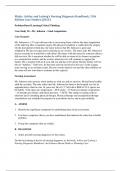
Makic: Ackley and Ladwig’s Nursing Diagnosis Handbook, 13th Edition Case Stu dies (2024) Problem -Based Learning/Critical Thinking Case Study 18—Mr. Johnson – Limb Amputation Case Scenario Mr. Johnson is a 37 -year-old man who is recovering from a below -the-knee amputation of the right leg after a traumatic injury. His physical condition is stable after the surgery. On the postoperative third day, the nurse notices that Mr. Johnson is quiet and withdrawn. He has not eaten and is refusing to see visitors. The nurse asks Mr. Johnson if he has concerns he would like to talk about. He shares with the nurse his concerns about a full recovery. He is uncertain whether he will be able to return to his former occupation as a construction worker, and he worries about how he will continue to support his family. He is married with an 8 -year-old son and has reservations that his family w ill see him as “helpless.” Until now, he has been actively involved in his son’s Little League team serving as an assistant coach. He now worries that his son and the other children on the team will not want him to continue in this capacity. Nursing Asses sment Mr. Johnson only answers when spoken to with yes and no answers. He had been healthy until the accident. The only other time Mr. Johnson has been in the hospital was for an appendectomy when he was 16 years old. He is 6’1” tall with a BMI of 23.8. S ports are his hobby. Vital signs are: temperature —98.9; pulse —75 beats per minute; respirations —16 breaths per minute; and blood pressure —110/70. The stump is healing with no infection and is attending physical therapy. Physical therapy and occupational t herapy consultations are scheduled to prepare for a prosthetic device and to gain mobility. A. ASSESS 1. Identify the significant symptoms by underlining them in the assessment. 2. List those symptoms (those you have underlined) that indicate the client has a health problem. 3. Group the symptoms that are similar. B. DIAGNOSE 1. Select possible nursing diagnoses for this client. Do this by looking at the list of nursing diagnoses in, the book, Ackley and Ladwig’ s Nursing Diagnosis Handbook: An Evidence -Based Guide to Planning Care . Case Study 18-2 Possible nursing diagnoses: 2. Validate the possible nursing diagnoses. Compare the signs and symptoms (defining characteristics) that you have identified from your client assessme nt with the defining characteristics for the nursing diagnosis that you have selected. Also read the definition and determine if this diagnosis fits this client. Validated nursing diagnoses include: 3. Write/select a nursing diagnostic statement for one of the nursing diagnoses by combining the nursing diagnosis label with the related to (r/t) factors. a. The label is the title of the nursing diagnosis as defined by NANDA -I. Include the Domain and Class . b. A related to (r/t) statement describes factors that may be contributing to or causing the problem that resulted in the nursing diagnosis. NANDA -I label: Related Factors (r/t): The complete nursing diagnostic statement is: C. PLAN 1. Select appropriate NOC outcome from Ackley/Ladwig text. NOC outcome: Fill out the grid with NOC indicators and the appropriate Likert scale. Select the appropriate point on the Likert scale to measure the client’s current status. INDICATOR 2. Or write outcomes to help resolve the symptoms (defining characteristics). Refer to Section III of the Ackley/Ladwig text for the nursing diagnosis care plan. Outcomes: 3. Select appropriate NIC interventions from Ackley/Ladwig text.
Case
Case Study 18—Mr. Johnson – Limb Amputation With Answers Problem-Based Learning/Critical Thinking Ackley and Ladwig’s Nursing Diagnosis Handbook, 13th Edition Makic (2024)
Rating
Sold
-
Pages
10
Grade
A+
Uploaded on
07-06-2024
Written in
2023/2024
Case Study 18—Mr. Johnson – Limb Amputation With Answers Problem-Based Learning/Critical Thinking Ackley and Ladwig’s Nursing Diagnosis Handbook, 13th Edition Makic (2024)
Institution
Case Study 18—Mr. Johnson – Limb Amputation
Course
Case Study 18—Mr. Johnson – Limb Amputation
Whoops! We can’t load your doc right now. Try again or contact support.
Written for
- Institution
- Case Study 18—Mr. Johnson – Limb Amputation
- Course
- Case Study 18—Mr. Johnson – Limb Amputation
Document information
- Uploaded on
- June 7, 2024
- Number of pages
- 10
- Written in
- 2023/2024
- Type
- Case
- Professor(s)
- Case study 18—mr. johnson – limb amputation
- Grade
- A+
Subjects
-
case study 18mr johnson limb amputation
Content preview
$26.34
Get access to the full document:
100% satisfaction guarantee
Immediately available after payment
Both online and in PDF
No strings attached

Also available in package deal
Package deal
Case Studies and Solutions for Text Book Ackley and Ladwig’s Nursing Diagnosis Handbook 13th Edition, Mary Beth Flynn Makic Case Studies 1-40 With Answers Problem-Based Learning/Critical Thinking Ackley and Ladwig’s Nursing Diagnosis Handbook, 13th Edit
40
2024
$ 1,056.60
More info