Section 6:
Nuclear Physics
Rutherford scattering
The Discovery of The Atomic Nucleus:
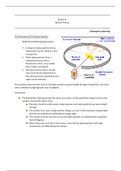
- Rutherford Scattering Experiments
A stream of alpha particle from a
radioactive source is fired at a very
thin gold foil.
When alpha particles from a
radioactive source strike a
fluorescent screen, a tiny visible
flash of light is produced.
The fluorescent screen is circular
and surrounds the experiment so
that alpha particles scattered by any
angle can be detected.
The scientists observed that most of the alpha particles passed straight through the gold film, and some
were scattered at angles greater than 90 degrees.
Conclusions:
The Rutherford scattering shows the atoms must have a small, positively charged nucleus that
contains most of the atom’s mass
The atom must be mostly empty shape because most alpha particles just pass straight
through
The nucleus must have a large positive charge, as some of the positively charged alpha
particles are repelled and deflected by a large angle.
The nucleus must be very tiny as very few alpha particles are deflected by any greater
than 90 degrees.
Most of the mass must be in the nucleus, since the fast alpha particles (with high
momentum) are deflected by the nucleus.
Nuclear Physics
Rutherford scattering
The Discovery of The Atomic Nucleus:
- Rutherford Scattering Experiments
A stream of alpha particle from a
radioactive source is fired at a very
thin gold foil.
When alpha particles from a
radioactive source strike a
fluorescent screen, a tiny visible
flash of light is produced.
The fluorescent screen is circular
and surrounds the experiment so
that alpha particles scattered by any
angle can be detected.
The scientists observed that most of the alpha particles passed straight through the gold film, and some
were scattered at angles greater than 90 degrees.
Conclusions:
The Rutherford scattering shows the atoms must have a small, positively charged nucleus that
contains most of the atom’s mass
The atom must be mostly empty shape because most alpha particles just pass straight
through
The nucleus must have a large positive charge, as some of the positively charged alpha
particles are repelled and deflected by a large angle.
The nucleus must be very tiny as very few alpha particles are deflected by any greater
than 90 degrees.
Most of the mass must be in the nucleus, since the fast alpha particles (with high
momentum) are deflected by the nucleus.