

Stoichiometry Questions And Answers Graded A+
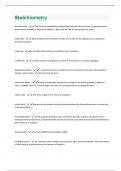
stoichiometry - The study of quantitative relationships between the amounts of reactants used and products formed by chemical reaction; is based on the law of conservation of mass. mole ratio - Ratio between the numbers of moles of any two of the substances in a balanced chemical equation. unknown - a variable whose values are solutions of an equation coefficient - a whole number that appears in front of a formula in a chemical equation balanced equation - a chemical equation in which mass is conserved; each side of the equation has the same number of atoms of each element. conversion factor - a ratio of equivalent values used to express the same quantity in different units; is always equal to 1 and changes the units of a quantity without changing its value molar mass - the mass in grams of 1 mol of a substance actual yield - the amount of product actually produced when the chemical reaction is carried out in an experiment theoretical yield - the amount of product that could form during a reaction calculated from a balanced chemical equation; it represents the maximum amount of product that could be formed from a given amount of reactant percent yield - actual yield/theoretical yield x 100% limiting reactant - a reactant that is totally consumed during a chemical reaction, limits the extent of the reaction, and determines the amount of productavogardo's number - # of particles in 1 mole of a pure substance (rounded to 6.022 x 10 to 23rd power); number of atoms in exactly 12 grams of a Carbon-12 isotope. the law of conservation of mass - states that mass is neither created nor destroyed during ordinary chemical reactions or physical changes.
Document information
- Uploaded on
- June 7, 2024
- Number of pages
- 2
- Written in
- 2023/2024
- Type
- Exam (elaborations)
- Contains
- Questions & answers


