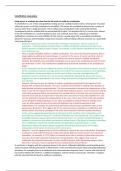
Deficit
ROBIN LAKOFF O’BAR
Language
Genderlect
Language
Mainly her own views and opinion= no supporting evidence Study on
1975 Language and a Woman’s Place TRUDGILL Disagreed
Caused debate, manners were used rather than explicit language Norwich Theory of being fe
Different Features make woman’s language weak: Studied how speech varied pronunciation of the words 3 Pairs
Hedges with the suffix ‘-ing’ 1 = occup
Avoiding Taboo Lexis Saw whether there was a difference in non-standard 2 = simila
Empty Adjectives forms, class + gender correlation questions
Tag Questions Overt + Covert Prestige 3 = powe
Super-Polite Form Overt= expresses power + status, women demonstrate
Hyper-Correct Grammar + Punctuation ‘social power’
Apologising More Covert= used by men ‘laddish’, non-standard, taboo
Indirect Requests language
Speaking Less Frequently
Speaking in Italics
Gender
BEATTIE
Recorded 10 hours of tutorial discussion and some 557 interruptions
(compared with 55 recorded by Z + W)
Beattie found that women and men interrupted with more or less
ZIMME
CAMERON equal frequency - men interrupted more, but by a margin so slight as “Doing G
Sex Vs. Gender not to be statistically significant. - How a pe
CRITICISMS
Verbal Hygiene you might simply have one very voluble man in the study which has a
Sex Vs. Ge
How girls are expected to interact in society disproportionate effect on the total Sex establ
Expected to speak in a ‘clean + proper’ way also questions the meaning of interruptions and why they have to Research
reflect dominance
Challenges that there are differences in male + female speech Men are 9
Myth of Mars and Venus HOWEVE
More factors such as; gender, age, class and ethnicity are were igno
important
There are more similarities than there are differences
, SINCLAIR + COULTHARD
Created the IRF model
Initiation - teacher asks a question ‘ What is the
DREW + HERITAGE IRF model?’
Institutional talk Response - student responds ‘ Its a model FRENCH + RAVEN
Jargon = efficient displaying the structure of questions asked in a There are 5 bases of power which a person may have:
Goal orientation - Participants in workplace conversation often classroom’ Coercive- the power to force someone to do
focuses on specific tasks and goals Feedback - teacher provides feedback, can be something. Should they refuse, there would be some
Turn taking rules/restrictions - Some occupational contexts have positive or negative form of punishment
special turn taking rules eg. meetings and courtroom hearings Expert- knowledge and information which marks
Professional lexis - Some occupational contexts may require specialist them as someone with power
lexis for better understanding or effective communication Legitimate- genuine power because of position
Allowable contributions - Participants in workplace conversation may Reward- the ability to reward a subordinate for
be restricted as to what the are allowed to talk about complying
Power Asymmetry - Workplace interactions are often asymmetrical Referent- a good rapport or a mutual respect with
one speaker has more power or specialist knowledge than the other someone makes them want to comply
e.g. manager/employee doctor/patient
Structure - Some workplace interactions have specific structures e.g.
interviews and meetings
GRICE’S MAXIMS:
Grice stated that there was a 'cooperative principle' in which there are
Occupation
four maxims (rules) which conversation must have in order to be
HO
Wh
successful
pow
QUALITY - what is said must be truthful and accurate
QUANTITY - what is said must be the right length, not too long or short
RELEVANCE - what is said must be relevant
MANNER - what is said should be clear, and not ambiguous SWALES
Coined the term 'discourse communities' to describe groups RO
of people with a common goal/purpose who need language Ro
(as a form of communication) ne
Ch
e.g
eq
mo
SPOLSKY CRYSTAL Yo
Using jargon shows you are a part of a discourse community - Use of jargon is part of identity at work ne
however, not knowing it makes you feel like you don't belong 'M
HORNYAK
ROBIN LAKOFF O’BAR
Language
Genderlect
Language
Mainly her own views and opinion= no supporting evidence Study on
1975 Language and a Woman’s Place TRUDGILL Disagreed
Caused debate, manners were used rather than explicit language Norwich Theory of being fe
Different Features make woman’s language weak: Studied how speech varied pronunciation of the words 3 Pairs
Hedges with the suffix ‘-ing’ 1 = occup
Avoiding Taboo Lexis Saw whether there was a difference in non-standard 2 = simila
Empty Adjectives forms, class + gender correlation questions
Tag Questions Overt + Covert Prestige 3 = powe
Super-Polite Form Overt= expresses power + status, women demonstrate
Hyper-Correct Grammar + Punctuation ‘social power’
Apologising More Covert= used by men ‘laddish’, non-standard, taboo
Indirect Requests language
Speaking Less Frequently
Speaking in Italics
Gender
BEATTIE
Recorded 10 hours of tutorial discussion and some 557 interruptions
(compared with 55 recorded by Z + W)
Beattie found that women and men interrupted with more or less
ZIMME
CAMERON equal frequency - men interrupted more, but by a margin so slight as “Doing G
Sex Vs. Gender not to be statistically significant. - How a pe
CRITICISMS
Verbal Hygiene you might simply have one very voluble man in the study which has a
Sex Vs. Ge
How girls are expected to interact in society disproportionate effect on the total Sex establ
Expected to speak in a ‘clean + proper’ way also questions the meaning of interruptions and why they have to Research
reflect dominance
Challenges that there are differences in male + female speech Men are 9
Myth of Mars and Venus HOWEVE
More factors such as; gender, age, class and ethnicity are were igno
important
There are more similarities than there are differences
, SINCLAIR + COULTHARD
Created the IRF model
Initiation - teacher asks a question ‘ What is the
DREW + HERITAGE IRF model?’
Institutional talk Response - student responds ‘ Its a model FRENCH + RAVEN
Jargon = efficient displaying the structure of questions asked in a There are 5 bases of power which a person may have:
Goal orientation - Participants in workplace conversation often classroom’ Coercive- the power to force someone to do
focuses on specific tasks and goals Feedback - teacher provides feedback, can be something. Should they refuse, there would be some
Turn taking rules/restrictions - Some occupational contexts have positive or negative form of punishment
special turn taking rules eg. meetings and courtroom hearings Expert- knowledge and information which marks
Professional lexis - Some occupational contexts may require specialist them as someone with power
lexis for better understanding or effective communication Legitimate- genuine power because of position
Allowable contributions - Participants in workplace conversation may Reward- the ability to reward a subordinate for
be restricted as to what the are allowed to talk about complying
Power Asymmetry - Workplace interactions are often asymmetrical Referent- a good rapport or a mutual respect with
one speaker has more power or specialist knowledge than the other someone makes them want to comply
e.g. manager/employee doctor/patient
Structure - Some workplace interactions have specific structures e.g.
interviews and meetings
GRICE’S MAXIMS:
Grice stated that there was a 'cooperative principle' in which there are
Occupation
four maxims (rules) which conversation must have in order to be
HO
Wh
successful
pow
QUALITY - what is said must be truthful and accurate
QUANTITY - what is said must be the right length, not too long or short
RELEVANCE - what is said must be relevant
MANNER - what is said should be clear, and not ambiguous SWALES
Coined the term 'discourse communities' to describe groups RO
of people with a common goal/purpose who need language Ro
(as a form of communication) ne
Ch
e.g
eq
mo
SPOLSKY CRYSTAL Yo
Using jargon shows you are a part of a discourse community - Use of jargon is part of identity at work ne
however, not knowing it makes you feel like you don't belong 'M
HORNYAK